LSERDY: long startup delay, when LSE in bypass mode driven by a slow clock
Hi,
I've an application where I'd like to use LSE in passive mode driven by a slow (1Hz) signal.
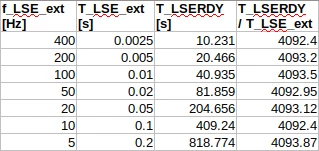
When testing bypass mode LSE with slow clocks, I observed long delays between startup (cold start) and LSERDY being set by hardware. When measuring that delay systematically, the results suggest that the hardware needs 4096 LSE clock cycles to set LSERDY
(See screenshot below with measurements at different frequencies of fLSE_ext)
Until LSERDY is set by hardware, LSE seems to be not passed through to the on-chip logic, and if LSE is driven with a 1Hz signal as I intended, then the chip will, on cold boot, need over 1 hour to enable LSE, which is kind of a show stopper.
So is there a workaround that allows the LSE in bypass mode to be used without waiting for LSERDY, or one to accelerate the LSE clock validation process?
As LSERDY seems to be intended to wait for the _crystal_ to stabilize, maybe it is overkill to use it for LSE bypass mode anyway.
Thanks, Patrick
BTW, I tested/observed this on a Nucleo-L433RC-P and the chip used for the target hardware will be a L431 (if that matters).