

Solved
STM32H753ZI DMA Handler stop working when switched from C to C++
Hi everyone, just a question about this DMA not triggering for unknown reasons.
The only thing I can deduced is the switch from C to C++ and how variables behave within an object maybe.
All I know is the peripheral is working and the DMA is setting the right flag. I also tried the C version of my code and it worked. Double check the buffer is in the right memory region as well the RAM_D1.
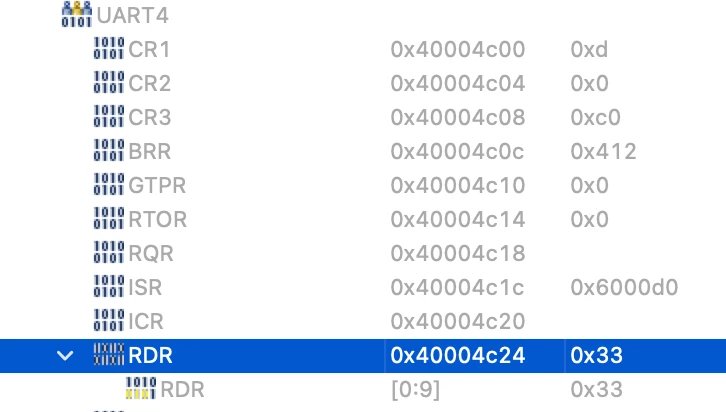
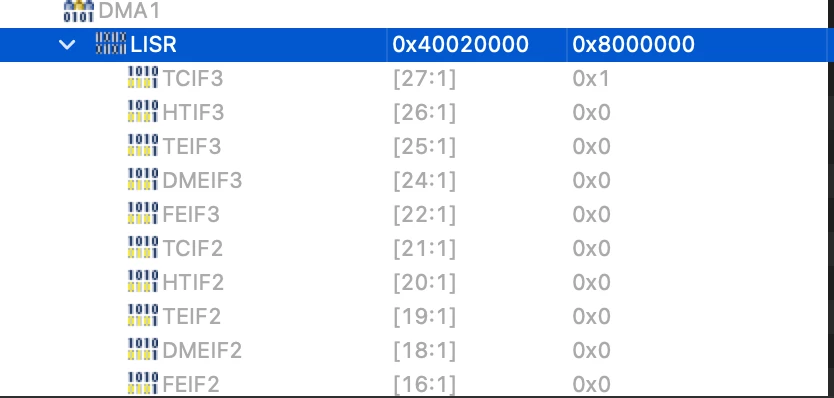
 For some reason it doesnt wanna hit the void DMA1_Stream3_IRQHandler(). Yes I used the
Main.cpp
int main () {

clock clock;
audioProcessor ap;
uart<uint8_t*> uart(ap.GET_UART4_RxBUFF(), 1);

while (1) {

	}
}

void DMA1_Stream3_IRQHandler() {

	if (((DMA1->LISR) & (DMA_LISR_TCIF3)) != 0) {
		 DMA1->LIFCR |= DMA_LIFCR_CTCIF3;

		 UART4_TC = OK;
	}
}
uart.h
/*
 * i2s.h
 *
 * Created on: Jun. 22, 2021
 * Author: Christopher
 */

#ifndef PERIPERHALS_HEADER_MIDCLASS_UART_H_
#define PERIPERHALS_HEADER_MIDCLASS_UART_H_
#include "peripheral.h"


template <class T>
class uart: public I_peripheral {

private:
		void SET_GPIO();
		void SET_Peripheral();
		void SET_Clock();
		void SET_DMA(T Rx_BUFF, uint32_t length);
		void SET_Interrupt();
		void SET_REG(T Rx_BUFF, uint32_t length);

public:
		 uart(T Rx_BUFF, uint32_t length) {
			SET_REG(Rx_BUFF, length);
		}
};

template <class T>
void uart<T>::SET_GPIO() {

	RCC->AHB4ENR &= ~(RCC_AHB4ENR_GPIODEN);
	RCC->AHB4ENR |= RCC_AHB4ENR_GPIODEN;

	GPIOD->MODER &= ~((GPIO_MODER_MODE0) |
				 (GPIO_MODER_MODE1));

	GPIOD->MODER |= (GPIO_MODER_MODE0_AF) |
				 (GPIO_MODER_MODE1_AF);

	GPIOD->OSPEEDR |= GPIO_OSPEEDR_OSPEED0_VERY_HIGH_SPEED |
				 GPIO_OSPEEDR_OSPEED1_VERY_HIGH_SPEED;


	GPIOD->AFR[0] &= ~((GPIO_AFRL_AFSEL0) |
				 (GPIO_AFRL_AFSEL1));

	GPIOD->AFR[0] |= (GPIO_AFRL_AFSEL0_UART4_RX) |
				 (GPIO_AFRL_AFSEL1_UART4_TX);
}

template <class T>
void uart<T>::SET_Peripheral() {

	UART4->BRR = 0x412;
	UART4->CR3 |= (USART_CR3_DMAT) | (USART_CR3_DMAR);
	UART4->CR1 |= (USART_CR1_M1_8BITS) | (USART_CR1_M0_8BITS) | (USART_CR1_RE) | (USART_CR1_TE);
	UART4->CR2 |= (USART_CR2_STOP_1BIT);
	UART4->CR1 |= USART_CR1_UE;
}

template <class T>
void uart<T>::SET_Clock() {

	RCC->APB1LENR |= RCC_APB1LENR_UART4EN;
	RCC->D2CCIP2R &= ~(RCC_D2CCIP2R_USART28SEL);
	RCC->D2CCIP2R |= RCC_D2CCIP2R_USART234578SEL_PLLCLK;

}

template <class T>
void uart<T>::SET_DMA(T Rx_BUFF, uint32_t length) {

	RCC->AHB1ENR &= ~(RCC_AHB1ENR_DMA1EN);
	RCC->AHB1ENR |= RCC_AHB1ENR_DMA1EN;

		//Setup DMA
		DMAMUX1_Channel3->CCR &= ~(DMAMUX_CxCR_DMAREQ_ID);
		DMAMUX1_Channel3->CCR |= (DMAMUX_CxCR_DMAREQ_ID_UART4_Rx);

		DMA1_Stream3->CR &= ~((DMA_SxCR_CT) |
				 (DMA_SxCR_PL) |
							 (DMA_SxCR_MSIZE) |
							 (DMA_SxCR_PSIZE) |
							 (DMA_SxCR_MINC) |
							 (DMA_SxCR_CIRC) |
							 (DMA_SxCR_DIR) |
							 (DMA_SxCR_PFCTRL)|
							 (DMA_SxCR_TCIE) |
							 (DMA_SxCR_HTIE));

		DMA1_Stream3->CR |= (DMA_SxCR_CT_MEM0) |
				 (DMA_SxCR_PL_HIGH) |
							 (DMA_SxCR_MSIZE_8BIT) |
							 (DMA_SxCR_PSIZE_8BIT) |
							 (DMA_SxCR_CIRC) |
							 (DMA_SxCR_DIR_PERI_TO_MEM) |
							 (DMA_SxCR_PFCTRL_DMA_FLOW) |
							 (DMA_SxCR_TCIE);

		DMA1_Stream3->NDTR = length;

		DMA1_Stream3->PAR = (uint32_t)&UART4->RDR;
		DMA1_Stream3->M0AR = (uint32_t)Rx_BUFF;

		DMA1_Stream3->CR |= DMA_SxCR_EN;
}

template <class T>
void uart<T>::SET_Interrupt() {

	NVIC_EnableIRQ(DMA1_Stream3_IRQn);
	NVIC_SetPriority(DMA1_Stream3_IRQn,1);
}

template <class T>
void uart<T>::SET_REG(T Rx_BUFF, uint32_t length) {

	SET_Clock();
	SET_GPIO();
	SET_DMA(Rx_BUFF, length);
	SET_Peripheral();
 SET_Interrupt();
}

#endif /* PERIPERHALS_HEADER_MIDCLASS_UART_H_ */
Some function to get the pointer to the buffer
/*
 * audioProcessor.cpp
 *
 * Created on: Jun. 22, 2021
 * Author: Christopher
 */
#include "audioProcessor.h"

 	 int audioProcessor::SAI1_A_RxBUFF[4096] = {0};
	 int audioProcessor::SAI1_B_TxBUFF[4096] = {0};
	 int audioProcessor::SAI2_A_TxBUFF[4096] = {0};
	 uint16_t audioProcessor::WS2812B_TxBUFF[1] = {0};
	 uint8_t audioProcessor::UART4_RxBUFF[1] = {0};

 	 int * audioProcessor::GET_SAI1_A_RxBUFF() {
		 return SAI1_A_RxBUFF;
	 }

	 int * audioProcessor::GET_SAI1_B_TxBUFF() {
	 		 return SAI1_B_TxBUFF;
	 }

	 int * audioProcessor::GET_SAI2_A_TxBUFF() {
	 	 return SAI2_A_TxBUFF;
	 }

	 uint16_t * audioProcessor::GET_WS2812B_TxBUFF() {
	 	 	 	 return WS2812B_TxBUFF;
	 	 }

	 uint8_t * audioProcessor::GET_UART4_RxBUFF() {
	 	 	 return UART4_RxBUFF;
	 }

	 uint8_t audioProcessor::GET_volume() {
		 return volume;
	 }

	 uint8_t audioProcessor::GET_subVolume() {
	 		 return subVolume;
	 	 }

	 double audioProcessor::GET_inputCompensator() {
	 		 return inputCompensator;
	 }
