


2026-04-07 6:47 AM - last edited on 2026-04-07 6:54 AM by mƎALLEm
While I was experimenting with the 'L476 Disco, the RM wording goes across multiple families, so it may be relevant to most/all of them.
In particular, for Shutdown mode (which is supposedly the lowest-VDD-consumption mode), the RM says:
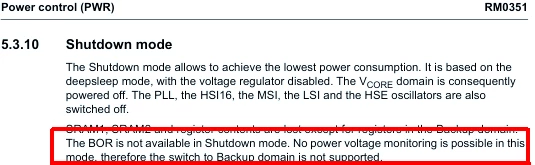
What does "switch to Backup domain is not supported" mean, exactly (assuming VDD and VBAT have separate sources)?
These are very different scenarios and it's important to know, which one of them is valid, to be able to plan the lowest power consumption mode properly.
Can ST please comment.
Thanks,
JW

Solved! Go to Solution.
2026-04-22 3:03 AM
After entering shut down mode, operation is guaranteed as long as VDD is above minimum required voltage.
No current is drain from the VBAT circuitry.
Once VDD drops below 1.6 V, there is no guarantee anymore, only more or less probable behaviors.
As per datasheet, once VDD allows device to enter operating range (specified as 1.71 V for all devices, might be between 1.62 to 1.70 V where BOR0 release reset for given device), functionality is guaranteed down to VBOR0 specified as 1.60 to 1.69 V. As there is no BOR enabled, 1.6 V will apply.
It is valid for devices you have listed.
L4 RM will not be changed for this point as it is considered as fully mature device. But I will propose to update wording for further RM's.
2026-04-08 3:51 AM
Hello @waclawek.jan
An internal ticket was submitted for further investigation. Internal ticket number: CDM0061481(This is an internal tracking number and is not accessible or usable by customers).
BR
Gyessine
To give better visibility on the answered topics, please click on Accept as Solution on the reply which solved your issue or answered your question.
2026-04-14 6:51 AM
Hello @waclawek.jan
The switch to VBAT and back is handled by the voltage monitoring system. However, this system is disabled in Shutdown mode in order to reduce power consumption by removing the current drawn by the voltage reference.
Since this block is responsible for the switch, and it is not available in Shutdown mode, VDD remains the supply voltage and no switch to VBAT is performed.
Hope that helps!
Gyessine
To give better visibility on the answered topics, please click on Accept as Solution on the reply which solved your issue or answered your question.
2026-04-14 7:54 AM - edited 2026-04-14 7:54 AM
Hi Gyessine,
This means scenario 2, a certain RTC corruption/reset, when VDD is removed, correct?
My problem with that is, that I've tried that experimentally on a 'L476 DISCO, and could *not* achieve a situation where RTC would *not* run correctly across periods where mcu was put into Shutdown and subsequently VDD was removed and shorted to ground. RTC always maintained the correct time.
I've described the experiment here.
ST or anybody else has comment to that?
Thanks,
JW
2026-04-20 9:01 AM
Hello @waclawek.jan
Can you please provide more details for these questions?
These information's would help us better understand the observed behavior and move toward a conclusion.
BR
Gyessine
To give better visibility on the answered topics, please click on Accept as Solution on the reply which solved your issue or answered your question.
2026-04-20 9:58 AM
Hy @Gyessine ,
Let me just make my setup clear: I started with the 'L476-DISCO board, removed the 0R R90 connecting VBAT to VDD, and added a 100uF ceramic capacitor between VBAT and GND in parallel to the existing 100nF C79. While the board was powered up, I charged the 100uF capacitor by shorting momentarily the removed R90 pads. I wrote a simple program which goes into SHUTDOWN mode when the joystick is pressed down. After going into SHUTDOWN, I removed the primary power (USB cable, powering from a battery bank, to avoid any potential debugger involvement), shorted VDD to ground using tweezers, and then re-powered. As per the discussed explanation in RM, I expected the RTC to be reset, but I found it running correctly.
Now to your questions:
No, I did not observe VDD using oscilloscope during the process. However, when the USB cable was removed, I shorted the 3V and GND (pins 4 and 5 at P1) for a couple of seconds, again using tweezers. 3V is connected to 3V_MFX via a 0R (R30) resistor-jumper, and 3V_MFX is connected to the target mcu's VDD (the VDD_MCU node) via the JP5 jumper, so I am quite confident VDD was grounded for some time.
The "shorting VDD to GND" should then void any questions on backup capacitors at VDD, shouldn't it.
I will try to repeat the experiment with measuring VDD at the middle pin of JP5, while still having the jumper at it in the bypass position and performing the same shorting at 3V/GND pins at P1; will report back soon.
JW
2026-04-21 6:32 AM
Hello Jan, let me join this discussion.
From your scenarios, number 3 is closest to the device behavior.
RTC supply is connected by switch to either VDD, or VBAT. This switch is controlled by voltage monitoring to ensure it is switched before VDD drops too low, below the minimum voltage needed by RTC circuitry.
In shutdown, there is no voltage monitoring to reduce consumption.
As voltage monitoring is not supported under shutdown, obviously all functionalities depending on voltage monitoring are not supported either. Device stays supplied from VDD, which MUST be stable because any drop in VDD may corrupt internal registers which are supposed to be kept.
Thus, we DO NOT guarantee correct operation of circuits under VBAT supply when VDD is lost during shut down.
It does not mean they will not operate somehow, even without clearly visible impact on test bench. Most likely, they will - as control switches are supplied from VDD, once VDD goes to short circuit, low level will appear on those switches and it will most probably lead to switch to VBAT.
However, it may happen below the minimum supply voltage required by those circuits and their content might be corrupted during this switch. It may not be visible on some samples, it may not be visible on some test scenarios, but risk is present here => functionality with no guaranteed behavior must be considered as not supported.
Obviously, customer may use and rely on undocumented behavior or unsupported functionalities ON THEIR RISK ONLY.
I hope it clarifies a bit device functionality.
2026-04-21 10:59 AM - edited 2026-04-21 11:00 AM
Hi @Viktor POHORELY ,
Thanks for chiming in with the details.
I'm not suggesting to use undocumented behaviour. However, the documentation as it is now is IMHO not entirely clear in what the behaviour exactly is. For example, in the same SHUTDOWN chapter, the following sentence
was what made me to wonder, why my observations were different from "*will* be lost", prompting me to make this post at all and come up with the 4 scenarios.
Also, in "the switch is not supported", if "switch" is a noun rather than verb, this could be interpreted also as "all control to the switch is lost [in SHUTDOWN mode]", implying behaviour 4 (i.e. no guarantees for backup domain in SHUTDOWN). You argue, that "as control switches are supplied from VDD", but I'm not sure this information follows unambiguously from the available documentation.
So, if the real behaviour is 3, that would mean, that as long as VDD remains above its lowest boundary (1.8V, is it?(*)), in SHUTDOWN mode, there are two guarantees: 1. that RTC (and anything else belonging to Backup power domain) remains operational and under VDD power; and 2. that there's no current drawn from VBAT. And then there are zero guarantees for behaviour when VDD gets below that boundary. Correct?
Thanks again,
Jan
(*) or whatever is the datasheet value for given STM32 model -- I presume the behaviour we are discussing here applies to all 'L4/'L5/'U0/'U3/'U5 and maybe more.
PS. To be absolutely clear, I am not suggesting changes in documentation. This clarification is all that suffices.
2026-04-21 11:53 AM
Hello Jan,
can i add one question, why not use Standby and switch VDD off ? Result is same as Shutdown without risk.
2026-04-22 1:46 AM
Hi @MM..1 ,
I am just curious what's the actual behaviour, as the difference from what's described in the RM makes me uncertain about the details.
As I've said, I wouldn't rely on undocumented behaviour. There may be legitimate uses for Shutdown, and building external VDD switch may be tedious/unpractical, too.
JW


