
2026-02-19 8:44 AM
Bonjour,
J'utilise la suite CUBEMX et CUBEIDE pour créer mon projet à partir d'une carte de développement NUCLEO-U575ZI-Q.
J'ai réalisé mon projet sur CUBEMX en gardant et validant le BSP de la NUCLEO pour utiliser les leds et surtout le debug via ST-LINK embarqué.
J'ai ajouté des IO pour effectuer une maquette avec SPI1 et OCTO-SPI1 plus quelques IO notamment une PWM.
Pour commencer j'ai d'abord réalisé un bout de code pour faire clignoter une led (LED_GREEN); à une certaine fréquence réglée par HAL_Delay.
Le souci est que cette fonction bloque car le Tick ne semble pas être validé, (HAL_GetTick me retourne toujours 0)...
Je crois pourtant avoir validé les interruptions :
Hello,
I am using the CUBEMX and CUBEIDE suite to create my project based on a NUCLEO-U575ZI-Q development board.
I created my project on CUBEMX, keeping the NUCLEO BSP to use the LEDs and, above all, debugging via the embedded ST-LINK.
I added I/Os to create a model with SPI1 and OCTO-SPI1, and a few I/Os, including a PWM.
To start with, I wrote a piece of code to make a LED (LED_GREEN) flash at a certain frequency set by HAL_Delay.
The problem is that this function blocks because the tick does not seem to be validated (HAL_GetTick always returns 0)...
However, I believe I have validated the interrupts:
Translated with DeepL.com (free version)
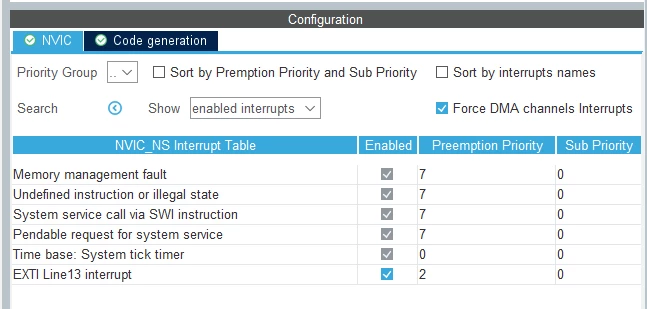
Can you help me, je débute dans l'environnement STM32CUBE...
Thanks in advance,
Eric
Solved! Go to Solution.
2026-02-25 2:50 AM
Hello @mƎALLEm ,
Yes, I tested a simple project taken from the examples provided by ST for the NUCLEO-U575 board, without TrustZone. It is the GPIO_Demo code, which I had already used as inspiration, but I created my own configuration by adding TrustZone and the I/O for the SPI and octo-spi outputs so that I could control the screen and the QSPI flash on my future prototype.
The demo works well without TrustZone.
When I look at the GPIO_Demo.ioc project on CubeMX, I see, for example, that neither the debug interface nor the Nucleo board's BSP are validated, even though I validated them in my CubeMX project.
The clock configuration is the same.
Extract from GPIO_Demo.ioc : Extract from my project :
The pinouts view of the two projects:
my project :
I used to work on Renesas Synergy with the BSP suite in e2studio, where everything could be configured graphically. I think it's the same here with cubeMX, but the example project doesn't really demonstrate this.
I think I have a lot to learn; the transition seems more complicated than I thought.
Eric
2026-02-25 3:00 AM - edited 2026-02-25 3:00 AM
@CLC_EricF wrote:
When I look at the GPIO_Demo.ioc project on CubeMX,
Extract from GPIO_Demo.ioc : Extract from my project :
There is nothing called GPIO_Demo.ioc in the CubeU5 package:
only:
GPIO_EXTI.ioc (NUCLEO-U575ZI-Q\Examples\GPIO\GPIO_EXTI)
GPIO_IOToggle.ioc (NUCLEO-U575ZI-Q\Examples\GPIO\GPIO_IOToggle)
GPIO_IOToggle_TrustZone.ioc (NUCLEO-U575ZI-Q\Examples\GPIO\GPIO_IOToggle_TrustZone)
Meanwhile, the last example has TrustZone enabled while toggling a LED so HAL_GetTick() should work with security enabled.
2026-02-25 3:21 AM
I'm sorry @mƎALLEm but there is an example for the U5:
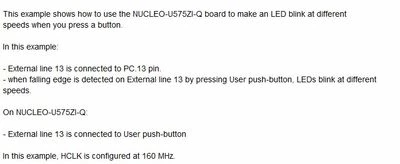
Here is the descriptif:
I was interested in this one precisely to see the configuration of the I/Os, the interrupts, and the configuration of the 160MHz clock, because I want to use the SPI at at least 20MHz.
But thank you anyway for your help and the other examples you mentioned.
I hope I can manage.
Best Regards,
Eric
2026-02-25 3:27 AM - edited 2026-02-25 5:04 AM
@CLC_EricF wrote:
Here is the descriptif:
Humm well. That seems to be this example from Github:
Indeed you can start by that one. Then move on with this one (GPIO_IOToggle_TrustZone):
at least to inspire from the TrustZone configuration/implementation.
For SPI example refer to these examples (I think without TrustZone enabled): https://github.com/STMicroelectronics/STM32CubeU5/tree/main/Projects/NUCLEO-U575ZI-Q/Examples/SPI
If you feel one of the posts helped you/answered your question please don't hesitate to accept it as solution.
And you are welcome.