

Demo STM32 -> PC via FT232H/2232H async. Parallel - throughput >7.5MByte/s.
Title edited to clarify the speed is Mbytes per second
The following example demonstrates how data can be sent from STM32 to a PC via FT232H/FT2232H through an asynchronous FT245 FIFO interface at a speed of over 7.5MB/s.
Motivation:
I need to send data from STM32 to a PC with a data rate of over 3MB/s as simply as possible. Ethernet and USB2.0 High Speed directly from STM32 would require a lot of self-education. So I first tried to use synchronous parallel interface of FT232H/2232H (up to 40MB/s) or FT600 (up to 400MB/s) with the help of STM32 PSSI. Unfortunately, this proved unfeasible, so i revived at least the asynchronous parallel interface with a theoretical maximum speed of 8MB/s.
At first, I tried to fit FSMC to this task, but I couldn't find a way to take "flow control" into account, so I ended up using "brute force" in the form of a combination of TIM+DMA+GPIO, and it seems to work. Since I came across programmers on the internet who would also like to use a similar approach, I decided to publish it.
The communication protocol is simple (from FT2232H datasheet):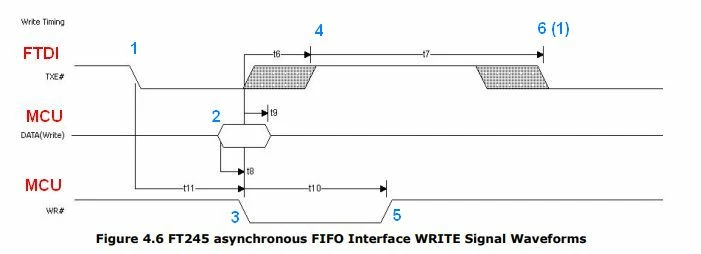
- FTDI signals with TXE=0 that it is ready to receive 1 byte of data (1)
- The MCU prepares the data for the bus (2) and generates a falling edge on WR (3)
- At that moment, FTDI reads the byte of data and sets TXE=1 (4)
- The MCU holds WR at 0 for at least another 30 ns (5), then returns WR=1 and waits until TXE is 0 again (6)
Core mechanism in STM32F446:
- Transmit is managed by TIM1, DMA2 and GPIO
- External signal (TXE line from FTDI => TIM1_ETR) gates TIM1 (low level enables counting) (a)
- TIM1 runs in one-pulse mode with repetition counter 256 (respecite less)
- TIM1 generates DMA requests from CH2 (as soon as posible after period start, therefore CCR2=1) (b)
- DMA transfers (parallel) data from memory buffer to GPIO (it takes some time) (c)
- TIM1 generates PWM on Channel 2 (WR line to FTDI). Falling edge means data write command to FTDI (d). The falling edge moment is selected so that the DMA has time to complete writing data to the GPIO (+ setup time elapsed).
- If external signal (TXE) sets to H (FTDI signals that it is not ready to receive data), timer is paused (not gated). When TXE become L, timers continue in run (and transmit)

Once the timer completes the predetermined number of periods (repetition counter), it stops and triggers an interrupt
In the interrupt routine, the program determines how much data needs to be sent and sets the repetition counter accordingly and starts the next transfer (enable timer).
Since the timer always sends a predetermined and selectable amount of data (period, DMA requests), there is no risk that the application will lose track of the amount of data sent. For example, when sending 520 bytes of data, 520 is set in the DMA->NDTR, the first burst will have RTR="256", the second also RTR="256", and the third RTR="8".
The transfer takes place in "bursts" determined by the RTR value of the timer. Typically, the largest possible RTR is selected if there is a lot of data. However, RTR is limited to 256 on older chips, while newer chips allow for higher values.
Test program runs at 180MHz and sends 8*1024 of 4kB buffers. PC app reads them, measure transfer time and check data integrity. PC app have to be ready before MCU start transmitt. MCU waits until PC sends one byte to FTDI which assert RXF flag. Reading from FTDI is not implementet in this exaple, but it is trivial in bit-bang style.
In this configuration i was able to reach more then 7.5MB/s and probably with some optimalisation of IRQ routine, or using MCU with greater repetition counter it can probably be almost theoretical maximum 8MB/s. PC app is included in attachment (plain C, FTDI D2XX libraries), but it can be read also by VCP. VCP terminals probably will limit transfer speed.
Perhaps it would be worth enabling FIFO on the DMA channel to reduce the traffic between DMA and SRAM — please confirm or correct me if I'm wrong.
Of course, my code implementation still needs a lot of work — it is only a "working prototype" — but the core seems to need no changes.
PA9 and PB7 servers only for debug monitoring.
#include "main.h"
void SystemClock_Config(void);
static void MX_GPIO_Init(void);
static void MX_DMA_Init(void);
static void MX_TIM1_Init(void);

#define NUM_BUFFERS_TEST (8*1024) // 8*1024 of 4kB packets (32MB)
uint32_t test_bursts = NUM_BUFFERS_TEST; // number of 4k buffers to send (to transfer test)
volatile uint8_t transfer_status=0; // indicate ongoing transfer
uint32_t datacounter; // number of remaining data to send
uint8_t buf[4096]; // data buffer
void init_system(void); // init transfer system (GPIO,TIM,DMA etc.)
void init_buf(void); // fill bufer with "Test pattern" (0,1,2...)
char transfer_start(void); // start transfer of buffer
void transfer_stop(void); // stop transfer

int main(void){

 HAL_Init();
 SystemClock_Config(); // Core 180MHz (90/45MHz APB buses, 180MHz timers)
 // init PB7 - used for debug purposess
 LL_AHB1_GRP1_EnableClock(LL_AHB1_GRP1_PERIPH_GPIOB);
 LL_GPIO_SetPinMode(GPIOB, LL_GPIO_PIN_7, LL_GPIO_MODE_OUTPUT);
 LL_GPIO_SetPinSpeed(GPIOB, LL_GPIO_PIN_7, LL_GPIO_SPEED_FREQ_HIGH);
 LL_GPIO_SetOutputPin(GPIOB, LL_GPIO_PIN_7);

 init_buf();
 init_system();
 // set PA9 speed to max (for debug purposess - PA9 (as timer PWM output) indicates time of DMA request generation)
 LL_GPIO_SetPinSpeed(GPIOA, LL_GPIO_PIN_9, LL_GPIO_SPEED_FREQ_HIGH);
 // wait until PC app set RXF - then MCU can be sure that PC app is ready to recieve data
 while(LL_GPIO_IsInputPinSet(GPIOA, LL_GPIO_PIN_1)){ // wait until RXF flag (signalises that FTDI is ready (PC send dummy byte))
 }

 while (1)
 {
 // transfer defined number of 4kB buffers
 	while(test_bursts){
 		transfer_start(); // start transfer of new buffer
				while(transfer_status){ // wait until transfer ends
					asm("nop"); // place for braekpoint during debug
				}
				test_bursts--; // decrement counter
 	}
 	if(test_bursts == 0){ // if all buffer has been sent
 		while(transfer_status){ // wait until last buffer transfer ends
 			asm("nop"); // place for braekpoint during debug
 		}
 		test_bursts=NUM_BUFFERS_TEST; // send another 8*1024 of 4kB transfer
 	}
 }
}


// initialise buffer with test pattern (0,1,2,3...)
void init_buf(void){
	uint32_t i;
	for(i=0;i<sizeof(buf)/sizeof(buf[0]);i++){
		buf[i]=i;
	}
}

/*
 * External signal (TXE line from FTDI) gates TIM1 (low level enables counting)
 * TIM1 runs in one-pulse mode with repetition counter 256
 * TIM1 generates internaly DMA requests from CH2 (as soon as posible after period start, therefore CCR2=1)
 * DMA transfers (parallel) data from memory buffer to GPIO
 * TIM1 generates PWM on Channel 2 (WR line to FTDI). Falling edge signalise data write command to FTDI. The falling edge moment is selected so that the DMA has time to complete writing data to the GPIO (+ setup time elapsed).
 * If external signal (TXE) sets to H (FTDI signals that it is not ready to receive data), timer is paused (not gated). When TXE become L, timers continue in run (and transmit)
 * Once the timer completes the predetermined number of periods (repetition counter), it stops and triggers an interrupt.
 * In the interrupt routine, the program determines how much data needs to be sent and sets the repetition counter accordingly and starts the next transfer (enable timer).
 *
 * Since the timer always sends a predetermined and selectable amount of data (period, DMA requests), it is possible to reasonably check whether all the necessary data has been sent.
 * For example, when sending 520 bytes of data, 520 is set in the DMA, the first burst will have RTR="256", the second also RTR="256", and the third RTR="8".
 *
 * The transfer takes place in "bursts" determined by the RTR value of the timer. Typically, the largest possible RTR is selected if there is a lot of data. However, RTR is limited to 256 on older chips, while newer chips allow for higher values.
 *
 * GPIO connections:
 * STM32			FTDI
 * PC0..7 	-> 		D0..7
 * PA12		<-		C1 (!TXE flag)
 * PA8		->		C3 (!WR cmd)
 *
 * PA1		<-		C0 (!RXF flag) - set to input with pullup
 * PA0		->		C2 (!RD cmd) - set to low
 *
 * PA9 - auxiliary timer output (DMA requests time indicator) - for debug
 * PB9 - auxiliary TIM IRQ routine indicator - for debug
 */


void init_system(void){
LL_TIM_InitTypeDef TIM_InitStruct = {0};
LL_TIM_OC_InitTypeDef TIM_OC_InitStruct = {0};
LL_GPIO_InitTypeDef GPIO_InitStruct = {0};
LL_DMA_InitTypeDef dma;

// init GPIOs
LL_APB2_GRP1_EnableClock(LL_APB2_GRP1_PERIPH_TIM1);
LL_AHB1_GRP1_EnableClock(LL_AHB1_GRP1_PERIPH_DMA2 | LL_AHB1_GRP1_PERIPH_GPIOD | LL_AHB1_GRP1_PERIPH_GPIOA | LL_AHB1_GRP1_PERIPH_GPIOC);
LL_RCC_SetTIMPrescaler(LL_RCC_TIM_PRESCALER_FOUR_TIMES);

// ošetření nepoužívaných IO z FTDI (vstupu RD a výstupu RXF)
// Setting GPIOs for RD and RXF
// RD=1 (we dont want to read from FTDI now)
LL_GPIO_SetOutputPin(GPIOA, LL_GPIO_PIN_0);
GPIO_InitStruct.Pin = LL_GPIO_PIN_0;
GPIO_InitStruct.Mode = LL_GPIO_MODE_OUTPUT;
GPIO_InitStruct.Speed = LL_GPIO_SPEED_FREQ_LOW;
GPIO_InitStruct.OutputType = LL_GPIO_OUTPUT_PUSHPULL;
GPIO_InitStruct.Pull = LL_GPIO_PULL_NO;
LL_GPIO_Init(GPIOA, &GPIO_InitStruct);
// RXF as input (we need to read RXF flag to check if PC app is running)
GPIO_InitStruct.Pin = LL_GPIO_PIN_1;
GPIO_InitStruct.Mode = LL_GPIO_MODE_INPUT;
GPIO_InitStruct.Pull = LL_GPIO_PULL_UP;
LL_GPIO_Init(GPIOA, &GPIO_InitStruct);

// PC0..7 ------> DMA Out (data bus to FTDI)
GPIO_InitStruct.Pin = LL_GPIO_PIN_0|LL_GPIO_PIN_1|LL_GPIO_PIN_2|LL_GPIO_PIN_3|LL_GPIO_PIN_4|LL_GPIO_PIN_5|LL_GPIO_PIN_6|LL_GPIO_PIN_7;
GPIO_InitStruct.Mode = LL_GPIO_MODE_OUTPUT;
GPIO_InitStruct.Speed = LL_GPIO_SPEED_FREQ_LOW;
GPIO_InitStruct.OutputType = LL_GPIO_OUTPUT_PUSHPULL;
GPIO_InitStruct.Pull = LL_GPIO_PULL_NO;
LL_GPIO_Init(GPIOC, &GPIO_InitStruct);

// PA12 ------> TIM1_ETR (TXE signal from FTDI)
// PA8 ------> TIM1_CH1 (WR signal to FTDI)
// PA9 ------> TIM1_CH2 (debug signal to see DMA request timing)
GPIO_InitStruct.Pin = LL_GPIO_PIN_8 | LL_GPIO_PIN_9 | LL_GPIO_PIN_12;
GPIO_InitStruct.Mode = LL_GPIO_MODE_ALTERNATE;
GPIO_InitStruct.Speed = LL_GPIO_SPEED_FREQ_HIGH;
GPIO_InitStruct.OutputType = LL_GPIO_OUTPUT_PUSHPULL;
GPIO_InitStruct.Pull = LL_GPIO_PULL_NO;
GPIO_InitStruct.Alternate = LL_GPIO_AF_1;
LL_GPIO_Init(GPIOA, &GPIO_InitStruct);

GPIO_InitStruct.Pin = LL_GPIO_PIN_12;
GPIO_InitStruct.Pull = LL_GPIO_PULL_UP;
LL_GPIO_Init(GPIOA, &GPIO_InitStruct);

// DMA setting
dma.PeriphOrM2MSrcAddress = (uint32_t)&(GPIOC->ODR); // directly write to whole GPIOC port
dma.MemoryOrM2MDstAddress = (uint32_t)buf; // will be set later
dma.Direction = LL_DMA_DIRECTION_MEMORY_TO_PERIPH;
dma.Mode = LL_DMA_MODE_NORMAL; // single "run"
dma.PeriphOrM2MSrcIncMode = LL_DMA_PERIPH_NOINCREMENT;
dma.MemoryOrM2MDstIncMode = LL_DMA_MEMORY_INCREMENT;
dma.PeriphOrM2MSrcDataSize = LL_DMA_PDATAALIGN_BYTE;
dma.MemoryOrM2MDstDataSize = LL_DMA_MDATAALIGN_BYTE;
dma.NbData = sizeof(buf)/sizeof(buf[0]); // will be set later
dma.Channel = LL_DMA_CHANNEL_6;
dma.Priority = LL_DMA_PRIORITY_LOW; // should be higher, but now there is only one stream/channel
dma.FIFOMode = LL_DMA_FIFOMODE_DISABLE; // that probrably should be changed to help to offload SRAM bus (!)
dma.FIFOThreshold = LL_DMA_FIFOTHRESHOLD_1_4;
dma.MemBurst = LL_DMA_MBURST_SINGLE;
dma.PeriphBurst = LL_DMA_PBURST_SINGLE;
LL_DMA_Init(DMA2, LL_DMA_STREAM_2, &dma);

// TIM1 base
TIM_InitStruct.Prescaler = 0; // time unit 1/180M = 5.55ns
TIM_InitStruct.CounterMode = LL_TIM_COUNTERMODE_UP;
TIM_InitStruct.Autoreload = 15; // 16*5.55 = 88ns
TIM_InitStruct.ClockDivision = LL_TIM_CLOCKDIVISION_DIV1;
TIM_InitStruct.RepetitionCounter = 16; // will be set later
LL_TIM_Init(TIM1, &TIM_InitStruct);
LL_TIM_SetOnePulseMode(TIM1, LL_TIM_ONEPULSEMODE_SINGLE); // one pulse mode - run number of "repetition counter" periods

// Tim1 input (gating) - TXE signal from FTDI
LL_TIM_SetTriggerInput(TIM1, LL_TIM_TS_ETRF);
LL_TIM_SetSlaveMode(TIM1, LL_TIM_SLAVEMODE_GATED); // gate mode - count only if TXE asserted
LL_TIM_ConfigETR(TIM1, LL_TIM_ETR_POLARITY_INVERTED, LL_TIM_ETR_PRESCALER_DIV1, LL_TIM_ETR_FILTER_FDIV1); // gated when TXE=0

// output to pin - WR signal to FTDI
LL_TIM_OC_StructInit(&TIM_OC_InitStruct);
TIM_OC_InitStruct.OCMode = LL_TIM_OCMODE_PWM1; // PWM mode, rising when counter starts, falling when "compare" event
TIM_OC_InitStruct.OCState = LL_TIM_OCSTATE_ENABLE;
TIM_OC_InitStruct.OCNState = LL_TIM_OCSTATE_DISABLE;
TIM_OC_InitStruct.CompareValue = 9; // set WR=0 56ns after timer starts (pulse duration 88-55 = 33ns)
TIM_OC_InitStruct.OCPolarity = LL_TIM_OCPOLARITY_HIGH;
LL_TIM_OC_Init(TIM1, LL_TIM_CHANNEL_CH1, &TIM_OC_InitStruct);

// DMA request generator - internal signal for DMA (also routed to PA9 for debug purposes)
TIM_OC_InitStruct.CompareValue = 1; // generate DMA request 5ns after (as soon as possible) timer start -> sending data to PORT
LL_TIM_OC_Init(TIM1, LL_TIM_CHANNEL_CH2, &TIM_OC_InitStruct);

// enable timer outputs
LL_TIM_EnableAllOutputs(TIM1);

// enable timer update IRQ (fires each burst and prepare another burst)
WRITE_REG(TIM1->SR, ~(TIM_SR_CC1IF | TIM_SR_CC2IF | TIM_SR_UIF)); // clear flags
NVIC_SetPriority(TIM1_UP_TIM10_IRQn, NVIC_EncodePriority(NVIC_GetPriorityGrouping(),0, 0));
NVIC_EnableIRQ(TIM1_UP_TIM10_IRQn);
LL_TIM_EnableIT_UPDATE(TIM1); // enable IRQ of update (when timer stops... we are using one-pulse mode)
}

// TIMer IRQ routine
// reloading timer data burst - to control overall number of transmited data from single buffer
void TIM1_UP_TIM10_IRQHandler(void){
	LL_TIM_ClearFlag_UPDATE(TIM1);
	LL_GPIO_SetOutputPin(GPIOB, LL_GPIO_PIN_7); // debug indication
	// prepare "new" burst
	// if number of remaining data in buffer > burst size -> then perform "full size" burst
	if(datacounter > 256){
		LL_TIM_SetRepetitionCounter(TIM1, 255); // set burst size (Repetition counter) - thats probably not neccesary (should be already set)
		LL_TIM_EnableCounter(TIM1); // start another burst
		datacounter = datacounter - 256; // decrement downcounter (number of bytes to transfer)
	} // nothing to transfer - done
	else if(datacounter == 0){ // if there is no data to transfer -> transfer is over
		transfer_stop();
	}
	else{ // "partial burst" (last one)
		LL_TIM_SetRepetitionCounter(TIM1, datacounter); // set burst size (Repetition counter)
		LL_TIM_EnableCounter(TIM1); // start another burst
		datacounter=0; // clear downcounter - thats last data of transfer
	}
	LL_GPIO_ResetOutputPin(GPIOB, LL_GPIO_PIN_7); // for debug/monitoring purposes
}


// start data transfer (indication in transfer_status)
char transfer_start(void){
	uint16_t transfer_size=4096; // copy total transfer size (now it is fixed, can be function parameter)
	datacounter = transfer_size; // copy "bytes to send" to downcounter

	// check if buffer is greater then burst size
	if(datacounter > 256){ // next burst is "full size"
		LL_TIM_SetRepetitionCounter(TIM1, 255);
		datacounter = datacounter - 256; // remaining bytes to send
	}else if(datacounter>0){ // next burst i "partial size"
		LL_TIM_SetRepetitionCounter(TIM1, datacounter);
		datacounter = 0; // last data to send
	}else{ // that shouldnt happen (who wants to transfer 0 bytes ?)
		return 1;
	}

	// set DMA
	LL_DMA_SetMemoryAddress(DMA2, LL_DMA_STREAM_2, (uint32_t)buf); // set buffer address (now fixed, can be function parameter)
	LL_DMA_SetDataLength(DMA2, LL_DMA_STREAM_2, transfer_size); // set total number of bytes to transfer

	// for safety, clear and update counter registers
	LL_TIM_SetCounter(TIM1, 0);
	LL_TIM_DisableIT_UPDATE(TIM1);
	LL_TIM_GenerateEvent_UPDATE(TIM1);
	WRITE_REG(TIM1->SR, ~(TIM_SR_CC1IF | TIM_SR_CC2IF | TIM_SR_UIF));
	LL_TIM_EnableIT_UPDATE(TIM1);

 // running transfer indication
	transfer_status=1;

	// enable transfer
 LL_TIM_EnableDMAReq_CC2(TIM1);
 LL_DMA_ClearFlag_HT2(DMA2); // all flags must be cleared to enable DMA (!!!)
 LL_DMA_ClearFlag_TC2(DMA2); // i am clearing only two of them - :/
 LL_DMA_EnableStream(DMA2, LL_DMA_STREAM_2);
 LL_TIM_EnableCounter(TIM1); // from now, transfer is running
 return 0;
}

// stop transfer (called when all bytes are out)
void transfer_stop(void){
	LL_DMA_DisableStream(DMA2, LL_DMA_STREAM_2);
	LL_TIM_DisableDMAReq_CC2(TIM1);
	LL_TIM_DisableCounter(TIM1);
	transfer_status=0;
}
Of course, I appreciate all comments, especially if I have overlooked any critical issues, etc.
Best regards,
Michal Dudka