

TIM15 - PWM CH1/CH1N - One Pulse Mode: how to avoid ''glitch'' ?
I am generating stimuli for a CPLD circuit using my Discovery board - STM32F303VCT.
I use CubeMX for peripheral/clock initialisation, and AC6 (Eclipse) for code.
I am using TIM15 - PWM CH1/CH1N - One Pulse Mode - with RCR of some value, say N-1.
The PWM signals are to run a half-bridge for an AC motor, and hence need to be complementary with a small dead-time. That is, when CH1 is high, then CH1N is low and vica verca, but with a small period where both are low to prevent shorting the bridge. Both may be low, but both may never be high s
imultaneously
.The code in question is pure polling, where I start the timer-pwm using HAL functions.
The first pulse-train is working fine... Both pwm-signals start from idle and generate N pulses with a small dead-time.
After those pulses, I have a 500 ms delay, and then generate N new pulses, using HAL again. However, this time I always get a ''glitch'' in the ''pwm1'' signal, prior to the pulse-train, as shown
The majority of the code is generated by CubeMX, with generally default settings for the TIM15
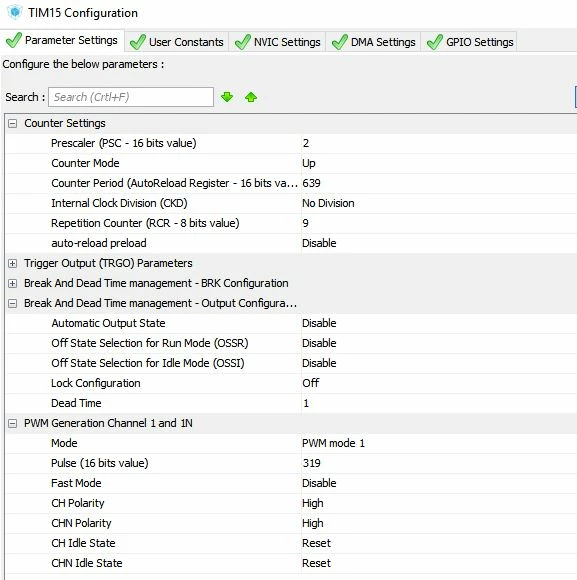
and (relevant) user-code in the while(1)-loop
if (HAL_GPIO_ReadPin(GPIOA, bluePB_Pin) == GPIO_PIN_SET)
{
HAL_Delay(200);
HAL_TIM_PWM_Start(&htim15, TIM_CHANNEL_1);
HAL_TIMEx_PWMN_Start(&htim15, TIM_CHANNEL_1);
HAL_Delay(500);
HAL_TIM_PWM_Start(&htim15, TIM_CHANNEL_1);
}
I guess the code is quite naïve, but it works fine for a single PWM signal, and BTW don't worry - I am not the one coding the microcontroller that will generate our PWM signals for our real motor !
I know of a couple of application notes, e.g. ''AN4013 STM32 cross-series timer overview'' and ''AN4776 - General purpose timer cookbook'', but they take some time to digest, and my goal here is just to generate stimuli to test my CPLD.
So, my question is how should I generate complementary pwm pulse-trains with no glitch ?
Also, anyone is very much welcome to refer to (free) tutorials / lectures / best-practice regarding STM32 timers.
https://community.st.com/tags/?tags=tim%20pwm
, , one-pulse-mode tim-pwm learning-stm32