

HAL_I2C_Mem_Write_DMA sends only one byte
The blocking version (HAL_I2C_Mem_Write) works nicely, now I'm trying to use HAL_I2C_Mem_Write_DMA. Here are the settings as given in the configuration tool.
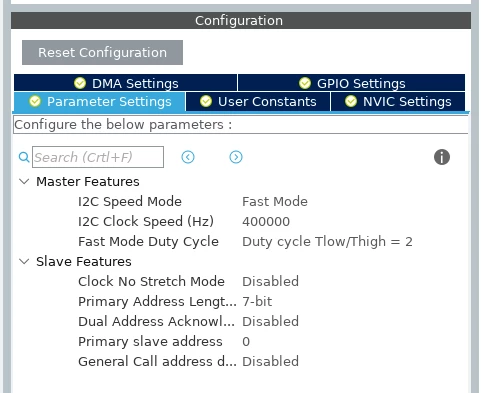
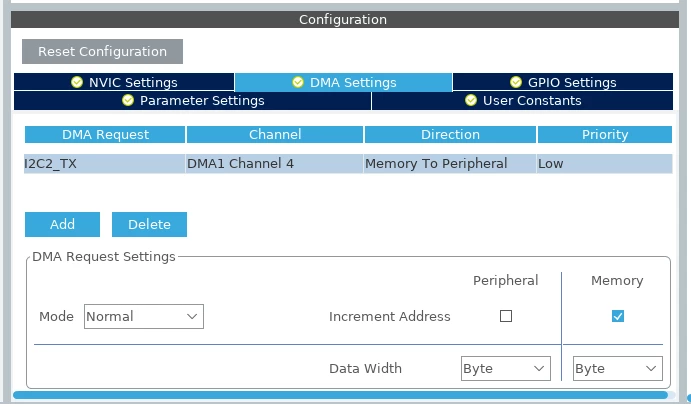
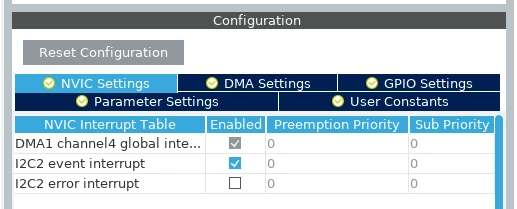
The resulting code generated by the configurator (I removed some comments for brevity):
static void MX_DMA_Init(void)
{
 __HAL_RCC_DMA1_CLK_ENABLE();
 HAL_NVIC_SetPriority(DMA1_Channel4_IRQn, 0, 0);
 HAL_NVIC_EnableIRQ(DMA1_Channel4_IRQn);
}

static void MX_I2C2_Init(void)
{
 hi2c2.Instance = I2C2;
 hi2c2.Init.ClockSpeed = 400000;
 hi2c2.Init.DutyCycle = I2C_DUTYCYCLE_2;
 hi2c2.Init.OwnAddress1 = 0;
 hi2c2.Init.AddressingMode = I2C_ADDRESSINGMODE_7BIT;
 hi2c2.Init.DualAddressMode = I2C_DUALADDRESS_DISABLE;
 hi2c2.Init.OwnAddress2 = 0;
 hi2c2.Init.GeneralCallMode = I2C_GENERALCALL_DISABLE;
 hi2c2.Init.NoStretchMode = I2C_NOSTRETCH_DISABLE;
 if (HAL_I2C_Init(&hi2c2) != HAL_OK)
 {
 Error_Handler();
 }
}

void HAL_I2C_MspInit(I2C_HandleTypeDef* hi2c)
{
 GPIO_InitTypeDef GPIO_InitStruct = {0};
 if(hi2c->Instance==I2C2)
 {
 __HAL_RCC_GPIOB_CLK_ENABLE();
 /**I2C2 GPIO Configuration
 PB10 ------> I2C2_SCL
 PB11 ------> I2C2_SDA
 */
 GPIO_InitStruct.Pin = GPIO_PIN_10|GPIO_PIN_11;
 GPIO_InitStruct.Mode = GPIO_MODE_AF_OD;
 GPIO_InitStruct.Speed = GPIO_SPEED_FREQ_HIGH;
 HAL_GPIO_Init(GPIOB, &GPIO_InitStruct);

 /* Peripheral clock enable */
 __HAL_RCC_I2C2_CLK_ENABLE();

 /* I2C2 DMA Init */
 /* I2C2_TX Init */
 hdma_i2c2_tx.Instance = DMA1_Channel4;
 hdma_i2c2_tx.Init.Direction = DMA_MEMORY_TO_PERIPH;
 hdma_i2c2_tx.Init.PeriphInc = DMA_PINC_DISABLE;
 hdma_i2c2_tx.Init.MemInc = DMA_MINC_ENABLE;
 hdma_i2c2_tx.Init.PeriphDataAlignment = DMA_PDATAALIGN_BYTE;
 hdma_i2c2_tx.Init.MemDataAlignment = DMA_MDATAALIGN_BYTE;
 hdma_i2c2_tx.Init.Mode = DMA_NORMAL;
 hdma_i2c2_tx.Init.Priority = DMA_PRIORITY_LOW;
 if (HAL_DMA_Init(&hdma_i2c2_tx) != HAL_OK)
 {
 Error_Handler();
 }

 __HAL_LINKDMA(hi2c,hdmatx,hdma_i2c2_tx);

 /* I2C2 interrupt Init */
 HAL_NVIC_SetPriority(I2C2_EV_IRQn, 0, 0);
 HAL_NVIC_EnableIRQ(I2C2_EV_IRQn);
 }

}
The code where I'm calling this from:
void SSD1306_BlitLineBuffer(uint8_t row) {

 if ( row >= (SSD1306_SCREEN_HEIGHT / SSD1306_LINEBUFFER_HEIGHT) )
 return;

 SSD1306_WriteCommand(0xB0 + row);
 SSD1306_WriteCommand(0x00);
 SSD1306_WriteCommand(0x10);

 //HAL_I2C_Mem_Write(&SSD1306_I2C_BUS, SSD1306_ADDRESS, 0x40, 1, ssd1306Bytes, SSD1306_BUFFER_SIZE, HAL_MAX_DELAY);

 if ( HAL_OK != HAL_I2C_Mem_Write_DMA(&SSD1306_I2C_BUS, SSD1306_ADDRESS, 0x40, 1, ssd1306Bytes, SSD1306_BUFFER_SIZE) ) {
 Error_Handler();
	}
}

void HAL_I2C_MemTxCpltCallback(I2C_HandleTypeDef *hi2c) {

}
The commented out non-DMA call works fine.
The buffer size is 128 bytes.
When I place a breakpoint in the callback, the breakpoint is successfully triggered.
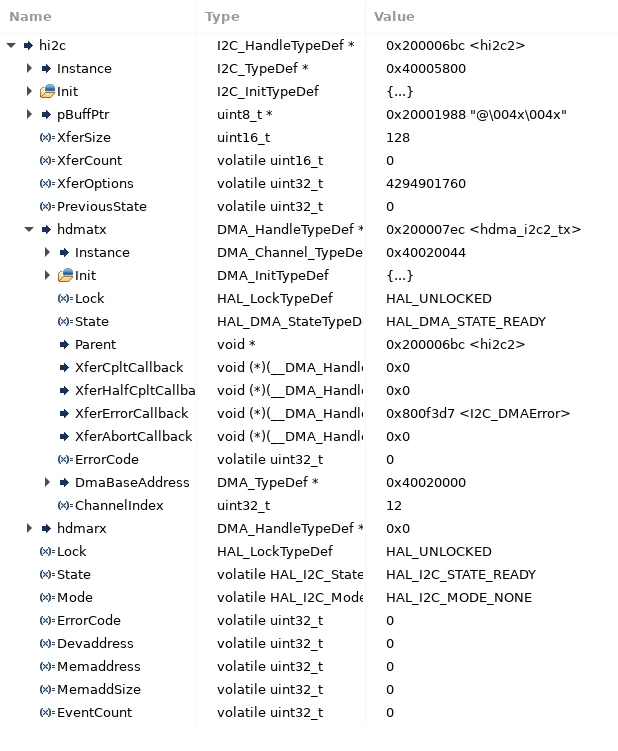
HAL_I2C_Mem_Write_DMA returns HAL_OK. When I step inside it, this is the state immediately before it returns:
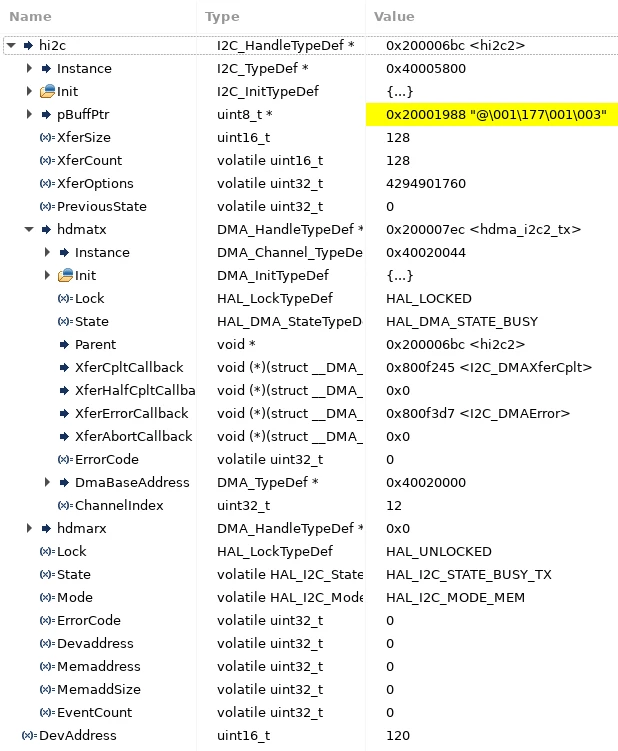
Note that XferCount starts as 128.
Here is the view from my logic analyzer, first the result from the blocking (non-DMA) call:

Now the result from the DMA version:

Only the MemAddress (0x40) is sent. The data buffer seems to be completely ignored.
When I place a breakpoint in the callback, XferCount has become zero, and the State and Mode are 'ready' and 'none' respectively. As far as I know this is what should be expected from normal operation.
The only other thing running is a pretty simple timer (no channels enabled) which is used to trigger this I2C call every 20 ms. When measured with the non-blocking version, the data transfer takes 3.2ms so there should be plenty of spare time.
So I have no clue why the buffer itself is not being sent. Any suggestions would be helpful.
