Solved
Floating values when writing to memory STM32L422KBT6
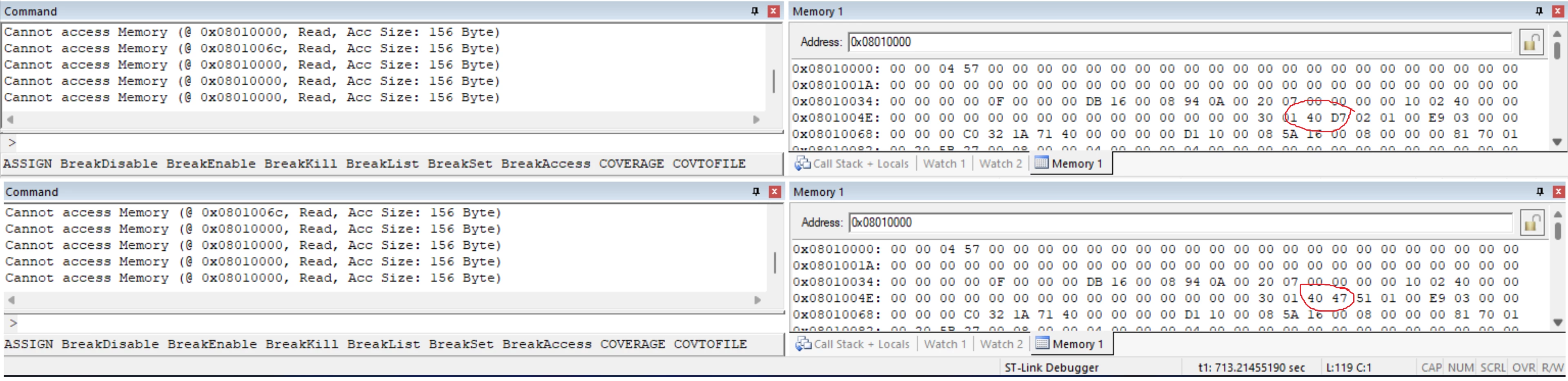
Hello, well I have some array of uint16_t data with is contains 50 records. If I truing to write it to the flash memory it looks like it have done an then if I write again, the HEX data in debug mode memory is randombly chenging. Ideally Firstly I need read data from flash(after power off) and write to array, on another iteration if data in array != data in flash, then overwrite flash. To put it sumply this is for manage/store a data in flash. Please help me.
- Function for writing in memory:
#define FLASH_START_ADDRESS 0x08010000

static uint32_t GetPage(uint32_t Addr) // Single Bank Device
{
 return ((Addr - FLASH_BASE) / FLASH_PAGE_SIZE);
}

// Function to write data to the flash memory
// BYTE pointer, Size in BYTES, put what you want in a STRUCTURE

void write_flash(uint8_t *data, uint32_t size)
{
 FLASH_EraseInitTypeDef EraseInitStruct = {0};
 uint32_t addr = FLASH_START_ADDRESS; // 64-bit aligned
 uint64_t value;
 uint32_t PageError;

 // Round up size to nearest multiple of 64 bytes
 size = (size + 63) & ~63;

 // Calculate number of 64-bit words to write
 uint32_t num_words = size / sizeof(uint64_t);

 // Unlock the flash memory for writing
 HAL_FLASH_Unlock();

 /* Clear OPTVERR bit set on virgin samples */
 __HAL_FLASH_CLEAR_FLAG(FLASH_FLAG_OPTVERR);

 /* Fill EraseInit structure, spanning size of write operation */
 EraseInitStruct.TypeErase = FLASH_TYPEERASE_PAGES;
 EraseInitStruct.Banks = FLASH_BANK_1;
 EraseInitStruct.Page = GetPage(addr); // Starting Page
 EraseInitStruct.NbPages = GetPage(addr + size) - EraseInitStruct.Page + 1; // Page Count, at least 1

 if (HAL_FLASHEx_Erase(&EraseInitStruct, &PageError) != HAL_OK)
 {
 // Insert code to handle the error here

 HAL_FLASH_Lock();
 return;
 }

 // Iterate over the array of data and write each element to the flash memory
 for (uint32_t i = 0; i < num_words; i++)
 {
 memcpy(&value, data, sizeof(uint64_t)); // alignment safe copy of byte array into 64-bit value

 if (HAL_FLASH_Program(FLASH_TYPEPROGRAM_DOUBLEWORD, addr, value) != HAL_OK)
 {
 // Insert code to handle the error here

 HAL_FLASH_Lock();
 return;
 }

 addr += sizeof(uint64_t); // Advance address
 data += sizeof(uint64_t); // Advance byte buffer
 }

 // Lock the flash memory after writing is complete
 HAL_FLASH_Lock();
}

void read_flash(uint8_t *data, uint32_t size)
{
 memcpy(data, (void*)FLASH_START_ADDRESS, size);
}


void convert_uint16_to_uint8(uint16_t *src, uint8_t *dst)
{
		uint32_t size = sizeof(*src);
 for (uint32_t i = 0; i < size; i++)
 {
 *dst++ = (uint8_t)(*src >> 8);
 *dst++ = (uint8_t)(*src & 0xFF);
 src++;
 }
}

void convert_uint8_to_uint16(uint8_t *src, uint16_t *dst)
{
		uint32_t size = sizeof(*src);
 for (uint32_t i = 0; i < size; i++)
 {
 *dst++ = (uint16_t)(*src++ << 8) | *src++;
 }
}- Function for put data through writing function
void flash_holding_registers()
{

	static uint16_t Holding_Registers_Database_test[50]={
		0000, 1111, 2222, 3333, 4444, 5555, 6666, 7777, 8888, 9999, // 0-9 40001-40010
		12345, 15432, 15535, 10234, 19876, 13579, 10293, 19827, 13456, 14567, // 10-19 40011-40020
		21345, 22345, 24567, 25678, 26789, 24680, 20394, 29384, 26937, 27654, // 20-29 40021-40030
		31245, 31456, 34567, 35678, 36789, 37890, 30948, 34958, 35867, 36092, // 30-39 40031-40040
		45678, 46789, 47890, 41235, 42356, 43567, 40596, 49586, 48765, 41029, // 40-49 40041-40050
};

	// Buffer array with extend from uint16_t to uint8_t
	uint8_t converted_data_uint8_t[sizeof(Holding_Registers_Database_test) * sizeof(uint16_t)]; //2 for uint16_t; 2 for uint32_t

	// Buffer array to compare valves RAM and ROM convertation from uint16_t to uint8_t
	uint8_t compare_data_uint8_t[sizeof(Holding_Registers_Database_test) * sizeof(uint16_t)]; //2 for uint16_t; 2 for uint32_t

	// Convert Holding_Registers_Database from an array of uint16_t values to an array of uint8_t values
	convert_uint16_to_uint8(Holding_Registers_Database_test, converted_data_uint8_t);

	// Read 100 bytes of data from the flash memory
	read_flash(compare_data_uint8_t, sizeof(Holding_Registers_Database_test) * sizeof(uint16_t));

 for (uint32_t i = 0; i < sizeof(Holding_Registers_Database_test); i++){
		if (converted_data_uint8_t[i] != compare_data_uint8_t[i]) {
					// Write the converted data to the flash memory
					write_flash(converted_data_uint8_t, sizeof(Holding_Registers_Database_test) * sizeof(uint16_t));
					convert_uint8_to_uint16(converted_data_uint8_t, Holding_Registers_Database_test);
					return;
		}
	}

}- How the data change if array is constant after iteration: