

FBaro.11
Associate III
November 28, 2020
Solved

L6699 Enhanced high voltage resonant controller. App Note AN4027 - Question on L6699 timing circuit.

  • November 28, 2020
  • 2 replies
  • 4316 views

This App Note is identified by the following meta-data:

Identifiers: AN4027, Doc ID 022604 Rev 1

Title: "12 V - 150 W resonant converter with synchronous rectification using the L6563H, L6699 and SRK2000"

Author: Claudio Spini.

Date: July 2012

Hello Sir/Madam,

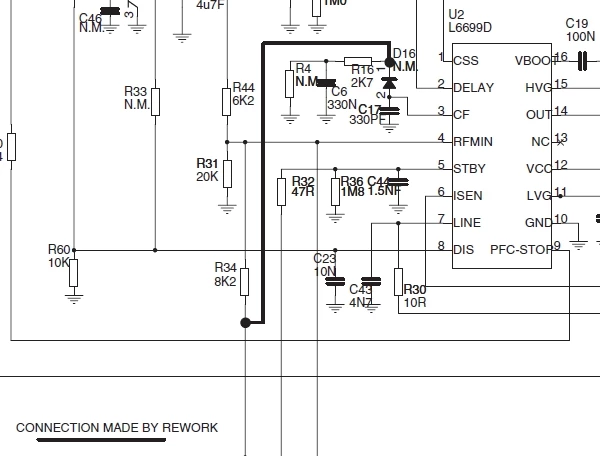
Question 1: The schematic on page 12/38 shows a connection between D16K & R34. (Note: D16 anode is connected to L6699 pin 3, CF). That connection is marked "connection made by re-work". I seek an explanation as to why this connection was done.

Question 2: Several components on the schematic are marked "N.M.", eg: D16, C43. What does "N.M." mean?

Many thanks!

Edit 02-Dec-2020: Added image below, the relevant portion of the schematic.
0693W000006EFvJQAW.jpg

This topic has been closed for replies.
Best answer by Cristiana SCARAMEL

Hello @FBaro.1​,

Q1:

L6599 and L6699 have the same oscillator section.

The mentioned components are for L6599A only, not intended to be used for L6699.

Concerning the oscillator of new device you can refer to the L6699 datasheet at page 17: section 6.3 Safe-start procedure.

Q2:

You can always find the explanation in the L6699 datasheet (6.3 section).

The added components of L6599A provide for an asymmetry of the oscillator triangle, providing a different duty among LVG and HVG signals to prevent initial current peaks at turn on.

The soft start pin can increase the frequency during soft start but with symmetrical duty only.

The L6699 overcomes the issue. 

Let me know if I solved your doubts.

2 replies

Cristiana SCARAMEL
Technical Moderator
December 1, 2020

Hello @FBaro.1​ and welcome to the ST Community.

Concerning your question:

  1. The "re-work" connection add an RC network in parallel to the optocoupler transistor in order to guarantee the loop regulation stability under all conditions.
  2. N.M. is the acronym of Not Mounted

If I answered your questions please "Select as Best" button.

"If you feel a post has answered your question, please click ""Accept as Solution"""
FBaro.11
FBaro.11Author
Associate III
December 1, 2020

Hello Cristiana,

Thanks for explaining that "N.M." means "Not Mounted" - this is equivalent to the term that we use, which is: "DNL" = "Do Not Load".

So, that means that D16 does not exist on the actual board that was tested in the app note, and therefore it is now very clear that R16 and C6 simply provide stability for the feedback loop. Great, thanks for that.

However, I am still intrigued by D16, and I would be very interested to know the intent of the original designer by the connection of D16 anode to L6699 pin 3 (CF), since pin 3 is the timing waveform, which will be a triangle wave, oscillating between 0.9V & 3.9V in time with the switching frequency. I am very surprised that such a connection was drawn on the schematic in the first instance, since any disturbance to the current to the capacitor on this pin will change the control characteristics of the L6699. Since C6 (330nF) is much larger than C17 (330pF), then perhaps this was intended either:

(a) to force the switching frequency to be very low at power up

(b) as a F to V converter, ie: dc voltage on C6 was a function of switching frequency, as a means to observe Fs?

Or perhaps neither of these are correct - maybe you may have a better idea what the original intention was? I have not seen any schematic of the L6599 or L6699 where the timing cap (pin 3) had any other component connected other than the timing capacitor.

Cheers,

-F.Barone.

2020-12-12 Edit: deleted image since this was already in the original question.

Cristiana SCARAMEL
Technical Moderator
December 22, 2020

Hello @FBaro.1​,

I didn’t forget your questions ;)

I am trying to get in contact internally with the expert of this product. I hope to be able to answer your doubts as soon as possible.

"If you feel a post has answered your question, please click ""Accept as Solution"""
FBaro.11
FBaro.11Author
Associate III
April 22, 2021

Update 26-Apr-2021: This comment has been deleted, as it has been posted as a new question here:

https://community.st.com/s/question/0D53W00000jlWV8SAM/l6599at-gate-drive-pulses-appear-unexpectedly

Regards,

-F.Barone.

Cristiana SCARAMEL
Technical Moderator
April 22, 2021

Hi @FBaro.1​ ,

please open a new topic in the Power Management section

As above mentioned I am not in charge of resonant controllers, but if you post in the right place some others Community members can help you.

Have a nice day.

"If you feel a post has answered your question, please click ""Accept as Solution"""
FBaro.11
FBaro.11Author
Associate III
April 22, 2021

Hi @Cristiana SCARAMEL​ ,

thanks for your reply, as per your advice I have posted a new topic in the Power Management, here is the link:

https://community.st.com/s/question/0D53W00000jlWV8SAM/l6599at-output-gate-drive-pulses-appear-unexpectedly

Regards,

Fabio Barone.
