Associate II
October 31, 2023
Question

"SD Card Support Issue on STM32F429IIT6 - Request for Technical Support"

  • October 31, 2023
  • 13 replies
  • 7183 views

i get `FR_NOT_READY`, `HAL_SD_ERROR_REQUEST_NOT_APPLICABLE` errors .

/* If requested card supports wide bus operation */
if((scr[1U] & SDMMC_WIDE_BUS_SUPPORT) != SDMMC_ALLZERO)
{
//...
return HAL_SD_
return HAL_SD_ERROR_REQUEST_NOT_APPLICABLE;
  }ERROR_NONE;
}
else
{
How do I fix this and make SD card work with 4bits wide bus?


sd card scematic   (part number-GTFP08431BEU)
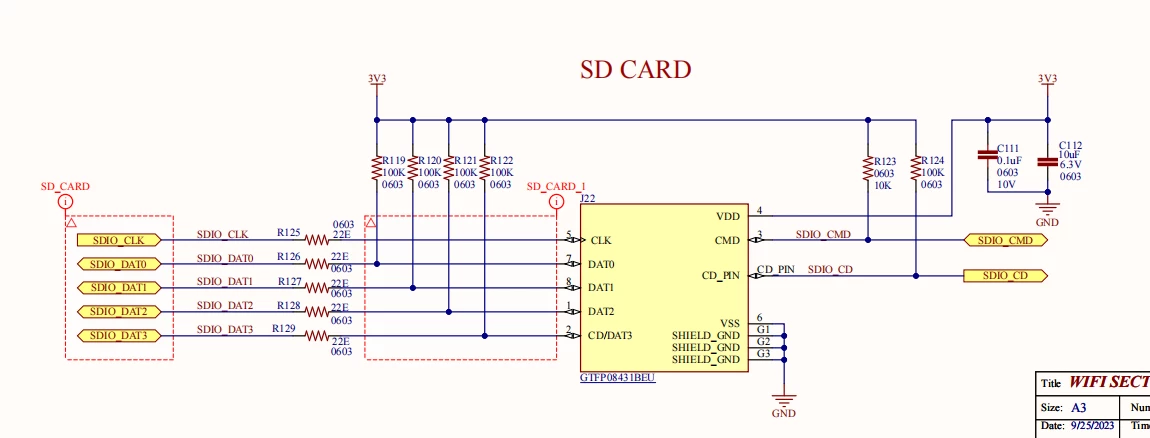
 

Rushikesh1234_0-1698738438263.png

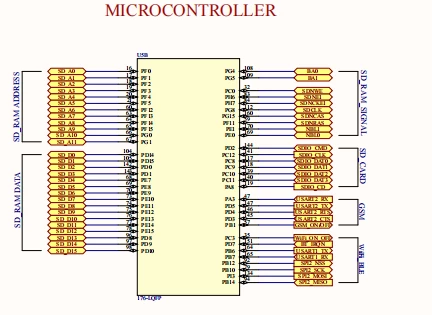
Microcontroller scematic  -

Rushikesh1234_1-1698738576535.png


This topic has been closed for replies.

13 replies

ST Technical Moderator
October 31, 2023

Hello @Rushikesh1234 


I'm not sure if it's related to the same issue discussed in this thread.

Solved: SDIO interface not working in 4Bits with STM32F4 F... - STMicroelectronics Community


To give better visibility on the answered topics, please click on "Best answer" on the reply which solved your issue or answered your question.Best regards,FBL
Associate II
October 31, 2023

i do the changes , but still it not fix

thanks regards,

Associate II
November 2, 2023

https://community.st.com/t5/stm32-mcus-embedded-software/solved-stm32f446-sdio-findscr-fifo-is-zero/td-p/116325

 this same problem  i have , i  am using stm cubeide version 1.12.1  

ST Technical Moderator
November 6, 2023

Hello again @Rushikesh1234 

Which cube firmware version do you use? You need to update the CubeIDE as well... Have you managed to initialize the FAT filesystem with single wide bus?  Additional context about the use case and sharing your project would be helpful to investigate further.

To give better visibility on the answered topics, please click on "Best answer" on the reply which solved your issue or answered your question.Best regards,FBL
Associate II
November 6, 2023

hello,

i am using stmcubeide version 1.12.1, and both 1 and 4  bit wide bus are not work 

when i use 4 bir mode it returns (FR_NOT_READY) error and for 1 bit mode  it returns (FR_DISK_ERR)   error.

code -

 
#include "main.h"
#include "fatfs.h"
 
SD_HandleTypeDef hsd;
UART_HandleTypeDef huart6;
 
void SystemClock_Config(void);
static void MX_GPIO_Init(void);
static void MX_SDIO_SD_Init(void);
static void MX_USART6_UART_Init(void);
 
extern char SDPath[4];  
extern FATFS SDFatFS;    
extern FIL SDFile;       
 
int main(void)
{
uint32_t byteswritten, bytesread;
uint8_t wtext[] = "STM32 FATFS works great!"; 
uint8_t rtext[_MAX_SS];
 
HAL_Init();
SystemClock_Config();
MX_GPIO_Init();
MX_SDIO_SD_Init();
MX_USART6_UART_Init();
MX_FATFS_Init();
 
FRESULT rc;
 
rc=f_mount(&SDFatFS, (TCHAR const*)SDPath, 0);
   if(rc != FR_OK)
 {
printf("\rMounted unsuccessfully\n\r");
Error_Handler();
 }
else
 {
printf("\rMounted successfully\n\r");
rc = f_open(&SDFile, "STM32.TXT", FA_CREATE_ALWAYS | FA_WRITE);
if(rc != FR_OK)
 {
printf("File creation error %d\n\r",rc);
 Error_Handler();
  }
else
  {
printf("\rFILE IS OPEN\n\r");
res = f_write(&SDFile, wtext, strlen((char *)wtext), (void *)&byteswritten);
 if((byteswritten == 0) || (res != FR_OK))
  {
Error_Handler();
  }
 else
  {
printf("File write\n\r");
f_close(&SDFile);
printf("file has been closed\n\r");
   }
   }
   }
while (1)
  {
    
  }
 
}
 
void SystemClock_Config(void)
{
  RCC_OscInitTypeDef RCC_OscInitStruct = {0};
  RCC_ClkInitTypeDef RCC_ClkInitStruct = {0};
  
  __HAL_RCC_PWR_CLK_ENABLE();
  __HAL_PWR_VOLTAGESCALING_CONFIG(PWR_REGULATOR_VOLTAGE_SCALE3);
  
  RCC_OscInitStruct.OscillatorType = RCC_OSCILLATORTYPE_HSI;
  RCC_OscInitStruct.HSIState = RCC_HSI_ON;
  RCC_OscInitStruct.HSICalibrationValue = RCC_HSICALIBRATION_DEFAULT;
  RCC_OscInitStruct.PLL.PLLState = RCC_PLL_ON;
  RCC_OscInitStruct.PLL.PLLSource = RCC_PLLSOURCE_HSI;
  RCC_OscInitStruct.PLL.PLLM = 8;
  RCC_OscInitStruct.PLL.PLLN = 50;
  RCC_OscInitStruct.PLL.PLLP = RCC_PLLP_DIV2;
  RCC_OscInitStruct.PLL.PLLQ = 3;
  if (HAL_RCC_OscConfig(&RCC_OscInitStruct) != HAL_OK)
  {
    Error_Handler();
  }
  RCC_ClkInitStruct.ClockType = RCC_CLOCKTYPE_HCLK|RCC_CLOCKTYPE_SYSCLK
                              |RCC_CLOCKTYPE_PCLK1|RCC_CLOCKTYPE_PCLK2;
  RCC_ClkInitStruct.SYSCLKSource = RCC_SYSCLKSOURCE_HSI;
  RCC_ClkInitStruct.AHBCLKDivider = RCC_SYSCLK_DIV1;
  RCC_ClkInitStruct.APB1CLKDivider = RCC_HCLK_DIV1;
  RCC_ClkInitStruct.APB2CLKDivider = RCC_HCLK_DIV1;
 
  if (HAL_RCC_ClockConfig(&RCC_ClkInitStruct, FLASH_LATENCY_0) != HAL_OK)
  {
    Error_Handler();
  }
}
static void MX_SDIO_SD_Init(void)
{
  hsd.Instance = SDIO;
  hsd.Init.ClockEdge = SDIO_CLOCK_EDGE_RISING;
  hsd.Init.ClockBypass = SDIO_CLOCK_BYPASS_DISABLE;
  hsd.Init.ClockPowerSave = SDIO_CLOCK_POWER_SAVE_DISABLE;
  hsd.Init.BusWide = SDIO_BUS_WIDE_4B;
  hsd.Init.HardwareFlowControl = SDIO_HARDWARE_FLOW_CONTROL_DISABLE;
  hsd.Init.ClockDiv = 0;
 
static void MX_USART6_UART_Init(void)
{
   huart6.Instance = USART6;
  huart6.Init.BaudRate = 115200;
  huart6.Init.WordLength = UART_WORDLENGTH_8B;
  huart6.Init.StopBits = UART_STOPBITS_1;
  huart6.Init.Parity = UART_PARITY_NONE;
  huart6.Init.Mode = UART_MODE_TX_RX;
  huart6.Init.HwFlowCtl = UART_HWCONTROL_NONE;
  huart6.Init.OverSampling = UART_OVERSAMPLING_16;
  if (HAL_UART_Init(&huart6) != HAL_OK)
  {
    Error_Handler();
  }
 
 }
static void MX_GPIO_Init(void)
{
  GPIO_InitTypeDef GPIO_InitStruct = {0};
  
    __HAL_RCC_GPIOC_CLK_ENABLE();
  __HAL_RCC_GPIOH_CLK_ENABLE();
  __HAL_RCC_GPIOA_CLK_ENABLE();
  __HAL_RCC_GPIOD_CLK_ENABLE();
  
 HAL_GPIO_WritePin(GPIOD, GPIO_PIN_6, GPIO_PIN_RESET);
 
  GPIO_InitStruct.Pin = GPIO_PIN_8;
  GPIO_InitStruct.Mode = GPIO_MODE_INPUT;
  GPIO_InitStruct.Pull = GPIO_NOPULL;
  HAL_GPIO_Init(GPIOA, &GPIO_InitStruct);
 
  GPIO_InitStruct.Pin = GPIO_PIN_6;
  GPIO_InitStruct.Mode = GPIO_MODE_OUTPUT_PP;
  GPIO_InitStruct.Pull = GPIO_NOPULL;
  GPIO_InitStruct.Speed = GPIO_SPEED_FREQ_LOW;
  HAL_GPIO_Init(GPIOD, &GPIO_InitStruct);
}
int __io_putchar(int ch)
{
HAL_UART_Transmit(&huart6, (uint8_t*)&ch, 1, 100);
return ch;}
void Error_Handler(void)
{
__disable_irq();
  while (1)
  {
  }
 
#ifdef  USE_FULL_ASSERT
 
void assert_failed(uint8_t *file, uint32_t line)
{
}
  
 
#endif 


Associate III
November 6, 2023

Hi, 

Does it work in 1 bit bus mode?

I had a bug when I configured it in the config .IOC to 4bit, it didn't work. However if I configured it as 1 bit, and in user-code of SDMMC init, added one extra function to turn it back to 4 bit, it worked. 

static void MX_SDMMC1_SD_Init(void)
{
 hsd1.Instance = SDMMC1;
 hsd1.Init.ClockEdge = SDMMC_CLOCK_EDGE_RISING;
 hsd1.Init.ClockPowerSave = SDMMC_CLOCK_POWER_SAVE_DISABLE;
 hsd1.Init.BusWide = SDMMC_BUS_WIDE_1B;
 hsd1.Init.HardwareFlowControl = SDMMC_HARDWARE_FLOW_CONTROL_DISABLE;
 hsd1.Init.ClockDiv = 4;

if (HAL_SD_Init(&hsd1) != HAL_OK)
 {
	 Error_Handler();
 }
 if (HAL_SD_ConfigWideBusOperation(&hsd1, SDMMC_BUS_WIDE_4B) != HAL_OK)
 {
	 Error_Handler();
 }
}

Another Question is:

- What is the clock frequency? (See you are using clock divide factor of 0) Maybe it is too high. (I am using 96MHz with CK.DIV=4)

- What SD card are you using? Class, and model

- How is your FATFS --> Platform settings --> Detect_SDIO pin configures and connected?


Associate II
November 6, 2023
static void MX_SDMMC1_SD_Init(void)
{
 hsd1.Instance = SDMMC1;
 hsd1.Init.ClockEdge = SDMMC_CLOCK_EDGE_RISING;
 hsd1.Init.ClockPowerSave = SDMMC_CLOCK_POWER_SAVE_DISABLE;
 hsd1.Init.BusWide = SDMMC_BUS_WIDE_1B;
 hsd1.Init.HardwareFlowControl = SDMMC_HARDWARE_FLOW_CONTROL_DISABLE;
 hsd1.Init.ClockDiv = 4;

if (HAL_SD_Init(&hsd1) != HAL_OK)
 {
	 Error_Handler();
 }
 if (HAL_SD_ConfigWideBusOperation(&hsd1, SDMMC_BUS_WIDE_4B) != HAL_OK)
 {
	 Error_Handler();
 }
}

 i tried this but it not work, the clock frequency is 16 MHz,  i use sandisk 8 gb sd card  

  and yes Detect_SDIO is configured and connected in FATFS Platform setting.

Associate III
November 6, 2023
static void MX_SDIO_SD_Init(void)
{
 hsd.Instance = SDIO;
 hsd.Init.ClockEdge = SDIO_CLOCK_EDGE_RISING;
 hsd.Init.ClockBypass = SDIO_CLOCK_BYPASS_DISABLE;
 hsd.Init.ClockPowerSave = SDIO_CLOCK_POWER_SAVE_DISABLE;
 hsd.Init.BusWide = SDIO_BUS_WIDE_1B;
 hsd.Init.HardwareFlowControl = SDIO_HARDWARE_FLOW_CONTROL_DISABLE;
 hsd.Init.ClockDiv = 4;
 HAL_SD_DeInit(&hsd); //In case of re-initialization

 if (HAL_SD_Init(&hsd) != HAL_OK)
 {
 return 1;
 }
 if (HAL_SD_ConfigWideBusOperation(&hsd, SDIO_BUS_WIDE_4B) != HAL_OK)
 {
 return 1;
 }
 return 0;
}

You did rewrite it to look like this? Since you are using SDIO and not SDMMC1?

Associate II
November 6, 2023

 thanks for replying,

 Yes i do changes according SDIO , still it won't work.

Associate III
November 6, 2023

The exact san disk model? (So I can look at the datasheet)?

Possible to add a picture of the physical setup? Wires etc.

.IOC file pictures of:

-  FATFS Platform settings

- SDIO GPIO settings

Associate II
November 6, 2023

sandisk model - SDSDQM-008G-B35

sd card schematic- 

Rushikesh1234_3-1699278401264.png


Rushikesh1234_0-1699278127528.png

FATFS Platform setting

Rushikesh1234_1-1699278297865.png


SDIO GPIO Setting 

Rushikesh1234_4-1699278438911.png


Associate III
November 6, 2023

Your SD card is a class 4. This means that it is capable of 4 MB/s. This means 16 MHz clock with no clock division would probably be to high. You will MAYBE need to test with higher clock division factors.

I can't find a good datasheet of the SD card, but some cards does not support 4-bit (often the slower versions). I have contacted Western Digital to see if they can confirm :) 

ST Technical Moderator
November 6, 2023

Hello @Rushikesh1234 , 

When exactly do you get the error? If while opening, you may need to create/format a volume on the logical drive before opening it. Also, it is possible that the issue is linked to your hardware setup. You can check the Getting started with STM32F4xxxx MCU hardware development - Application note section 8.4.1, guidelines are proposed to help with design interface connectivity of SDMMC.

The total capacitance of the SD memory card bus is the sum of the bus master capacitance. CHOST, the bus capacitance CBUS itself and the capacitance CCARD of each card connected to this line. The total bus capacitance is CL= CHost + CBus + N*CCard where Host is STM32F4xxxx, bus is all the signals and Card is SD card.


To give better visibility on the answered topics, please click on "Best answer" on the reply which solved your issue or answered your question.Best regards,FBL