Get ready for the STM32 Summit 2026 | Online, November 3
Stay ahead of the latest technical news & updates.
Most recent activity
This November update includes upgraded toolchains for faster builds, a new quick-reset debug button to speed up testing, and improved platform support for Mac and Linux users, making development smoother and more efficient.Toolchain updates STM32CubeIDE?GDB libncurses for Linux users Linux users no longer need to manually obtain libncurses for GDB to work properly, simplifying setup and reducing troubleshooting. GNU tools for STM32 - GCC-14: now bundled and set as the default toolchain for new projects using GCC. This major version upgrade includes numerous improvements and bug fixes (full changelog available here). Mac users benefit from a native AArch64 package, enabling faster builds without Rosetta emulation. Newlib is rebuilt with -O2 optimization, trading some code size for better runtime performance, aligning with upstream Arm toolchains. ST Arm Clang 19.1.6+st.10 New Osize.cfg tuning for minimal code size, replacing the former Omin.cfg. Package size reduced by approximatel
TSZ901 operational amplifier (op-amp) combines precision and zero-drift properties with 10MHz gain-bandwidth (GBW), adding enhanced stability to applications that demand high speed with high accuracy. Leveraging chopper-stabilization, unusual among 10MHz op amps, the TSZ901 has input-offset voltage of just 5µV at 25°C and within 8µV across the full operating-temperature range from -40°C to 125°C. Unlike op amps that require trimming to deliver required accuracy only within a limited temperature range, this one delivers consistent performance at all temperatures. With input noise of just 9nV/√Hz, the TSZ901 demands minimal power, drawing just 1.5mA at 5V and operating with a supply voltage from 5.5V down to 2.5V. These properties ensure the TSZ901 performs strongly in circuits such as MEMS-sensor interfaces, current-sense amplifiers, precision active filters, instrumentation buffers, transimpedance amplifiers, precision analog front-ends, and voltage references. Designers can minimize c
STMicroelectronics has expanded its range of rad-hard ICs with three new low-voltage rectifier diodes for the power circuits of Low Earth Orbit (LEO) satellites. Delivered in mass-produced, lightweight SOD128 plastic packages, the flight-ready LEO1N58xx diodes provide power management and protection in circuits such as switched-mode power supplies and high-frequency DC-DC converters. Manufactured using ST’s space-proven Power Schottky and Ultrafast technologies, the LEO1N58xx family meets the New Space industry’s stringent demands for cost-effectiveness, radiation hardness, small size, quality assurance, and higher-volume availability. Developed from ST’s space-grade European Space Components Coordination (ESCC) approved diodes, the new LEO-ready parts are produced under strict quality controls using automotive IATF 16949 manufacturing processes with wafer-level traceability. The devices are AEC-Q101 qualified, subject to Wafer-Lot Acceptance Testing (WLAT), and supplied with a Certifi
STMicroelectronics has added VIPerGaN65W, a 65 Watt flyback converter, in the VIPerGaN series that combines a 700V GaN transistor and quasi-resonant PWM control IC in a single QFN 5x6 package. Joining the VIPerGaN50W announced previously, the new VIPerGaN65W extends opportunities for customers to develop high-quality, cost-effective USB-PD chargers, fast battery chargers, and auxiliary power supplies that ensure superior user experiences. The flyback controller of these converters operates in quasi-resonant mode with zero-voltage switching (ZVS) up to the full load. Valley skipping optimizes efficiency at mid-to-high load, with ST’s proprietary valley locking to prevent noise at audio frequencies and thus ensure silent operation. With frequency foldback at light load, the converter enters burst operation at no-load to cut power consumption below 30mW for eco-design compliance. The integrated gate driver is fine-tuned for the GaN transistor parameters, which saves designers adding exter
What are DDR3L and DDR4? DDR3L and DDR4 are common types of DRAM used in embedded systems. DDR3L is a low-voltage version of DDR3, offering good performance with lower power consumption. DDR4 is the newer generation, providing higher speeds and better efficiency. Both are essential for fast, reliable memory access in modern applications. Current memory market challenges The global memory market is facing major challenges: demand is rising due to 5G, AI, automotive, and cloud sectors, and manufacturers shift from LPDDR4 and DDR4 to LPDDR5/DDR5 to sustain the increasing performance level needed in the consumer and servers’ markets. This move puts the LPDDR4/DDR4 market under pressure, causing prices to triple and lead times to double since early 2025. For developers, this means higher costs, supply uncertainty, and potential project delays. ST’s solution: multi-memory support with STM32MP2 ST’s STM32MP2 series supports DDR3L memory alongside LPDDR4 and DDR4. This multi-memory comp
The STM32 Summit brought together the latest in microcontroller technology and embedded solutions. If you couldn’t join us, don’t worry; three expert-led tech dives are also available on demand, offering valuable insights into brand-new STM32V8 high-performance MCUs, STM32 graphics & framebuffer strategies, and smart sensor applications. Sign up for free to watch the tech dives with the details below. Tech dive 1 | New product announcement STM32V8: next-gen, high-performance STM32 MCUs built on 18 nm process node The STM32V8 is the industry’s first microcontroller built on cutting-edge 18 nm FD-SOI technology, featuring advanced phase-change embedded memory (PCM). This innovative series delivers high-performance and secure solutions tailored for the most demanding industrial environments. In this session, you’ll discover how the STM32V8 can transform your next design with: Enhanced robustness in ha
IPS1050LQ low-side switch IC provides flexible overcurrent protection, including a static mode with fixed, programmable current limit and a dynamic mode that safely handles high inrush current. With a maximum rating of 65V, for the output stage, the IC can be used in equipment such as programmable logic controllers (PLCs), factory automation, and CNC machines. The IC has three pins for selecting the static or dynamic mode and setting the operating current limit, allowing eight permissible values. In static mode, the activation level and threshold can be set using external resistors or by driving the pins from the GPIO ports of a microcontroller or ASIC. Connecting a capacitor to one or more of the pins selects the dynamic mode, which sets an initial limit of up to 25A to allow for inrush current. The limit reduces automatically in stages, with each duration determined according to capacitance value, before reaching the desired operating current limit. Based on STMicroelectronics’ prove
VNF1248F automotive e-fuse MOSFET controller combines ST’s fast-acting, advanced e-fuse features for harness protection and enhanced flexibility, enabling power saving and advanced performance in automotive functional-safety systems. A new addition to the STi2Fuse family, the VNF1248F reacts within 100μs, which is faster than a conventional wire fuse and ensures flexible and robust protection to avoid fault propagation inside the vehicle The VNF1248F integrates the new capacitive charging mode (CCM) functionality to ensure proper driving of large capacitive loads with high inrush current. In addition, an enhanced Standby-ON mode with current capability up to 600mA and current consumption lower than 75uA enhances the vehicle’s efficiency when in park mode, helping increase autonomy. An optional external supply pin for logic reduces power consumption by 0.4W in 48V systems and battery-undervoltage shutdown compatible with the automotive LV124 standard ensures system stability. The chip f
IntroductionIn a significant advancement to our software ecosystem for embedded sensor applications, ST has established a GitHub repository with platform-independent Rust drivers for MEMS sensors. The repository, accessible at https://github.com/STMicroelectronics/st-mems-rust-drivers, offers a comprehensive collection of Rust libraries designed to facilitate and expedite the integration of ST MEMS sensors across a broad spectrum of embedded platforms. Expanding MEMS sensor support in RustRust is increasingly recognized for its powerful memory safety guarantees, modern language features, and rapidly expanding ecosystem. It is gaining widespread adoption among embedded developers and is endorsed by leading technology companies like Google, Microsoft, and Meta as a reliable, industry-standard programming language. We have developed a suite of platform-independent Rust drivers that deliver robust, efficient, and user-friendly interfaces for a wide range of MEMS sensors. The repository con
The STM32WBA6 is the most advanced microcontroller in the STM32WBA series, designed to empower developers building next-gen wireless IoT devices. Combining high performance, flexible connectivity, and robust security, the MCUs offer the following high-end features: Up to 2 Mbytes of flash memory and 512 Kbytes of RAM. Up to 86 GPIOs and USB OTG high-speed support for advanced connectivity. Design flexibility with a wide range of package options. QFN48 pin to pin compatibility for upgrades from STM32WBA55. How STM32WBA6 makes a difference in your projects Smart locks: Leverage 2 Mbytes of flash for flexible key management and secure data storage. Support dual-bank firmware architecture to enable seamless OTA updates without downtime. Simplify hardware design and reduce bill of materials (BOM) costs with the integrated radio, accelerating time to market. Deliver an enhanced user experience through reliable and secure wireless connectivity. Smart home Matter and Thread end d
STMicroelectronics today announced the ST33KTPM-IDevID, a turnkey solution for device authentication and remote attestation. The solution is based on the first TPM (Trusted Platform Module) device certified to FIPS 140-3 standard, the ST33KTPM2X. The TPM comes pre-provisioned with an initial device ID (DevID) and an initial attestation key (IAK), following the TCG’s “TPM 2.0 Keys for Device Identity and Attestation v1.10” specification. How does the ST33KTPM-IDevID simplify security integration? Designers using this secure solution can easily deploy ST-provisioned keys and certificates in their connected products. This turnkey solution not only speeds up design time but also enables secure network integration without the need for secure infrastructure at their manufacturing sites. Which applications and use cases does it support? The ST33KTPM-IDevID supports communication via SPI or I²C interfaces. It provides strong asset protection to meet security and regulatory requirements across
STMicroelectronics is introducing a series of GaN flyback converters that simplify designing and building compact, efficient USB-PD chargers, fast battery chargers, and auxiliary power supplies. The converters handle reduced loads with a proprietary technique that ensures power supplies and chargers always operate soundlessly for a superior user experience. Beginning with the VIPerGaN50W, which contains a 700V GaN power transistor, the new converters also integrate the flyback controller, and optimized gate driver in a compact power package. The integrated gate driver saves fine-tuning the gate resistance and inductance, helping accelerate time to market, in addition to increasing power density and minimizing the bill of materials. The 50W flyback controller operates in quasi-resonant mode with zero-voltage switching (ZVS) up to the full load. Frequency foldback at light load and valley skipping at mid-to-high load limit the switching frequency for optimal efficiency. In valley skippin
Ready for 48V automotive power architectures, the L98GD8 driver from STMicroelectronics has eight fully configurable channels for driving MOSFETs in flexible high-side and low-side configurations. Able to operate from a 58V supply, the L98GD8 provides rich diagnostics and protection for safety and reliability. The 48V powernet lets car makers increase the capabilities of mild-hybrid systems including integrated starter-generators, extending electric-drive modes and enhancing energy recovery to meet stringent new, globally harmonized vehicle-emission tests. Powering additional large loads at 48V, such as the e-compressor, pumps, fans, and valves further raises overall electrical efficiency and lowers vehicle weight. ST’s L98GD8 assists the transition, as an integrated solution optimized for driving the gates of NMOS or PMOS FETs in 48V-powered systems. With eight independent, configurable outputs, a single driver IC controls MOSFETs connected as individual power switches or as high-side
ST’s DCP3601 miniature monolithic buck converter combines extensive feature integration and flexibility, enabling simple, low-BOM designs to achieve high conversion efficiency. The power switches and compensation are built-in, requiring only six components to complete the circuit, including the inductor, bootstrap and filter capacitors, and feedback resistors for setting the output voltage. With its 3.3V-to-36V input voltage range and 1A output capability, the DCP3601 can power low-voltage loads in applications such as smart meters, domestic appliances, and industrial 24V conversion. Synchronous rectification and a fixed switching frequency of 1MHz ensure high efficiency across the load range and under all operating conditions, reaching 91% at 600mA with 12V input and 5V output. Flexibility comes from the selection of different variants, offering the choice of forced-PWM operation for noise-sensitive applications or pulse-skipping at light load for minimal power consumption. Additional
Clang/LLVM toolchain project overview For over a decade ST has offered GNU tools for STM32 as the free, reference toolchain when developing STM32 applications. It is well supported across the complete STM32Cube ecosystem and will continue to be maintained by ST. The Clang/LLVM toolchain will over time offer STM32 developers better code density and execution speed. This release is a first step on the journey towards better toolchain performance and increased STM32Cube ecosystem integration. The toolchain will be supported within STM32CubeMX and with STM32Cube for Visual Studio Code. This release provides a first version of the ST Arm Clang toolchain built on the Arm LLVM source tree. It allows early adopters to try a toolchain with a similar performance compared to today’s GCC. It offers more sanity checkers, more optimized C libraries, while compiler benchmark figures will come later. Further to this initial release, developers can expect two additional steps: Feedback collection Ear
STMicroelectronics has released an IO-Link development kit that simplifies building actuators and sensors by providing all necessary hardware and software, including an actuator board containing an intelligent power switch. By including the actuator hardware, ST’s P-NUCLEO-IOD5A1 kit goes further to help users leverage IO-Link’s powerful bidirectional point-to-point connectivity in all types of device nodes. Widely used in industrial-automation projects, the protocol enables rich interactions with sensors and actuators, including device configuration and diagnostic reporting as well as basic input/output data. The P-NUCLEO-IOD5A1 box comprises an STM32 Nucleo microcontroller (MCU) main development board, a transceiver board, and the actuator board. The transceiver and actuator are stackable and connect to headers on the main board. This modular kit lets users quickly configure their IO-Link device and begin evaluation, leveraging the drivers and application examples included in the com
STDRIVEG210 and STDRIVEG211 half-bridge gallium nitride (GaN) gate drivers are tailored for systems powered from industrial or telecom bus voltages, 72V battery systems, and 110V AC line-powered equipment. Rated for maximum rail voltage of 220V, the drivers integrate linear regulators to generate high-side and low-side 6 V gate signals and provide separate sink and source paths for optimum control. The STDRIVEG210 is featured for power-conversion applications such as server and telecom supplies, battery chargers, adapters, solar micro-inverters and optimizers, LED lighting, and USB-C power sources. Suitable both for resonant and hard-switching topologies, its 300ns startup time permits to minimize the wake-up time especially during intermittent operation (burst mode). The STDRIVEG211, equipped with overcurrent detection and smart shutdown, targets motor drives in power tools, e-bikes, pumps, and servos, as well as class-D audio amplifiers, in addition to power supplies. Both devices si
The STM32Cube ecosystem is continuously evolving, with the latest release of STM32Cube MCU packages bringing significant updates. STM32Cube MCU packages provide optimized drivers and middleware, offering full access to hardware features and ready-to-use examples. These packages are extended by STM32Cube expansions, which include additional application-specific middleware and drivers for companion chips. These essential software components for STM32 devices are regularly updated to support new hardware and include new software examples, enabling developers to achieve more, faster. Key changes in the latest releaseNew tools and versions: The latest STM32Cube tools include STM32CubeMX configuration tool v6.13.0 and STM32CubeIDE v1.17.0. Additionally, there are new versions for eight existing STM32Cube MCU packages and two brand-new packages to support the introduction of the STM32WL3 series and new STM32N6 microcontrollers. Enhanced STM32C0 package: Now, includes support for the lates
Have you ever thought that small displays mean outdated or retro-style UIs? That’s about to change, starting today! ST is excited to introduce a new program designed specifically for users working with our mainstream STM32 MCUs, including STM32C0, U0, WBA, and U3 series. Thanks to TouchGFX, our free graphics framework optimized for STM32 MCUs, you can now create modern, smartphone-like user interfaces featuring: Smooth, fluid animations Rich, vibrant colors Intuitive and responsive navigation Why this matters to youBuilding advanced UIs on resource-constrained MCUs has never been easier or more cost-effective. TouchGFX leverages smart techniques such as:Asset compression to reduce memory footprint An optimized framebuffer strategy to maximize rendering efficiencyThis means your UI will not only look amazing but also run efficiently on low-cost hardware without compromising performance. What you get, completely free:A step-by-step tutorial guide to get you started in no time An all-in
AI is gaining incredible momentum, and it is making its way into the very heart of our embedded systems. This field, which we call edge AI, brings machine learning capabilities directly onto microcontrollers, microprocessors, and smart sensors.While specialized chips like the STM32N6 series can run complex AI tasks, general-purpose STM32 microcontrollers are also capable of handling many applications, especially those involving time-series data from sensors. Your STM32 is AI-readyThe data captured by sensors from vibration, current, or environmental monitoring represents an excellent opportunity to enhance your projects. By embedding a small AI model in your microcontroller, you can enable your device to perform intelligent monitoring, anomaly detection, or data interpolation locally. This adds significant value and can be implemented across the STM32 portfolio, from the ultra-low-power STM32U3 series and the mixed-signals STM32G4 series, to the high-performance STM32H5 series. Running
We are pleased to announce the release of ST AIoT Craft V1.2, the latest update to our innovative web-based tool designed to accelerate AIoT (artificial intelligence of things) projects using ST’s smart sensors. Building on the success of previous versions, this release introduces a range of new features, most notably a powerful collaboration capability that makes AIoT development more connected, coordinated, and efficient. With the new project-sharing feature, you can now group multiple models and classifiers within the same project and share them with a defined group of users. This functionality simplifies coordination and helps maintain consistency across your AIoT initiatives. Additionally, dataset sharing enables multiple users to collect data collaboratively for the same model or classifier. This distributed data gathering improves model accuracy and simplifies data management across users. Alongside enhanced collaboration, the new version of ST AIoT Craft introduces several imp
L99VR03 300mA low-dropout (LDO) regulator provides resilient and efficient power, with a wide input-voltage range and very low quiescent current consumption, only 3.5µA at no load. The IC has an enable pin for turning the regulator off, which reduces the idle current to 800nA, and integrates soft-start circuitry to limit current during power-up and fault recovery. Qualified to AEC-Q100, the L99VR03 powers circuitry such as automotive microcontroller systems, logic ICs, and sensors in body-control modules, telematics controllers, lighting controllers, and head units. Additional applications include providing sustaining power for slow ramp-up systems. The device has a wide operating temperature range, from -40°C to 175°C, allowing deployment under the hood in combustion engine vehicles and in the power modules of EV drivetrains. ST’s L99VR03 LDOs are available with a fixed 3.3V or 5V output and operate with up to 40V at the input. The output is accurate to within ±2% in all operating con
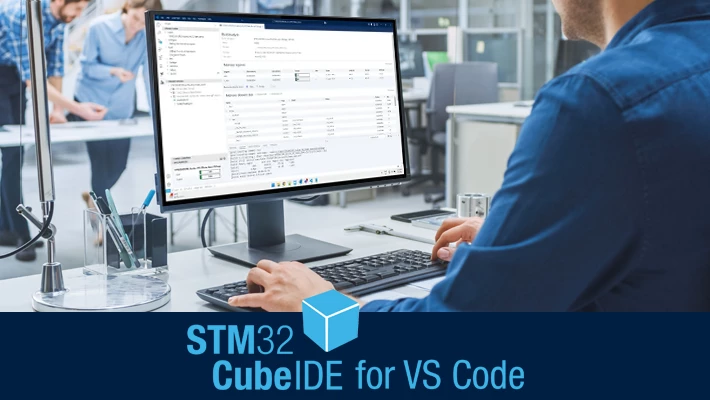
STM32Cube for VS Code deployment: a developer-centric approach This July update marks the first incremental update since the pre-release was published in May. STM32Cube for VS Code will follow an agile development approach with frequent, small updates. This strategy minimizes update risks and enables ST to respond to developer feedback rapidly, ensuring continuous improvement. STM32Cube for VS Code is currently delivered as a pre-release. The pre-release version will soon be merged into the stable track. To install it, select: Install pre-release version What’s new in the July 2025 update #1 Live data watch This feature is one of the most appreciated in STM32CubeIDE. The latest update of STM32Cube for VS Code provides a first version of the live data watch capability, which allows users to: monitor any type of data object in real-time. keep monitored variables across debug sessions. The live expression feature is set up inside launch.json by adding the following lines: #2 Introdu
The SPSA068 from STMicroelectronics is a compact, convenient, and cost-effective power-management IC (PMIC) for automotive applications. With configurable parameters and qualified to AEC-Q100, the SPSA068 supports ISO 26262 functional safety (FuSa) approval up to ASIL-B. Designed for use with microcontrollers (MCUs) that operate from a single-supply voltage, the SPSA068 implements all the features required in a turnkey solution for MCU power management. It integrates a 1A battery-compatible buck voltage regulator, a precise (1%) voltage reference, watchdog supervisors, diagnostic indicators, MCU reset control, and Serial Peripheral Interface (SPI) for configuration and status checking. The device parameters are customizable via non-volatile memory (NVM). The buck regulator output can be configured to 5V, 3.3V, or 1.2V, and other voltages can be achieved using external resistors, with load-current options of 0.5A or 1A, while the switching frequency can be set to 0.4MHz or 2.4MHz. The v
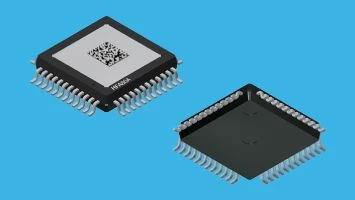
The HFA80A automotive-grade analog-input class-D audio amplifier combines high efficiency, small size, and a low bill of materials, with load diagnostics optimized for automotive and native electromagnetic compatibility (EMC). With its feedback-before-filter topology and 2MHz nominal PWM frequency, the HFA80A lets designers optimize the output filter for the targeted performance and achieve a compact outline with small component values. Spread-spectrum operation simplifies meeting the mandatory CISPR 25 specification, with no additional EMC-specific filtering required. The amplifier delivers clear and powerful listening experiences, driving up to 4x 49W into 2Ω speakers at 14.4V and with typical harmonic distortion (THD) specified at 0.015% (1W/4Ω). Pure sound is assured, with low output noise and crosstalk as well as 80dB power supply rejection specified at 1W/1kHz with 4Ω loads. Flat frequency response up to 40kHz ensures generous bandwidth for high-resolution audio, which designers
Already have an account? Login
Enter your E-mail address. We'll send you an e-mail with instructions to reset your password.