Get ready for the STM32 Summit 2026 | Online, November 3
Stay ahead of the latest technical news & updates.
Most recent activity
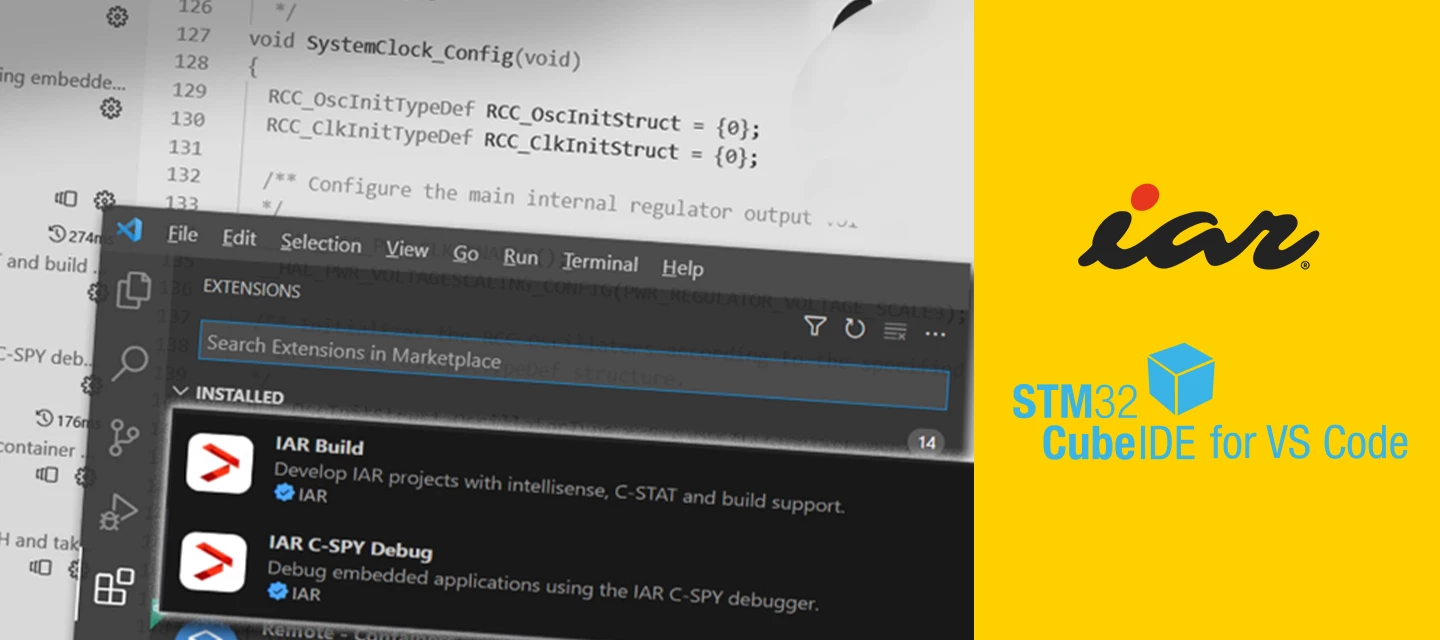
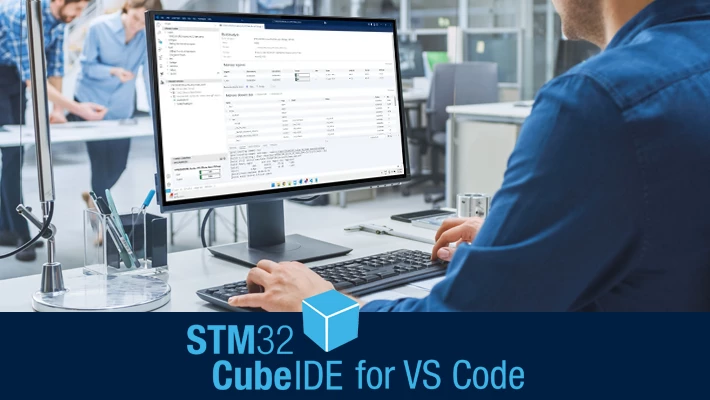
Getting started with advanced STM32 debugging in VS Code with IAR C-SPYDebugging embedded systems gets harder as projects grow.At some point, breakpoints and variable windows stop being enough. You need to see how your application behaves over time, track down fast bugs, inspect registers in context, and measure what your code is really doing.If you are building STM32 projects in VS Code, you can do that without leaving your workflow.STM32Cube for VS Code brings together C/C++ editing, CMake and Ninja builds, Git, and one-click debugging. It also helps teams stay flexible across IDEs and operating systems while keeping CI/CD workflows consistent.Once your STM32 project is running in VS Code, the IAR C-SPY Debug extension adds a professional-grade analysis layer that scales with project complexity. C-SPY is IAR’s advanced debugging and analysis engine for embedded systems.If you are new to STM32Cube for VS Code, start with ST official guides:Create projects with the STM32 VS Code extens
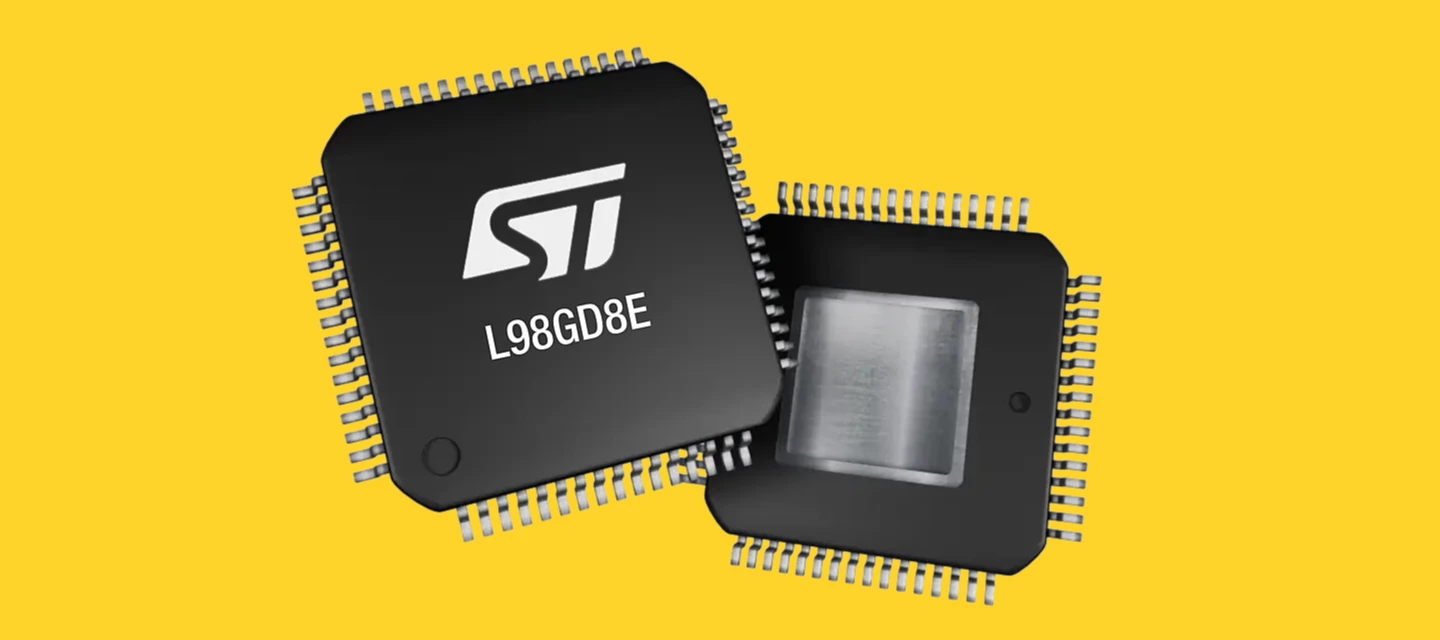
With an absolute maximum rating (AMR) of 75V, STMicroelectronics’ L98GD8E is the only 48V automotive pre-driver to combine compliance with the ISO 21780 standard for 48V electrical systems and eight channels for high-side and low-side driving. The device’s eight outputs are independently configurable for driving external high-side N-channel and P-channel, or low-side N-channel MOSFETs, allowing flexibility to handle loads in a variety of configurations. One IC can control up to two H‑bridges in DC motor drives, or can manage multiple relays, resistive or capacitive loads, and provide peak&hold control for small valves. Channel 6 is suitable for driving safety-relevant loads requiring a dedicated enable pin. Typical applications for the L98GD8E include mild-hybrid systems such as powertrain and energy recovery, as well as auxiliary systems such as e-compressors and integrated starter generators. Capable of driving multiple loads, its flexibility simplifies leveraging the 48V powerne
The ASM330LHHG1 automotive-qualified inertial measurement unit (IMU), which operates from -40°C to 125°C, can be mounted in vehicle zones including those where the ambient temperature may be a concern. Combining low-noise sensors, temperature compensation, and a 6-channel synchronized output, the IMU fulfils the industry’s need for greater dead-reckoning accuracy to support navigation and positioning. Today’s cars, vans, and trucks, as well as industrial and agricultural vehicles, can leverage increasingly accurate GNSS positioning technologies for applications such as routing, tracking, navigation, and driver assistance. These new and enhanced systems need high-quality dead reckoning to maintain continuity between satellite updates and provide effective fallback during GNSS outages or corruption, ensuring superior performance and greater resilience. ST’s ASM330LHHG1 meets this need by delivering 3-axis accelerometer and 3-axis gyroscope data through its synchronized output that ensure
STMicroelectronics’ L9963F automotive battery-management IC includes all the features needed to manage lithium battery packs in hybrid (HE) and full electric (FE) vehicles, as well as industrial energy storage systems, and 48V/96V applications. The L9963F brings under-the-skin improvements to the industry-proven L9963E as a fully compatible replacement that requires no hardware or software changes for existing users of the L9963 series. One device can monitor from 4 to 14 stacked cells, thereby addressing applications up to 48V. Connecting multiple ICs permits even larger arrays of up to 31 battery packs with a total of 434 series cells. Coulomb counting inside the L9963F supports pack overcurrent detection in both ignition on and off states. A fully redundant cell-measurement path, with ADC swap, provides enhanced safety and enables limp-home functionality. The L9963F can take its power from the monitored battery and integrates circuitry to generate stable internal references and ensu
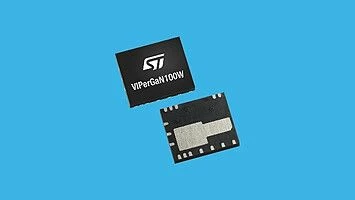
STMicroelectronics has introduced two 100-Watt VIPerGaN high-voltage converters, extending wide-bandgap energy savings throughout domestic appliances, building and home automation, smart lighting, and consumer products including televisions and device chargers. The new converters include the VIPerGaN100W, with 3.5A drain current limit, while the VIPerGaN100WB has a 4.2A current limit for handling short-term peak power up to 125W. The extra flexibility saves designers over-specifying power circuitry in equipment containing inductive loads like solenoid valves or motors, such as in coffee makers, small appliances, and air-conditioners. Both converters are compatible with the universal AC input voltage range, from 85V to 265V, and will deliver 100W from 185V supply. The 700V gallium-nitride (GaN) power transistor in each converter ensures ruggedness and reliability, with extremely low RDS(on) of 0.27mΩ that helps achieve great thermal performance. The 5mm x 6mm QFN devices also integrate
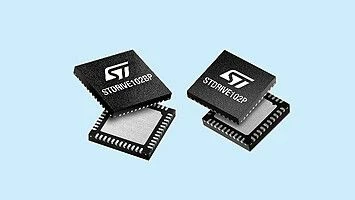
STMicroelectronics has introduced new STDRIVE102 gate-driver ICs for three-phase brushless motors, adding the STDRIVE102P and STDRIVE102BP that feature an SPI interface to simplify configuring the gate current and other settings. Designed for supply voltages from 6V to 50V, the STDRIVE102 series ensures high energy efficiency in battery-operated equipment such as power tools and domestic appliances. Able to drive six external N-channel power MOSFETs, the drivers can be programmed to source up to 1A and sink up to 2A and provide slew-rate regulation without external resistors. An ultra-low standby current of only 50 nA typ. helps maximize battery life in portable and battery-powered applications. STDRIVE102 components integrate an advanced charge pump that ensures continuous operation of the high-side driver circuitry, simplifying the design of applications that require a PWM duty cycle of 100%. Integrated 12V and 3.3V linear regulators (LDOs) power the internal low-side drivers and emb
STM32Cube AI Studio is now available as ST’s new standalone environment for optimizing, validating, and deploying AI models on STM32 MCUs. Evolving from the X-CUBE-AI legacy, it brings a unified workflow, improved performance evaluation, and a modern user experience designed for both embedded engineers and AI developers. What’s new for developers A stronger foundation for embedded AI Built on the trusted X-CUBE-AI legacy to ensure consistent, reliable embedded AI performance Based on ST Edge AI Core technology for aligned performance across the STM32 AI toolchain Separates embedded and AI tasks to reduce project complexity Modern, intuitive UI for smoother, faster development New capabilities for embedded model optimization, validation & acceleration Detailed model performance reports, including latency and memory usage Experiment comparison tools
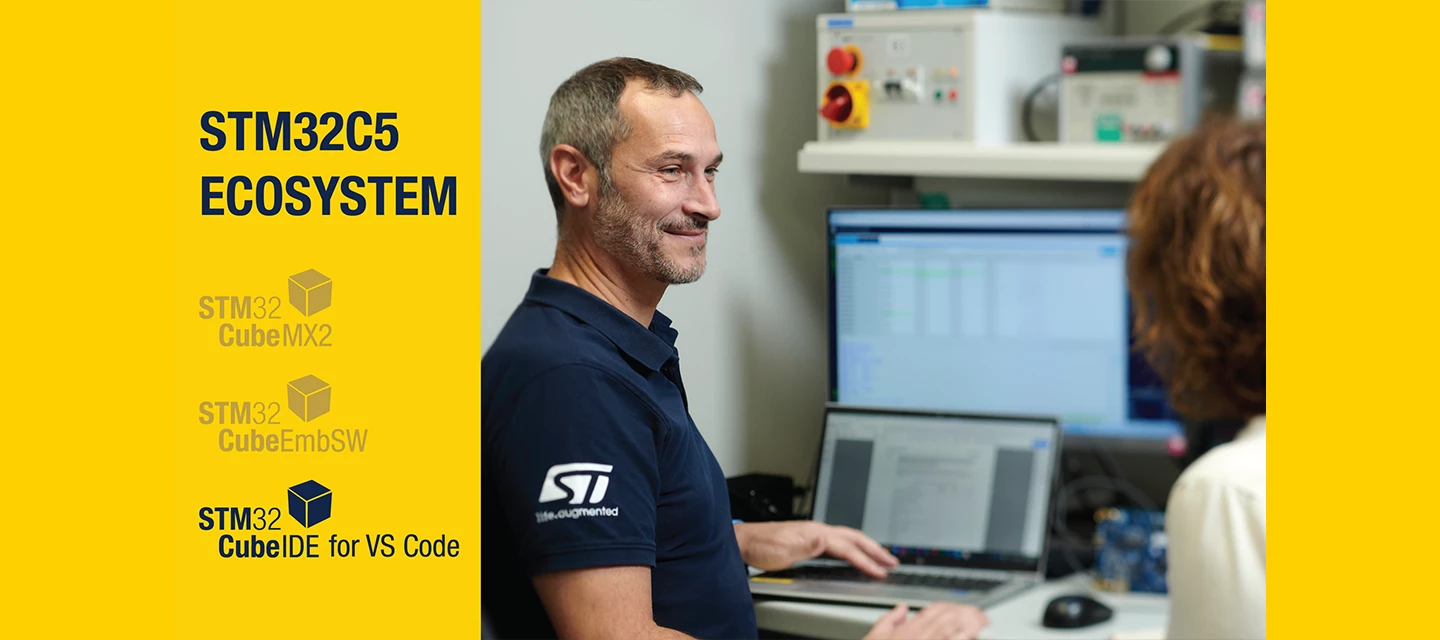
The March 2026 release of STM32CubeIDE for Visual Studio Code is a key part of the STM32C5 series launch and the wider evolution of the STM32Cube ecosystem. Together with the new STM32CubeMX2 configuration tool and the updated STM32CubeIDE and STM32CubeIDE for VS Code integrations, this release is designed to provide seamless development experience for the next generation of STM32 MCUs.ST thanks the developer community for their feedback and patience as the team continues to build tools for VS Code. Highlights of the March 2026 updateSTM32 View update: faster access to tools and resources in VS CodeThe latest STM32 View update introduces new shortcuts that help developers launch tools and find documentation more efficiently. New shortcuts allow you to:Launch STM32CubeMX2 Start STM32CubeMX2 directly from VS Code for faster project configuration.Import STM32Cube examples Bring STM32Cube example projects into VS Code in just a few clicks.Limitation: only single-core‑ STM32CubeIDE/Eclipse
Combining sensing for three axes in a single digital device, STMicroelectronics’ IIS3DWBG1 wide-bandwidth vibration sensor simplifies design and cuts bill-of-materials costs in industrial and automotive condition-monitoring applications. The 3-axis IIS3DWBG1 is suitable for use in industrial condition-monitoring systems, where sensor placement and mounting govern measurement accuracy. Its tiny dimensions and wide operating-temperature range of -40°C to 125°C enhance flexibility to place small, externally attached sensors at optimal diagnostic locations regardless how difficult they are. The compact footprint also facilitates integration inside smart motors and smart gearboxes, while the low power consumption helps designers ensure long-lasting operation in battery-powered applications. The sensor’s wide bandwidth and high resolution, as a 3-axis device, simplify capturing patterns associated with defects or wear, as well as equipment setup issues such as looseness and misalignment, to
ST has been ranked the number one vendor worldwide in general‑purpose microcontrollers (GP MCU) for the fifth consecutive year, based on research published by Omdia*, a global analyst and advisory leader. This recognition reflects the continued trust developers place in STM32 when building MCU designs. Thank you for choosing STM32 and for being part of this journey. Since the launch of the first STM32 nearly 20 years ago, our guiding principle has remained the same: we put developers first. This means providing embedded developers with cutting-edge STM32 hardware and software technology, comprehensive support, and high-quality, reliable supply. Your feedback, challenges, and ideas help shape our roadmap and drive continuous improvement and innovation across the STM32 portfolio. We look forward to continu
This September update marks the second incremental update since the prerelease was published in May. #1 STM32Cube for Visual Studio Code becomes STM32CubeIDE for Visual Studio CodeThe STM32Cube for Visual Studio Code environment is still in its early stages. To ensure clarity and consistency between ST-developed IDEs within the STM32Cube ecosystem, we are renaming it STM32CubeIDE for Visual Studio Code. #2 Semi-hosting for ST-LINK GDB serverThe semi-hosting support can be enabled in three modes: Console mode – allowing users to have I/O console interaction with the target All mode – (console + file) allowing users to write data also from the target to a file on the host The ST DAP adds a new set of attributes to enable and configure semi-hosting. This addition into the DAP comes with a minimal TCP/IP console allowing developers to interact with the target when using the Console mode: #3 Attach to remote debug serverAttach debug is a recent feature available in previous versions. Th
TSB192 dual op amps deliver very high precision for applications that need a wide operating-voltage range, with offset voltage of 20µV, temperature drift of 100nV/°C, and gain-bandwidth of 8MHz. While op amps with comparable offset voltage are usually precision devices that require a low-voltage supply, ST’s TSB192 can operate from any voltage between 4V to 36V. With 30µV maximum offset across the full temperature range and the low drift, the TSB192 minimizes reliance on compensation in signal-conditioning networks within industrial, automotive, healthcare, and consumer-electronic equipment. Drawing up to 1.9mA per channel extends the runtime of battery-operated equipment and rail-to-rail outputs maximize the available dynamic range. The precision and linearity of the TSB192 ensures repeatable performance in analog integrators and measurement circuitry of equipment such as temperature detectors, medical instrumentation, electronic scales, and industrial test instruments. The generous g
STM32CubeIDE 2.1.0 brings broader device support, smoother workflows, and faster builds so you can develop and debug STM32 projects more efficiently. Key updates and benefitsBroader MCU support for new designsSupport for the STM32C5 series and additional microcontrollers in the STM32WBA2, STM32WL5 dual-core, STM32H5, STM32U3, and STM32F7 series, enabling you to adopt the latest STM32 products without changing tools. Auto-refresh of Project ExplorerThe Project Explorer now automatically updates when files in the workspace change.This removes the need to manually refresh after code regeneration (for example with standalone STM32CubeMX), improving interoperability and saving development time. CMake presets supportSTM32CubeIDE now supports CMake presets, the modern interface between IDEs or CI systems and build systems.This makes it easier to import existing CMake-based codebases into STM32CubeIDE, streamline CI integration, and work smoothly with STM32CubeMX2 exports that use CMake inste
STMicroelectronics has released new versions in STM32Cube ecosystem, expanding STM32CubeMX support to more STM32 products and enabling configuration of innovative on‑chip IP for smarter, more efficient embedded designs. The new release brings STM32CubeMX support for the latest STM32H5, STM32U3, and STM32WBA2 devices, helping developers quickly start new designs and reuse existing workflows across a growing STM32 portfolio. STM32Cube v1.22 also adds configuration support for two advanced peripherals on selected STM32 devices: PLAy (Programmable Logic Array) provides a small, configurable logic fabric on‑chip, ideal for custom glue logic, simple state machines, and deterministic event detection. By wiring internal events and external GPIO signals directly into PLAy, applications can react in hardware with cycle‑accurate timing, offloading the CPU and often eliminating external logic components. The PLAy is supported on latest STM32H5E4/5F4 and STM32H5E5/5F5 product lines
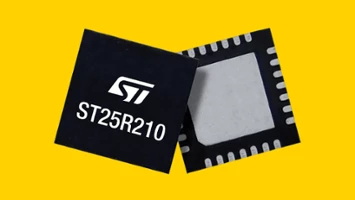
The new ST25R210 is a high-performance NFC reader IC optimized for cost-sensitive Aliro, access control, industrial, and consumer applications. With up to 1.6 W output power, excellent interaction range, and robust performance in noisy environments, the ST25R210 is now available to order. Buy now Why choose the ST25R210? Engineered to deliver high performance in cost‑sensitive designs, the new ST25R210 combines 1.6 W output power with improved low‑power card detection (LPCD) and high sensitivity to extend detection distance while keeping power consumption low.The chip is also backed by a 10‑year longevity commitment. How does it enable sleek, space saving designs? Its compact 4 x 4 mm QFN package frees valuable PCB space for your own differentiation, while production in France supports secure, traceable supply chains. How does it work? The microcontroller controls the ST25R210 NFC reader IC via an SPI interface. The ST25R210 then drives the 13.56 MHz RF interface to communicate wit
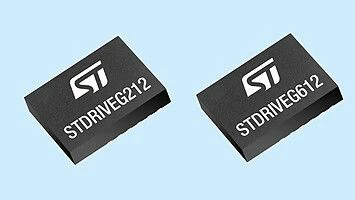
STMicroelectronics has announced two new high-speed half-bridge gate drivers that bring gallium-nitride (GaN) efficiency, thermal performance, and miniaturization to a broad range of power and motion-control applications. The STDRIVEG212 and STDRIVEG612 deliver tightly controlled 5V gate-drive signals to enhanced-mode GaN HEMTs, powered from a high-side voltage up to 220V or 600V respectively. The drivers are highly integrated, with high-side and low-side 5V linear regulators (LDOs), a high-side bootstrap diode, and protection including under-voltage lock-out (UVLO), in a compact QFN package. An integrated fast-startup voltage regulator stabilizes the supply voltage for the driver output stage, ensuring consistent gate control, while an embedded comparator turns off both GaNs on detecting overcurrent. Smart shutdown (SmartSD) automatically holds the switches off long enough to cool down and a fault pin provides overcurrent, overtemperature and UVLO reporting.The drivers are featured to
Capable of supplying 3A from a 3mm x 1.6mm footprint, STMicroelectronics’ DCP3603 monolithic buck converter simplifies design, saves PCB space, accelerates time to market, and enhances system reliability. With a 3.3V-to-36V input-voltage range, this convenient miniature converter can power equipment such as smart meters, domestic appliances, and industrial 24V loads. Leveraging synchronous rectification, and available with either 1MHz or 500kHz fixed switching frequency, the DCP3603 maintains high efficiency across the load range, reaching 93% at 600mA with 12Vin and 5Vout. With power switches and compensation built-in, only an inductor, bootstrap and filter capacitors, and feedback resistors are needed to complete the circuit, ensuring a minimal bill of materials. Designers can choose from two variants, configured for forced-PWM operation for optimal performance in noise-sensitive applications, or pulse-skipping for minimal power consumption at light load. Both variants implement freq
STM32CubeProgrammer v2.22 further strengthens ST’s all‑in‑one programming and provisioning tool with support for new STM32 devices, enhanced security features, and productivity improvements. New STM32 support Developers can now use STM32CubeProgrammer to program and provision the latest STM32 devices, ensuring rapid ramp‑up on new projects: Newly supported STM32 lines: STM32H5 STM32WBA2x STM32C5 STM32U3 This reinforces STM32CubeProgrammer as a single tool covering all STM32 lines and packages, available as GUI, CLI, and C API, and supporting all key interfaces (JTAG/SWD, UART, USB, CAN, I²C, SPI) on Windows, Linux, and macOS. New features for faster and more efficient workflows Export Memory MCU Map (GUI)A new “Export Memory MCU Map” feature simplifies the dump of device memory maps (option bytes, OTP, internal and external Flash) into HEX output files, making it easier to analyze, archive, and reuse programming configurations across projects and production flows. D
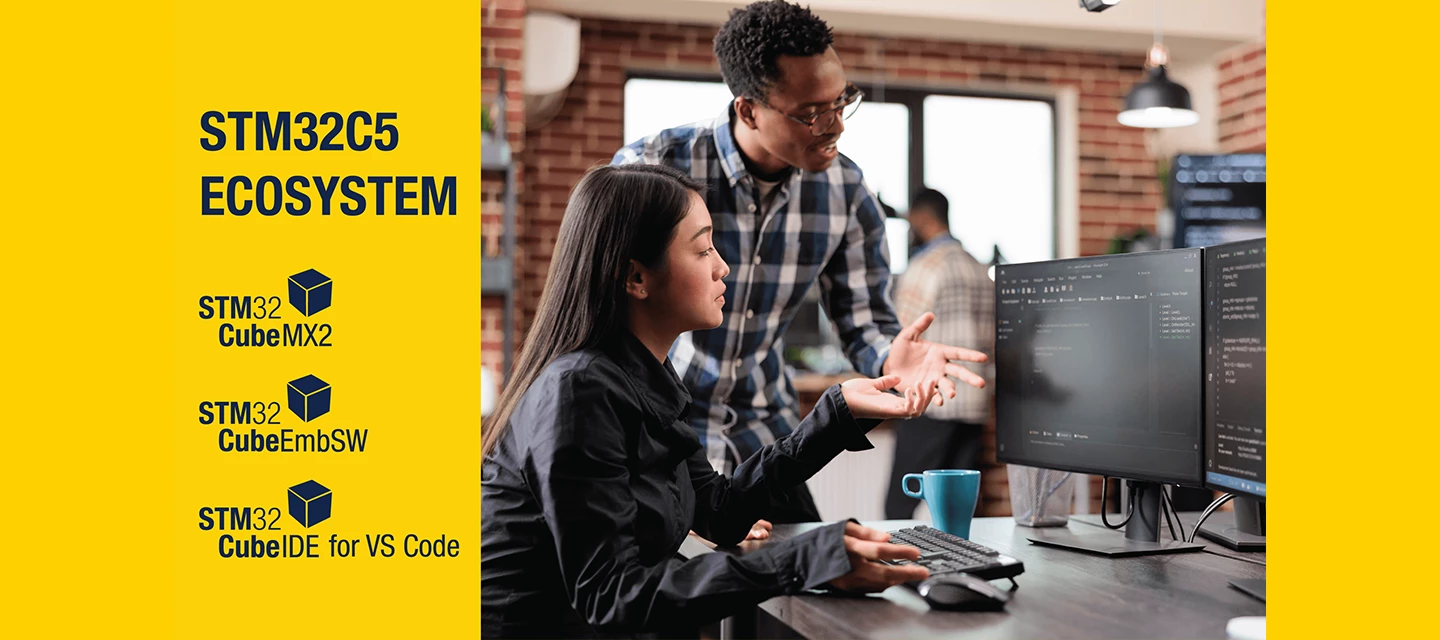
With the introduction of the STM32C5 series, we’re rolling out a next‑gen STM32Cube foundation designed to boost your productivity and unlock even more performance from STM32 MCUs. You keep the STM32Cube ecosystem you know – same concepts, same user flow – but under the hood we’re rebuilding key layers to scale with upcoming STM32 series and developer expectations. Core focus areas: STM32 HAL2 (new optimized hardware abstraction layer) STM32CubeMX2 (revamped init & code generation) STM32CubeIDE for VS Code (new free IDE option) All new STM32 series starting with STM32C5 will benefit from this upgraded foundation.All existing STM32 series remain fully supported by current STM32Cube components, which will continue to be maintained over time. Why a new foundation for STM32Cube? The first STM32Cube architecture dates back to 2014 and has continuously evolved to follow the growth of the STM32 portfolio.
STMicroelectronics has introduced a series of low-RDS(on) MOSFETs made with new Smart STripFET F8 technology, which is engineered for optimum conduction performance and small die size. The devices target space-constrained applications including power distribution and battery management in automotive products. The first device in the new series, the STL059N4S8AG, is a 40V/420A N-channel enhancement-mode MOSFET with RDS(on) 0.59mΩ, housed in a PowerFLAT 5x6 package. The compact outline saves PCB space, easing the design of smaller control modules, while high thermal conductivity and efficient dissipation help meet stringent reliability targets. The devices also have an extended maximum operating temperature of 175°C. The STL059N4S8AG is available as an AEC-Q101 qualified part in a package with wettable flanks that facilitates optical inspection in automotive assemblies. ST’s Smart STripFET F8 technology builds on the conventional STripFET F8 with a modified trench gate that enhances on-s
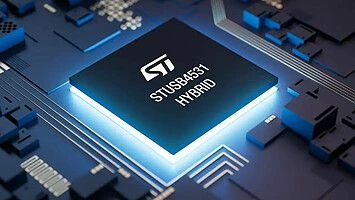
The STUSB4531 USB Power Delivery (PD) sink controller introduces a new, patented hybrid mode that simplifies implementing optional USB PD features for added value in USB-powered and USB-chargeable devices. The STUSB4531 contains a certified, hardwired USB PD stack that works with ST-proprietary AUTORUN algorithms to enable software-free power negotiation, supervision, and management. These AUTORUN algorithms simplify developing battery-charging and VBUS-powered electronics in equipment such as portable audio devices, wearables, set-top boxes, Wi-Fi access points, healthcare devices, and lighting. The latest updated algorithms can negotiate with AC adapters to ensure the optimum power profile, including adjustable voltage supply (AVS) and high-power charging in dead-battery mode for faster device reactivation. The new hybrid mode now added to the STUSB4531 lets an external application processor interact with the stack to leverage the protocol layers for USB PD communication. This gives
STPMIC1L and STPMIC2L power-management ICs (PMICs) help designers leverage the embedded-processing muscle of ST’s Arm® Cortex®-A microprocessors (MPUs) in performance-oriented industrial applications. Tailored for the 32-bit STM32MP1x and 64-bit STM32MP2x series, the new PMICs deliver cost-effective power and protection while saving board space, simplifying hardware design, and minimizing the bill of materials. With multiple fixed and adjustable LDOs and DC/DC buck converters for all MPU power rails, each PMIC also contains an LDO suited to powering external DDR DRAM. The PMICs target equipment such as point-of-sale (POS) terminals, network gateways, home-automation systems, edge-processing platforms, printers, barcode scanners, and metering systems. With their extended junction temperature rating from -40°C to 125°C, the devices withstand harsh environments in applications like industrial controls, thermostats, and smart-factory devices. The STPMIC1L for the STM32MP1 series has two DC
The STM32Cube embedded software ecosystem is continuously updated to support the latest STM32 microcontrollers and on-chip innovations.The latest STM32Cube releases add expanded device coverage, support for new IPs, updated middleware, and numerous quality improvements, helping developers: Integrate new STM32 MCUs more quickly Prototype with HSP and PLAY without starting from scratch Reuse code across projects and shorten time‑to‑market What’s new in STM32Cube Embedded Software? PLAY support on STM32H5 – custom logic without FPGA complexity The Programmable Logic Array (PLAY) lets developers implement custom logic circuits and state machines directly on STM32H5, avoiding external logic devices or FPGAs. PLAY uses look‑up tables with multiple inputs to create flexible logical functions for a wide range of use cases. With STM32CubeH5 v1.6.0, developers get everything needed to quickly try and adopt PLAY: HAL driver for PLAY Familiar HAL interface to configure and control PLAY No need
STSAFE-L010 is a new secure chip engineered for manufacturers seeking robust, entry-level authentication that maximizes return on investment. With STSAFE-L010, manufacturers can now easily prevent cloning and counterfeiting while also maximizing revenue streams by reinforcing brand loyalty.Order your board today. What use cases does it support?STSAFE-L010 offers an optimized command set that delivers device authentication, secure counters, and secure storage. Compact, the secure solution is ideal for applications where authentication and usage monitoring of consumables and peripherals are critical.Key use cases include:Authentication of genuine parts: guaranteeing that only authentic peripherals, accessories, or consumables are used. Discover more about battery authentication. Usage monitoring and control: secure counters allow manufacturers to track and limit usage according to specifications or usage policies. How does it work?STSAFE-L010 is a plug-and-play solution that can be emb
We are pleased to share some exciting developments in STM32Cube that will enhance your development experience and unlock the rich features of STM32 microcontrollers even further. Transition to FreeRTOS and enhanced middleware offeringsWe are moving back to FreeRTOS™ as the main kernel, integrating it with USBX, FileX, and LWIP. This strategic shift will help us build a consistent middleware offering, set to be introduced before the end of this year. Notably, USBX and FileX will be available in both bare metal and RTOS-agnostic versions, providing greater flexibility and adaptability for your projects.In parallel, we continue our investment in supporting leading open-source frameworks. Launch of STM32Cube version 3 for Visual Studio CodeWe are thrilled to announce the release of STM32Cube for VS Code, marking version 3 of the existing STM32 VS Code extension. This substantial upgrade is built on a new modular foundation, enabling you to selectively choose features and manage updates and
Already have an account? Login
Enter your E-mail address. We'll send you an e-mail with instructions to reset your password.