May 25, 2022
Solved

[STM32CubeIDE 1.9.0] De-initialization of peripherals doesn't seem to work

  • May 25, 2022
  • 4 replies
  • 2769 views

Hello,

I'm trying to do the memory position jump using this code:

JumpAddress = *(__IO uint32_t*) (APPLICATION_ADDRESS + 4);
	Jump_To_Application = (pFunction) JumpAddress;
	__set_MSP(*(__IO uint32_t*) (APPLICATION_ADDRESS ));
	Jump_To_Application();

I managed to make it work with only one GPIO, but when I add peripherals in the bootloader, it no longer works.

I'm trying to de-initialize the peripheral, a UART has this reference (stm32f4xx_hal_uart.c):

/**
 * @brief DeInitializes the UART peripheral.
 * @param huart Pointer to a UART_HandleTypeDef structure that contains
 * the configuration information for the specified UART module.
 * @retval HAL status
 */
HAL_StatusTypeDef HAL_UART_DeInit(UART_HandleTypeDef *huart)
{
 /* Check the UART handle allocation */
 if (huart == NULL)
 {
 return HAL_ERROR;
 }
 
 /* Check the parameters */
 assert_param(IS_UART_INSTANCE(huart->Instance));
 
 huart->gState = HAL_UART_STATE_BUSY;
 
 /* Disable the Peripheral */
 __HAL_UART_DISABLE(huart);
 
#if (USE_HAL_UART_REGISTER_CALLBACKS == 1)
 if (huart->MspDeInitCallback == NULL)
 {
 huart->MspDeInitCallback = HAL_UART_MspDeInit;
 }
 /* DeInit the low level hardware */
 huart->MspDeInitCallback(huart);
#else
 /* DeInit the low level hardware */
 HAL_UART_MspDeInit(huart);
#endif /* (USE_HAL_UART_REGISTER_CALLBACKS) */
 
 huart->ErrorCode = HAL_UART_ERROR_NONE;
 huart->gState = HAL_UART_STATE_RESET;
 huart->RxState = HAL_UART_STATE_RESET;
 huart->ReceptionType = HAL_UART_RECEPTION_STANDARD;
 
 /* Process Unlock */
 __HAL_UNLOCK(huart);
 
 return HAL_OK;
}

When I look for the reference of HAL_UART_MspDeInit, this appears (stm32f4xx_hal_uart.c):

/**
 * @brief UART MSP DeInit.
 * @param huart Pointer to a UART_HandleTypeDef structure that contains
 * the configuration information for the specified UART module.
 * @retval None
 */
__weak void HAL_UART_MspDeInit(UART_HandleTypeDef *huart)
{
 /* Prevent unused argument(s) compilation warning */
 UNUSED(huart);
 /* NOTE: This function should not be modified, when the callback is needed,
 the HAL_UART_MspDeInit could be implemented in the user file
 */
}

But there is another reference implemented (stm32f4xx_hal_msp.c):

/**
* @brief UART MSP De-Initialization
* This function freeze the hardware resources used in this example
* @param huart: UART handle pointer
* @retval None
*/
void HAL_UART_MspDeInit(UART_HandleTypeDef* huart)
{
 if(huart->Instance==USART1)
 {
 /* USER CODE BEGIN USART1_MspDeInit 0 */
 
 /* USER CODE END USART1_MspDeInit 0 */
 /* Peripheral clock disable */
 __HAL_RCC_USART1_CLK_DISABLE();
 
 /**USART1 GPIO Configuration
 PA9 ------> USART1_TX
 PA10 ------> USART1_RX
 */
 HAL_GPIO_DeInit(GPIOA, GPIO_PIN_9|GPIO_PIN_10);
 
 /* USER CODE BEGIN USART1_MspDeInit 1 */
 
 /* USER CODE END USART1_MspDeInit 1 */
 }
 
}

How should I de-initialize these peripherals?
This topic has been closed for replies.
Best answer by

I found (Google found) some references that worked

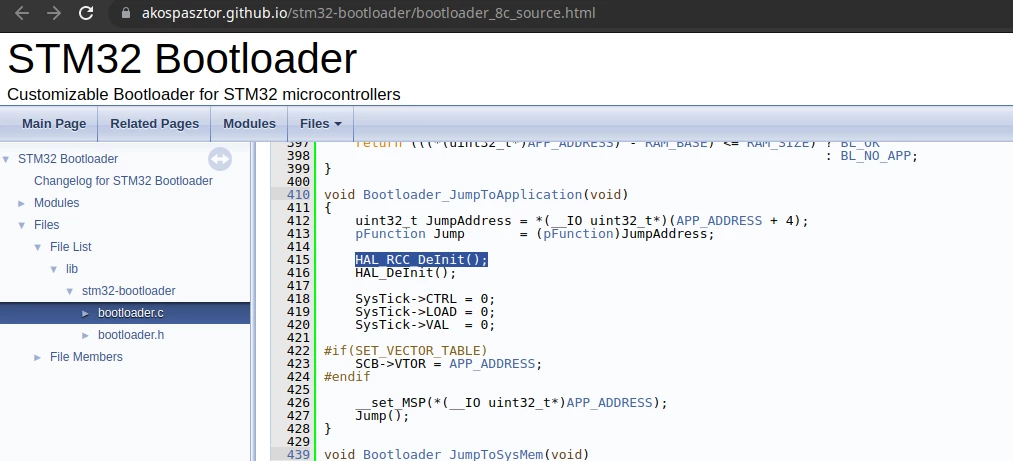
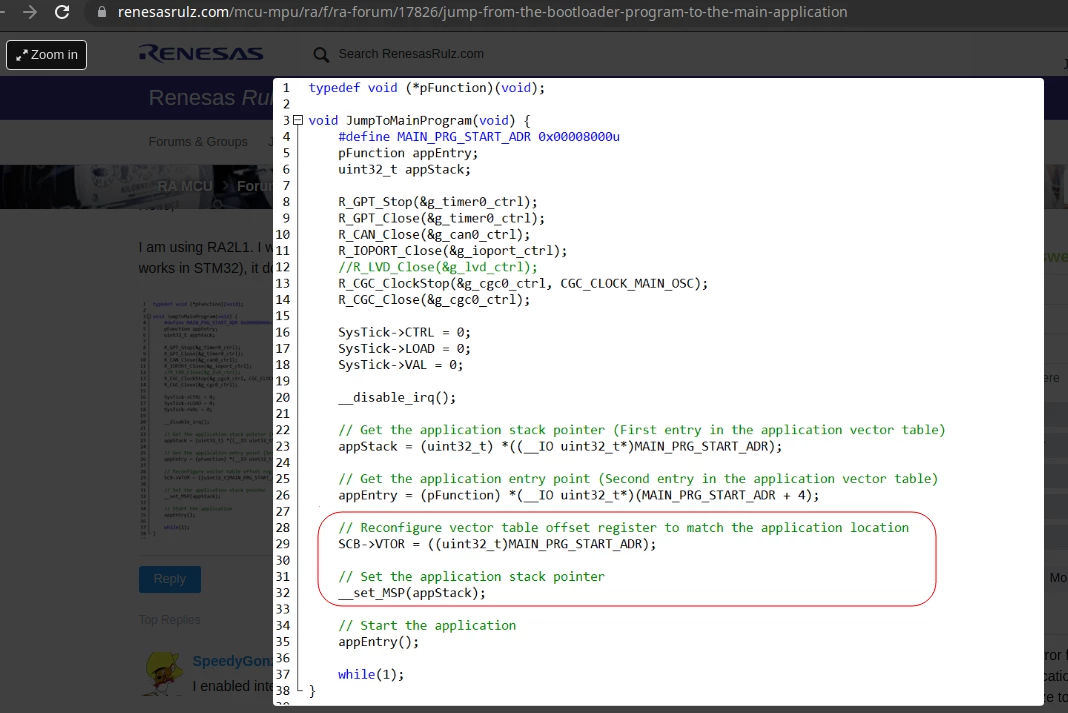
Google found this one: "when I run the below code block (that works in STM32)"

0693W00000NqgkWQAR.png 

0693W00000Nqgl5QAB.png 

The code that worked:

uint32_t JumpAddress;
typedef void (*pFunction)(void);
pFunction Jump_To_Application;
#define APPLICATION_ADDRESS (uint32_t)0x08008000
 
HAL_RCC_DeInit();
JumpAddress = *(__IO uint32_t*) (APPLICATION_ADDRESS + 4);
Jump_To_Application = (pFunction) JumpAddress;
SCB->VTOR = APPLICATION_ADDRESS;
__set_MSP(*(__IO uint32_t*) (APPLICATION_ADDRESS ));
Jump_To_Application();

USART1 initialization uses these instructions:

UART_HandleTypeDef huart1;
 
huart1.Instance = USART1;
huart1.Init.BaudRate = 115200;
huart1.Init.WordLength = UART_WORDLENGTH_8B;
huart1.Init.StopBits = UART_STOPBITS_1;
huart1.Init.Parity = UART_PARITY_NONE;
huart1.Init.Mode = UART_MODE_TX_RX;
huart1.Init.HwFlowCtl = UART_HWCONTROL_NONE;
huart1.Init.OverSampling = UART_OVERSAMPLING_16;
if (HAL_UART_Init(&huart1) != HAL_OK) {
	Error_Handler();
}

When operating on this reference type UART_HandleTypeDef, the code execution failed. If I left any of these lines it would no longer work:

huart1.Instance = USART1;
huart1.Init.BaudRate = 115200;
huart1.Init.WordLength = UART_WORDLENGTH_8B;
huart1.Init.StopBits = UART_STOPBITS_1;
huart1.Init.Parity = UART_PARITY_NONE;
huart1.Init.Mode = UART_MODE_TX_RX;
huart1.Init.HwFlowCtl = UART_HWCONTROL_NONE;
huart1.Init.OverSampling = UART_OVERSAMPLING_16;

The instruction that resolved was this:

SCB->VTOR = APPLICATION_ADDRESS;

Ref.:

[How to Create a Super Simple Bootloader]

https://www.youtube.com/playlist?list=PLnMKNibPkDnEb1sphpdFJ3bR9dNy7S6mO

[STM32 USB training - 11.3 USB MSC DFU host labs]

https://www.youtube.com/watch?v=CGUC1wqSLCE

[STM32 USB training - 09.9 USB DFU device labs]

https://www.youtube.com/watch?v=n_LDXOQHerU

4 replies

Andrew Neil
Super User
May 25, 2022

"when I add peripherals in the bootloader, it no longer works"

What, exactly, "doesn't work", and how do you detect that?

What symptoms do you observe?

What debugging have you done to see what's going on?

A complex system that works is invariably found to have evolved from a simple system that worked.A complex system designed from scratch never works and cannot be patched up to make it work.
Best answer
May 26, 2022

I found (Google found) some references that worked

Google found this one: "when I run the below code block (that works in STM32)"

0693W00000NqgkWQAR.png 

0693W00000Nqgl5QAB.png 

The code that worked:

uint32_t JumpAddress;
typedef void (*pFunction)(void);
pFunction Jump_To_Application;
#define APPLICATION_ADDRESS (uint32_t)0x08008000
 
HAL_RCC_DeInit();
JumpAddress = *(__IO uint32_t*) (APPLICATION_ADDRESS + 4);
Jump_To_Application = (pFunction) JumpAddress;
SCB->VTOR = APPLICATION_ADDRESS;
__set_MSP(*(__IO uint32_t*) (APPLICATION_ADDRESS ));
Jump_To_Application();

USART1 initialization uses these instructions:

UART_HandleTypeDef huart1;
 
huart1.Instance = USART1;
huart1.Init.BaudRate = 115200;
huart1.Init.WordLength = UART_WORDLENGTH_8B;
huart1.Init.StopBits = UART_STOPBITS_1;
huart1.Init.Parity = UART_PARITY_NONE;
huart1.Init.Mode = UART_MODE_TX_RX;
huart1.Init.HwFlowCtl = UART_HWCONTROL_NONE;
huart1.Init.OverSampling = UART_OVERSAMPLING_16;
if (HAL_UART_Init(&huart1) != HAL_OK) {
	Error_Handler();
}

When operating on this reference type UART_HandleTypeDef, the code execution failed. If I left any of these lines it would no longer work:

huart1.Instance = USART1;
huart1.Init.BaudRate = 115200;
huart1.Init.WordLength = UART_WORDLENGTH_8B;
huart1.Init.StopBits = UART_STOPBITS_1;
huart1.Init.Parity = UART_PARITY_NONE;
huart1.Init.Mode = UART_MODE_TX_RX;
huart1.Init.HwFlowCtl = UART_HWCONTROL_NONE;
huart1.Init.OverSampling = UART_OVERSAMPLING_16;

The instruction that resolved was this:

SCB->VTOR = APPLICATION_ADDRESS;

Ref.:

[How to Create a Super Simple Bootloader]

https://www.youtube.com/playlist?list=PLnMKNibPkDnEb1sphpdFJ3bR9dNy7S6mO

[STM32 USB training - 11.3 USB MSC DFU host labs]

https://www.youtube.com/watch?v=CGUC1wqSLCE

[STM32 USB training - 09.9 USB DFU device labs]

https://www.youtube.com/watch?v=n_LDXOQHerU

May 26, 2022

About the reference below, just comment it and the IDE redirected to the other implementation

__weak void HAL_UART_MspDeInit(UART_HandleTypeDef *huart)