

caleb
Associate III
August 21, 2019
Solved

STM32H743 (STM32H7) SDMMC DMA not configurable

  • August 21, 2019
  • 6 replies
  • 10529 views

Hello,

I'm attempting to use the SDMMC with an SD card, and with DMA. However, when I use the STM32CubeMX IDE, there is no option to enable or use the DMA.

Using: STM32CubeMX version 5.3.0

Here's the configuration for SDMMC1 on the STM32H743
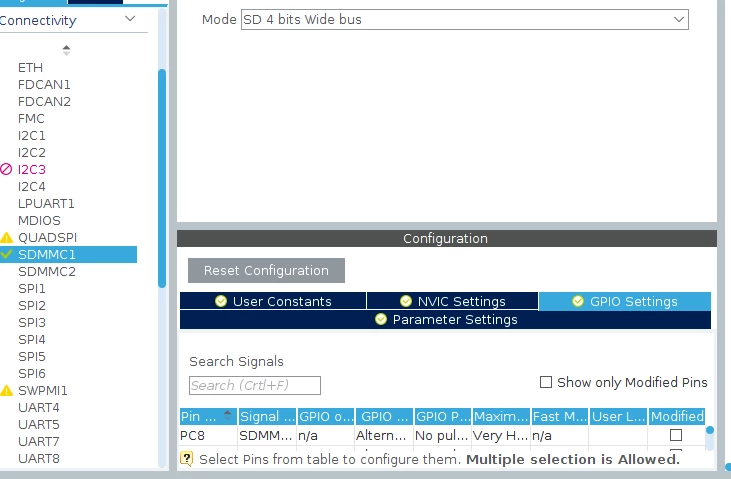
0690X00000AA4V8QAL.png

And here it is for SDMMC1on the STM32F7
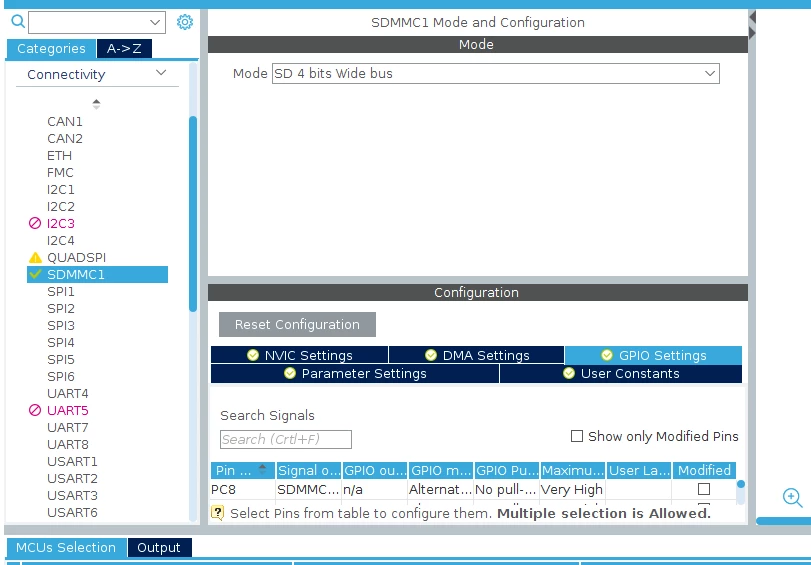
0690X00000AA4VIQA1.png

Notice that there is no DMA configuration option for the H7, but there is for the F7.

Does this mean that ST doesn't have DMA based drivers on the H7? With the polling drivers, my performance is extremely slow -- something like 0.2MB/sec.

Any idea how to get reasonably high write speeds on the SDMMC interface on the H7?

BTW, I'm using a custom board without the transceiver.

Thanks,

-Caleb

This topic has been closed for replies.
Best answer by Tesla DeLorean

You need to write some multiple of the sector/cluster size, writing random and short lengths via f_write will be brutal, I'm writing 32KB blocks. The erase size on the cards probably pushing 128KB. You need to employ better buffering.

There is likely other code in the library dropping the clock setting further.

Y-Step STM32H743, 50 MHz wire clock

Core=400000000, 400 MHz

CPUID 411FC271 DEVID 450 REVID 1003

Cortex M7 r1p1

STM32H7xx

C0000018 2000BCC8 00000000

10110221 12000011 00000040

FPU-D Single-precision and Double-precision

I'm not using CubeMX, custom board, ported my NUCLEO-H7 SDMMC BSP over

Decoder Wheel for clock sources, run after test

 {
 uint32_t ck = SDMMC1->CLKCR & 0x3FF;
 uint32_t sdmmcsel = RCC->D1CCIPR & (1 << 16);
 PLL1_ClocksTypeDef PLL1_Clocks;
 PLL2_ClocksTypeDef PLL2_Clocks;
 uint32_t sdmmc_ker_ck;
 HAL_RCCEx_GetPLL1ClockFreq(&PLL1_Clocks);
 HAL_RCCEx_GetPLL2ClockFreq(&PLL2_Clocks);
 printf("PLL1_Q_CK=%9d, %6.2lf MHz\n", PLL1_Clocks.PLL1_Q_Frequency, (double)PLL1_Clocks.PLL1_Q_Frequency*1e-6);
 printf("PLL2_R_CK=%9d, %6.2lf MHz\n", PLL2_Clocks.PLL2_R_Frequency, (double)PLL2_Clocks.PLL2_R_Frequency*1e-6);
 sdmmc_ker_ck = (sdmmcsel ? PLL2_Clocks.PLL2_R_Frequency : PLL1_Clocks.PLL1_Q_Frequency);
 printf("SDMMC1_CK %9d, %6.2lf MHz\n", ck, ((double)sdmmc_ker_ck * 1e-6) / (double)(2.0 * ck));
 } // sourcer32@gmail.com

6 replies

Tesla DeLorean
Guru
August 21, 2019

>> With the polling drivers, my performance is extremely slow -- something like 0.2MB/sec.

You're doing something very wrong then, as the polled can hit basically the same numbers as DMA, except the DMA has less bus/interrupt loading issues.

POLLED, 16GB SanDisk Ultra PLUS, no transceiver, no DDR

HCLK=200000000, 200.00 MHz

APB1=100000000, 100.00 MHz

APB2=100000000, 100.00 MHz

PLL1_Q_CK=200000000, 200.00 MHz

PLL2_R_CK= 48000000, 48.00 MHz

SDMMC1_CK     2, 50.00 MHz

CRC32 A534026F Memory Image

32768000 Bytes, 1715150723 Cycles

 7.64 MBps Write (FatFs)

4288 ms run time

 7.64 MBps (Sanity Check)

20008E00 20008E00 2048 COUNTER.001

................................

CRC32 A534026F PKZIP 5ACBFD90 COUNTER.001

COUNTER.001

32768000 Bytes, 677958670 Cycles

19.33 MBps Read (FatFs)

1695 ms run time

19.33 MBps (Sanity Check)

Tips, Buy me a coffee, or three.. PayPal Venmo (See Profile) Up vote any posts that you find helpful, it shows what's working..
caleb
calebAuthor
Associate III
August 22, 2019

Thanks Clive, good to know! I thought something must be very wrong.

Are you on an H7 or an F7, or something else.

My basic setup is this:

  • STM32H743 on a Nucleo 144 pin, jumpered over to a SD breakout board.
  • Using STM32CubeIDE to generate code
    • SYSCLK = 400
    • APB1 = 100
    • APB2 = 100
    • PLL_Q_CK = 50
    • SDMMC_CLK = 50 (running from PLL_Q)
    • actual clock speed at SD card is 12.5MHz
  • Configure SDMMC2 for 4 bits (no DMA because no DMA option seems to be available)
  • Generate code
  • Change USE_SD_TRANSCEIVER to 0 from 1 in stm32h7xx_hal_conf.h
  • Add the following bits to my main.c:
 FATFS fs;
 FIL file;
 check_err(f_mount(&fs, "", 1));
 check_err(f_open(&file, "headworn.txt", FA_WRITE|FA_CREATE_ALWAYS));
 const char msg[] =
		 "0123456789012345678901234567890123456789012345678901234567890123456789012345678901234567890123456789"
		 "0123456789012345678901234567890123456789012345678901234567890123456789012345678901234567890123456789"
		 "0123456789012345678901234567890123456789012345678901234567890123456789012345678901234567890123456789"
		 "0123456789012345678901234567890123456789012345678901234567890123456789012345678901234567890123456789"
		 "0123456789012345678901234567890123456789012345678901234567890123456789012345678901234567890123456789"
		 "01234567890\n";
 const unsigned bytes_to_write = strlen(msg);
 unsigned bytes_read;
 int i;
 int MEGABYTE = (1024*1024 / sizeof(msg));
 for (i = 0;i < MEGABYTE * 1; i++) {
	 check_err(f_write(&file, msg, bytes_to_write, &bytes_read));
 }
// HAL_GPIO_WritePin(RED_GPIO_Port, RED_Pin, 1);
 check_err(!(bytes_read == bytes_to_write));
 check_err(f_close(&file));
 check_err(f_mount(0, "", 0));

This all runs okay and actually writes to the SD card, but is mind-bogglingly slow at 0.2 MB/sec.

If I plug the same card into a USB SD reader and write files from my PC, it's runs at about 8MB/sec.

Any idea what I'm missing? Any chance you can share your code that gets performance numbers like this?

An interesting note is that it doesn't seem to matter what my SD clock speed is. I can slow it way down, and it still takes the same amount of time to run. This suggests to me that it's waiting somewhere on responses from the SD card itself.

Thanks again Clive for all your incredible help on this forum!

Cheers

-Caleb

Tesla DeLorean
Tesla DeLoreanBest answer
Guru
August 22, 2019

You need to write some multiple of the sector/cluster size, writing random and short lengths via f_write will be brutal, I'm writing 32KB blocks. The erase size on the cards probably pushing 128KB. You need to employ better buffering.

There is likely other code in the library dropping the clock setting further.

Y-Step STM32H743, 50 MHz wire clock

Core=400000000, 400 MHz

CPUID 411FC271 DEVID 450 REVID 1003

Cortex M7 r1p1

STM32H7xx

C0000018 2000BCC8 00000000

10110221 12000011 00000040

FPU-D Single-precision and Double-precision

I'm not using CubeMX, custom board, ported my NUCLEO-H7 SDMMC BSP over

Decoder Wheel for clock sources, run after test

 {
 uint32_t ck = SDMMC1->CLKCR & 0x3FF;
 uint32_t sdmmcsel = RCC->D1CCIPR & (1 << 16);
 PLL1_ClocksTypeDef PLL1_Clocks;
 PLL2_ClocksTypeDef PLL2_Clocks;
 uint32_t sdmmc_ker_ck;
 HAL_RCCEx_GetPLL1ClockFreq(&PLL1_Clocks);
 HAL_RCCEx_GetPLL2ClockFreq(&PLL2_Clocks);
 printf("PLL1_Q_CK=%9d, %6.2lf MHz\n", PLL1_Clocks.PLL1_Q_Frequency, (double)PLL1_Clocks.PLL1_Q_Frequency*1e-6);
 printf("PLL2_R_CK=%9d, %6.2lf MHz\n", PLL2_Clocks.PLL2_R_Frequency, (double)PLL2_Clocks.PLL2_R_Frequency*1e-6);
 sdmmc_ker_ck = (sdmmcsel ? PLL2_Clocks.PLL2_R_Frequency : PLL1_Clocks.PLL1_Q_Frequency);
 printf("SDMMC1_CK %9d, %6.2lf MHz\n", ck, ((double)sdmmc_ker_ck * 1e-6) / (double)(2.0 * ck));
 } // sourcer32@gmail.com

Tips, Buy me a coffee, or three.. PayPal Venmo (See Profile) Up vote any posts that you find helpful, it shows what's working..
Danish1
Lead III
August 22, 2019

My reading of the stm32h7 reference manual suggests that the SDMMC module has its own built-in DMA controller IDMA.

You can't use DMA1 or DMA2 so there's a lot less to configure.

(I think you can use the MDMA for SDMMC DMA).

Now how much of this is brought out to stm32Cube is down to ST. You might have to write your own code to use the SDMMC IDMA.

(My main use of STM32Cube is to explore how I might distribute my required peripherals amongst the ones present on a microcontroller, as there are a lot of shared pins and DMA channels/streams. I tend not to use its code-generation ability.)

Hope this helps,

Danish

oleksandr.karbivsky
Senior II
August 22, 2019

Hi. "The SDMMC host interface embeds a dedicated DMA controller allowing high-speed transfers between the interface and the SRAM." - from STM32H743 datasheet.

You can use HAL_SD_ReadBlocks_DMA and HAL_SD_WriteBlocks_DMA functions (they just start DMA transfer). And you must wait for transactions. Check HAL_SD_TxCpltCallback or HAL_SD_RxCpltCallback.

Mohammed Eshaq
Associate II
May 10, 2021

I have the exact same problem. After debugging I found out that: HAL_SD_TxCpltCallback() and HAL_SD_RxCpltCallback() never get called!

Any ideas?

Reza1
Associate
January 3, 2022

Hi,

I have faced same issues in 2022. I'm using STM32H743II and Generating its code with  STM32CubeMX version 6.3.0 and FatFs library.

When I touch the screen repetitively, "f_open" returns DISK_ERROR. I have seen this problem when have used STM32F7 and i have resolved it by confining micro SD with DMA. Now I want to run micro SD with DMA in STM32H743II but I can't reach the appropriate config in Cube. I have read about IDMA and MDMA but can't run them. I don't know how config IDMA or MDMA with SDMMC.

I hope someone helps me, please?

Thanks

Reza1
Associate
January 4, 2022

Hi,

I have faced with same issues in 2022. I'm using STM32H743II and generating its code with STM32CubeMX version 6.3.0 and FatFs library.

When I touch the screen repetitively, "f_open" returns DISK_ERROR. I have seen this problem when have used STM32F7 and I have resolved it by setting micro SD with DMA. Now I want to run micro SD with DMA in STM32H743II but I can't reach the appropriate config in Cube. I have read about IDMA and MDMA but can't run them. I don't know how config IDMA or MDMA with SDMMC.

Anybody can help me, please?

Thanks