cancel
Showing results for 
Search instead for 
Did you mean: 

STM32G030F6P6 TSSOP20 crystal oscillator?

MarkJordan
Associate II

As I understand, the TSSOP20 version needs an external oscillator instead of a 8MHz crystal connected directly to the MCU pins. Is that correct?

I'm asking because I have seen a board on AliExpress using this same processor with a 8MHz crystal.

1 ACCEPTED SOLUTION

Accepted Solutions
TDK
Super User

Correct, the TSSOP20 doesn't have an OSC_OUT which means it can't be hooked up to a crystal directly.
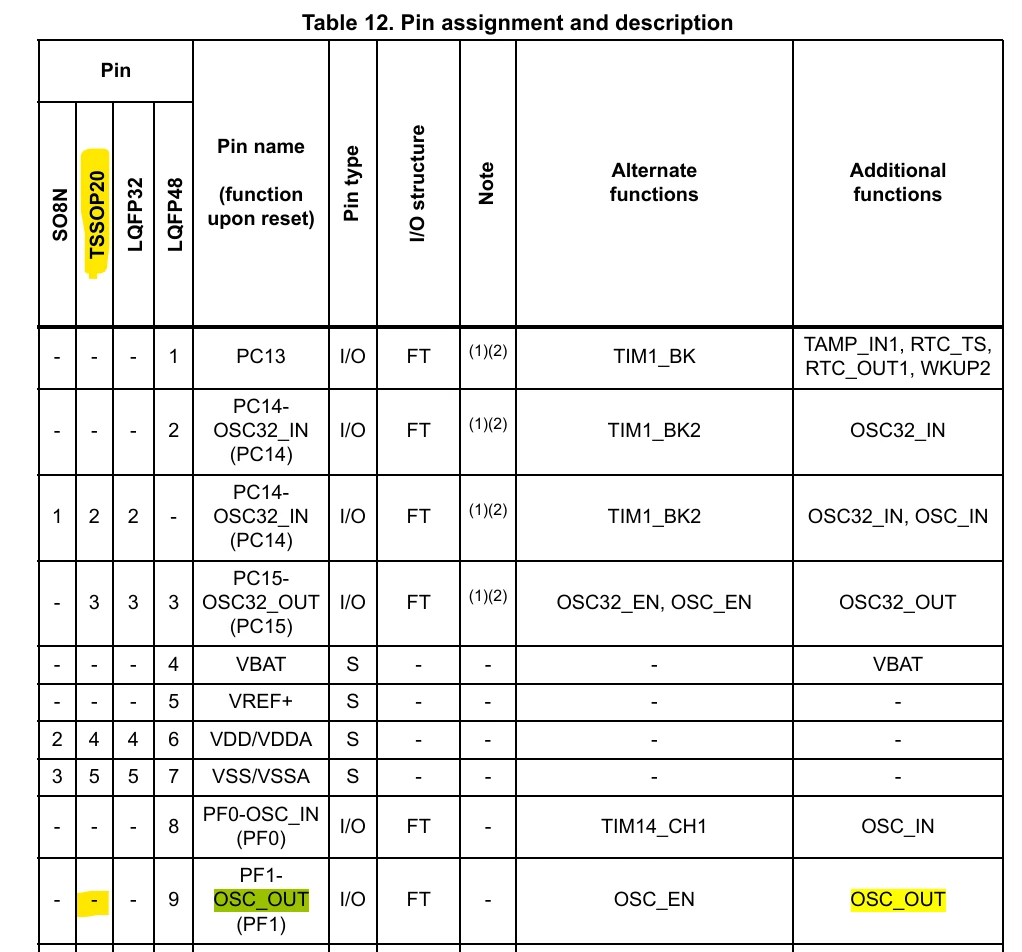
TDK_0-1722202518903.png


No clue what's going on with that board. Schematic doesn't seem available. Probably the crystal is not very useful on it.

If you feel a post has answered your question, please click "Accept as Solution".

View solution in original post

6 REPLIES 6
TDK
Super User

Correct, the TSSOP20 doesn't have an OSC_OUT which means it can't be hooked up to a crystal directly.

TDK_0-1722202518903.png


No clue what's going on with that board. Schematic doesn't seem available. Probably the crystal is not very useful on it.

If you feel a post has answered your question, please click "Accept as Solution".
BarryWhit
Lead II

Very curious. a schematic (could be typical AE misinfo) is available but shows no crystal

https://nl.aliexpress.com/item/1005005574646465.html


There's also a Baidu (Chinese Cloud drive) download link at the top of that page for a zip file of assets for that board, but it seems to be china only.


On at least one unrelated project, someone thought it was a good idea to connect a 16Mhz crystal to OSC32, I wonder if that's a clever hack or a *** mistake: hack.https://github.com/brunohoplite/stm32g030f6p6_evaluation_board/blob/master/PCB/Schematic_stm32g0f0_eval.pdf


Update: really?!? the word *** is censored? that's so ***ing ***. What a bunch of ***.

- If someone's post helped resolve your issue, please thank them by clicking "Accept as Solution".
- Please post an update with details once you've solved your issue. Your experience may help others.

Definitely a mistake ... Don't ask me how I know ^^ 

RomainR.
ST Employee

Hi,

The TSSOP20 versions of the STM32G0 only support an external HSE bypass oscillator on PC14 (OSC_IN), but they can also use a LSE crystal on PC14–PC15 as the SYSCLK source.

I would be curious to understand the purpose of this 8 MHz crystal on this STM32G030F6 board. I could not find any schematic for this board. Very strange !

If I were to use this kind of hardware, for a lower price and with slightly better PCB manufacturing quality, I would rather use this instead, especially since the schematics are available online:
https://github.com/WeActStudio/WeActStudio.STM32G0xxC0xxCoreBoard/tree/master

Otherwise, here our official reference hardware, which is fully documented and supported by our ecosystem.

https://www.st.com/en/evaluation-tools/nucleo-g031k8.html

Best regards,

Romain,


To give better visibility on the answered topics, please click on Accept as Solution on the reply which solved your issue or answered your question.

> The TSSOP20 versions of the STM32G0 only support an external HSE bypass oscillator on PC14 (OSC_IN)

As you might have understood I made the same mistake as presented in the above board...

Could you elaborate on external HSE bypass oscillator concept ?


Hello @oxomoxo 
Refer to RM0454 in section 5.2.1 HSE clock and HSE bypass section.
In this mode the clock is injected on single OSC_IN IO (here PC14 for SON8, TSSOP20 and LQFP32 packages), the clock can be a sinus wave or digital square.
The HSE crystal can be only used on LQFP48 with the external 48MHz crystal connected on PF0-OSC_IN and PF1-OSC_OUT. (see also DS12991 Table 12)
Best regards,

Romain,

To give better visibility on the answered topics, please click on Accept as Solution on the reply which solved your issue or answered your question.

