Nicolas Goy
Associate II
June 19, 2018
Solved

Design questions around ST25R3911B

  • June 19, 2018
  • 8 replies
  • 4403 views
Posted on June 19, 2018 at 19:10

I need to integrate an NFC reader for medical device pairing. I already designed a tag for the sensor which works with my phone.

The next step for me is to add an NFC reader to the portable monitor. The biggest antenna I can fit into the back of the monitor is about 15cmx10cm and as it is quite big, I picked the ST25R3911B to drive it because it has good power. I need a read range of about  20-30cm. Apparently, the best standard to achieve such range is ISO15693. My current tag uses ISO14443/B but I can easily swap the IC with something like the MLR24LR.

The sensor has a zigbee chip, and I only need the NFC to exchange the encryption key (about 128bytes with all metadata), so datarate is not important.

Some info:

- Tag is 45mmx35mm, using TI RF430CL330, but if ISO15693 is preferred, I can swap the IC and redesign the PCB.

- The max antenna I can fit inside my monitor (NFC reader) is 15cmx10cm.

- I need to pass 128bytes of data. (1kbit) Read only (only written by the sensor microcontroller using SPI)

- Read distance should be minimum 20cm, 30 or even 50cm preferred.

I have a few questions:

- Is ISO15693 the best choice for my application?

- I picked the ST25R3911B, is it good, or another chip?

- If MLR24LR the right choice for ISO15693 for the tag?

- I downloaded the antenna matching tool, I understand the antenna parameters inputs, but I wonder about the 'matching inputs', there are presets called 'VHBR, EVMCo and General purpose', but I am not sure I understand how those impacts the system.

- In AN4974 the antenna is attached to the ground at the middle, is this necessary for differential design (using both RFI0/1 and RFO0/1 connections, design of figure 3 in DS11793 page 14)?

#nfc

    This topic has been closed for replies.
    Best answer by Travis Palmer
    Posted on June 26, 2018 at 09:05

    Dear Nicolas,

    I think ISO15693 would be the right choice for your read range requirements.In order to read the ISO15693 tags you will need a powerful and sensitive reader - which means the ST25R3911B fits perfectly.

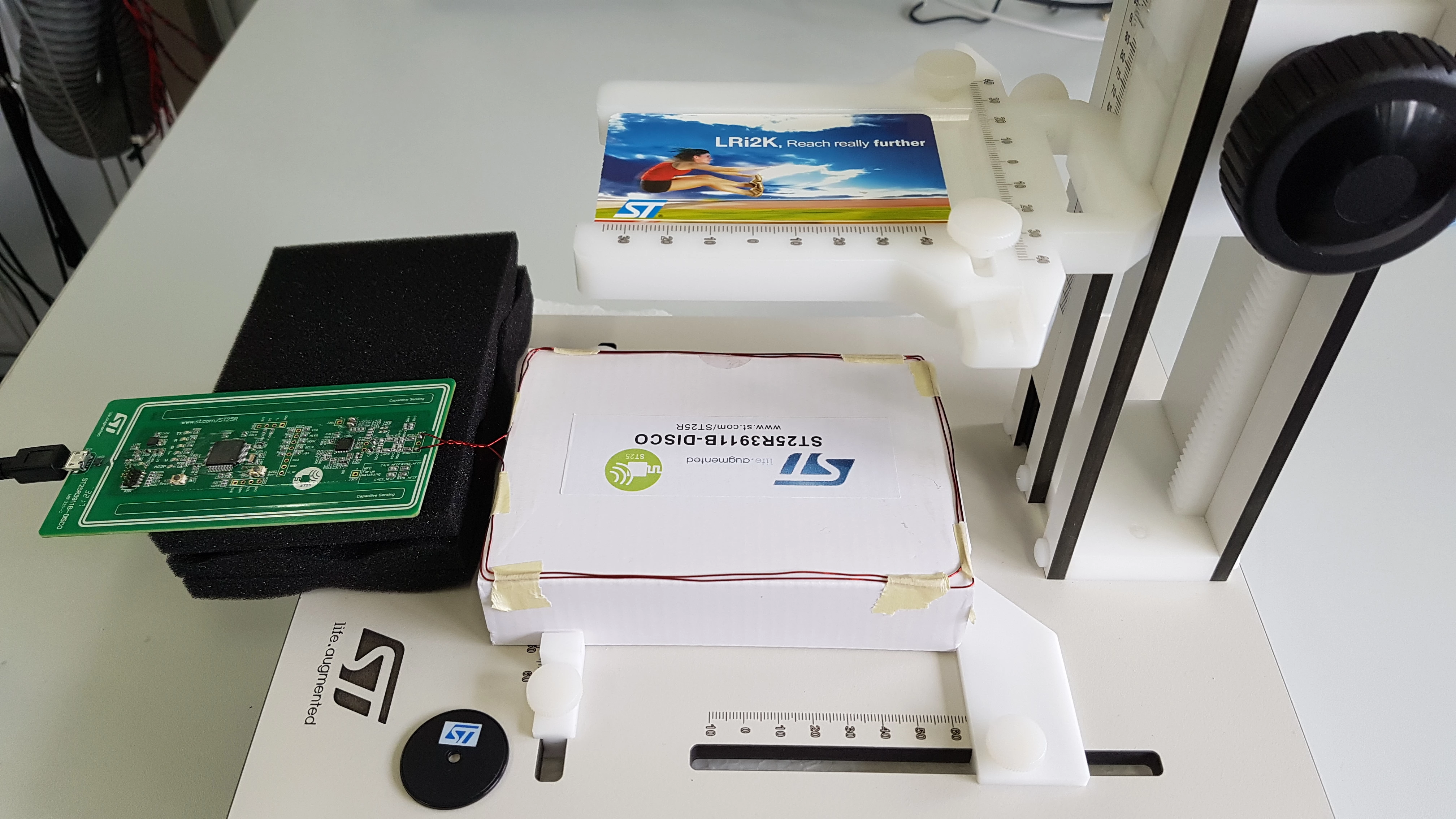
    I did a little proof of concept. I connected a 14x10cm 2 turn wire wound antenna to a ST25R3911B-DISCO board and measured the read range with several tags. The antenna inductance is around 1.7µH. The antenna has no middle GND connection.

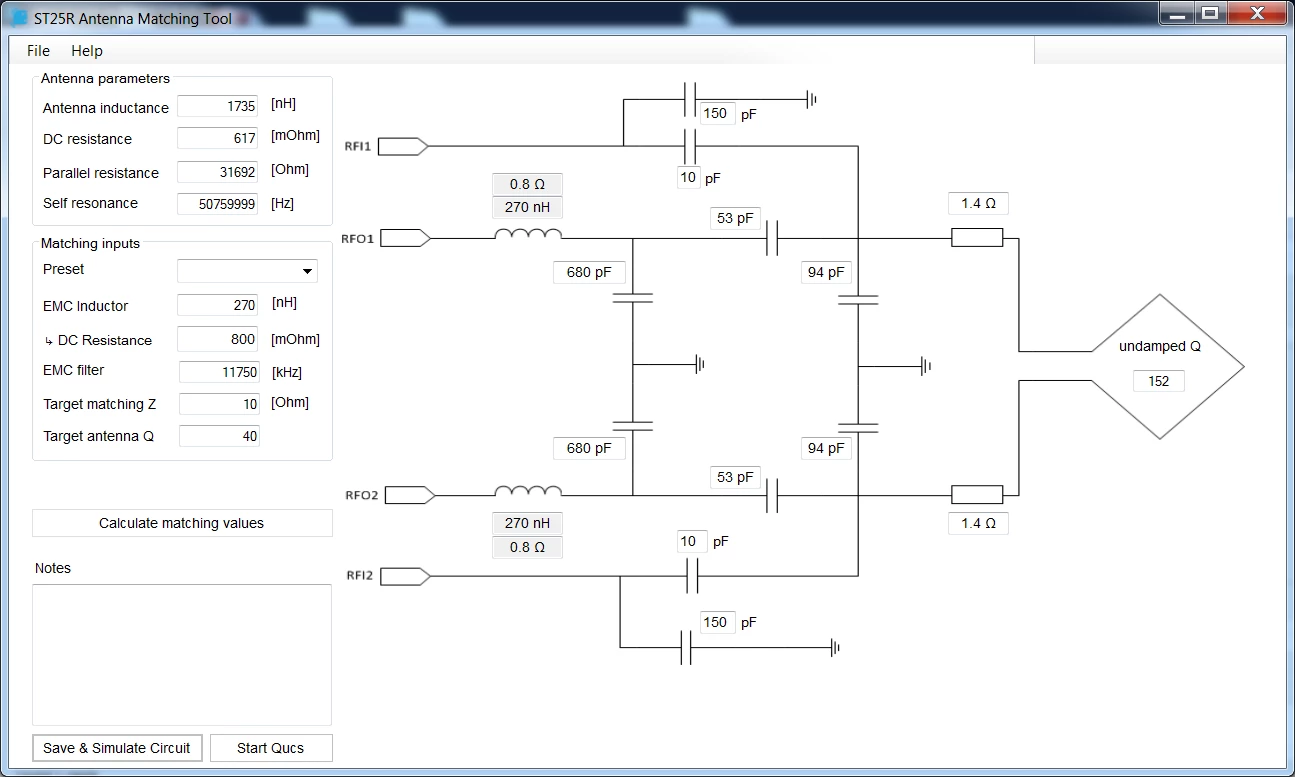
    Thisare the inputs i did in the ST25R Antenna Matching Tool:

    0690X0000060LBSQA2.png

    Besides the measured antenna parameters i have chosen my EMC filter settings and target matching impedance and target antenna Q.

    The presets define matching inputs for a special purpose. VHBR has data rates up to 6.5mbit and therefore requires very low Q-Factor. EMVCo only requires 106kbps therefore a Q-Factor around 25 is suite able. ISO15693 even has lower data rates. Therefore we can further increase the Q-Factor.

    The matching impedance defines the power transmitted towards the antenna.

    Since we want quite some output power i have chosen 10 Ohm matching impedance. Since ISO15693 is quite relaxed on rise and fall times i have chosen a target reader Q-Factor of

    This was then my reader setup:

    0690X0000060PHGQA2.jpg

    This are the followingresults i got:

    Tag type read range [cm]

    LRi2K (ID1 8.5 x 5.4 cm - picture) 24

    ST black coin (3cm diameter - picture) 21

    ST25DV_Discovery_ANT_C5 (4.0x2.2 cm) 20

    I did some tweaking on the receiver settings (AM only, 1st level gain set to boost). also due to the high output power it was necessary to bypass the internal Vsp_RF regulator (connect pin 9 to VDD). V_RFI was adjusted to 2.7Vpp. For the EMC filter i have chosen low DCR, high Q coils.

    Also you have to be aware that you will need a verygood PCB design and good decoupling to other noise sources (like DC/DC, ...)

    With further improvements (adjusting the Q-Factor and matching impedance) you should be able to reach at least 25cm read range with the ST25DV ANT C5. Placing a pick up coil close to the tag will tell you if your reader is sensitivity or power limited and tell you in which direction you have to optimize.

    BR Travis

    8 replies

    Travis Palmer
    Travis PalmerBest answer
    ST Employee
    June 26, 2018
    Posted on June 26, 2018 at 09:05

    Dear Nicolas,

    I think ISO15693 would be the right choice for your read range requirements.In order to read the ISO15693 tags you will need a powerful and sensitive reader - which means the ST25R3911B fits perfectly.

    I did a little proof of concept. I connected a 14x10cm 2 turn wire wound antenna to a ST25R3911B-DISCO board and measured the read range with several tags. The antenna inductance is around 1.7µH. The antenna has no middle GND connection.

    Thisare the inputs i did in the ST25R Antenna Matching Tool:

    0690X0000060LBSQA2.png

    Besides the measured antenna parameters i have chosen my EMC filter settings and target matching impedance and target antenna Q.

    The presets define matching inputs for a special purpose. VHBR has data rates up to 6.5mbit and therefore requires very low Q-Factor. EMVCo only requires 106kbps therefore a Q-Factor around 25 is suite able. ISO15693 even has lower data rates. Therefore we can further increase the Q-Factor.

    The matching impedance defines the power transmitted towards the antenna.

    Since we want quite some output power i have chosen 10 Ohm matching impedance. Since ISO15693 is quite relaxed on rise and fall times i have chosen a target reader Q-Factor of

    This was then my reader setup:

    0690X0000060PHGQA2.jpg

    This are the followingresults i got:

    Tag type read range [cm]

    LRi2K (ID1 8.5 x 5.4 cm - picture) 24

    ST black coin (3cm diameter - picture) 21

    ST25DV_Discovery_ANT_C5 (4.0x2.2 cm) 20

    I did some tweaking on the receiver settings (AM only, 1st level gain set to boost). also due to the high output power it was necessary to bypass the internal Vsp_RF regulator (connect pin 9 to VDD). V_RFI was adjusted to 2.7Vpp. For the EMC filter i have chosen low DCR, high Q coils.

    Also you have to be aware that you will need a verygood PCB design and good decoupling to other noise sources (like DC/DC, ...)

    With further improvements (adjusting the Q-Factor and matching impedance) you should be able to reach at least 25cm read range with the ST25DV ANT C5. Placing a pick up coil close to the tag will tell you if your reader is sensitivity or power limited and tell you in which direction you have to optimize.

    BR Travis

    Nicolas Goy
    Associate II
    June 26, 2018
    Posted on June 26, 2018 at 13:44

    Woaw, this was an insanely helpful answer, I did not expect someone to create a test setup. Thanks a lot.

    I have two questions in addition, first, I didn't quite understood what you meant by 'V_RFI was adjusted to 2.7Vpp' adjusting the peek to peek RF voltage is done in hardware or software? Second, for PCB design, is there anything else you recommend beside what is in AN5043 (page 15) for power filtering, especially with VSP_RF bypassed?

    Thanks

    Travis Palmer
    ST Employee
    June 26, 2018
    Posted on June 26, 2018 at 15:31

    Dear Nicolas,

    The V_RFI is the antenna voltage applied to receiver. This voltage is divided down by C401:C402 and C411:C412 (UM2042, page 13). The V_RFI should not exceed 3Vpp. Due to component and PCB tolerances 2.7Vpp is recommended. Depending on the Q-Factor the antenna voltage is typically between 20Vpp and 70Vpp - higher Q gives a higher antenna voltage.

    Besides the AN5043 there is no further guideline for PCB layout. Filter component manufacturer have special web tools (for example SimSurfing) which can help you to design special power supply filter. You can foresee T and PI filter footprints in the VDD supply of your PCB layout. I would still foresee a 0R jumper (like the J303) between VDD and VSP_RF.

    BR Travis

    Travis Palmer
    ST Employee
    July 31, 2018

    Dear Nicolas,

    Your calculation seems feasible. i would try using 10/330pF and then adjust the capacitive voltage divider based on the measured V_rfi voltage.

    In order you want to enable AAT you have to replace the trim capacitor by a capacitive voltage divider similar to the RFI capacitive voltage divider. The capacitance of these voltage dividers should have the values 56pF. 27pF, 12pF and 5.6pF - similar to the current trim capacitance values. If necessary you can increase or decrease the trim range afterwards.

    The target voltage should be <= 20V.

    BR Travis

    SGeor.15
    Visitor II
    February 15, 2019

    Dear Travis,

    We are also trying to achieve up to 25 cm reading distance by using the ISO15693 standard.

    I would like to replicate your setup, for demonstration purpose. Unfortunately, we do not have an VNA that goes that low in frequency. In that case can you reveal what type of wire you used as reader antenna, thickness and length? Do you have these values available to share?

    Best regards,

    Sindre Georgsen

    Development engineer

    Informasjonskontroll AS

    Norway

    Travis Palmer
    ST Employee
    February 15, 2019

    Dear Sindre,

    I used an "Insulated copper wire" with 0.5mm diameter.

    I can recommend you a device called “miniVNA pro�?. It can be used for matching the antenna to a real ohmic impedance for a quite reasonable price.

    BR Travis

    rg12
    Visitor II
    May 2, 2019

    Hi Travis,

    Apologies for resurrecting an old post and I recognize you may no longer have the details, however I was looking for some help regarding increasing the read range of the ST25R3911B-Disco. However I am unsure of the procedure you followed: which further changes were necessary from changing the antenna and soldering the jumper on J303?

    Travis Palmer
    ST Employee
    May 10, 2019

    ​Dear rg12,

    All nessesary changes have been described in my first response.

    The design flow would be the following:

    1.) Do a antenna 14x10 cm (wire wound)

    2,) Measure the antenna parameters as descirbed in the "AN4974 Antenna matching for ST25R3911B/ST25R391x devices"

    3.) Adapt the matching inputs in the ST25R Antenna matching tool according to your application

    4.) Simulate and verify the calculated matching component values.

    5.) Adjust the capacitive voltage divider. V_RFI should not exceed 3.0Volt

    6.) if nessesary (Powerconsumption in constant wave > 200mA) bypass the internal regulator = shortcut J303

    Please let me know if this answers your questions.

    BR Travis

    rg12
    Visitor II
    May 10, 2019

    Hi Travis,

    Thank you very much for describing your process flow. I was unsure if hardware changes were required on the Disco-Board, and I see now that it is.

    Regarding V_RFI, is this adjusted by first measuring the output voltage of V_RFO and then adjusting the capacitive voltage divider accordingly or is the value of V_ RFO determined during simulation.

    Cheers

    Rg12

    Travis Palmer
    ST Employee
    May 13, 2019

    ​Hello Rg12,

    Both approaches are valid.

    I would recommend to adjust the RFI value in simulaton between 2.5 and 2.9V and after assembly crosscheck and finetune it. Be aware, the ST25R Antenna matching tool does not calculate the capacitive voltage divider. It chooses a default value of 10:150pF. In simulation you can then alter this value according to your need.

    br Travis