

Question
Why STM32 I2C slave is returning unwanted NACK or indefinitely clock stretching?
I am trying to write an STM32 as an I2C slave:
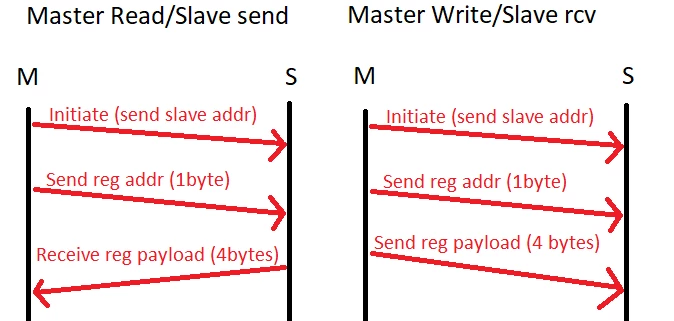 I wrote a code for it but when I run it, however, I get some weird stuff
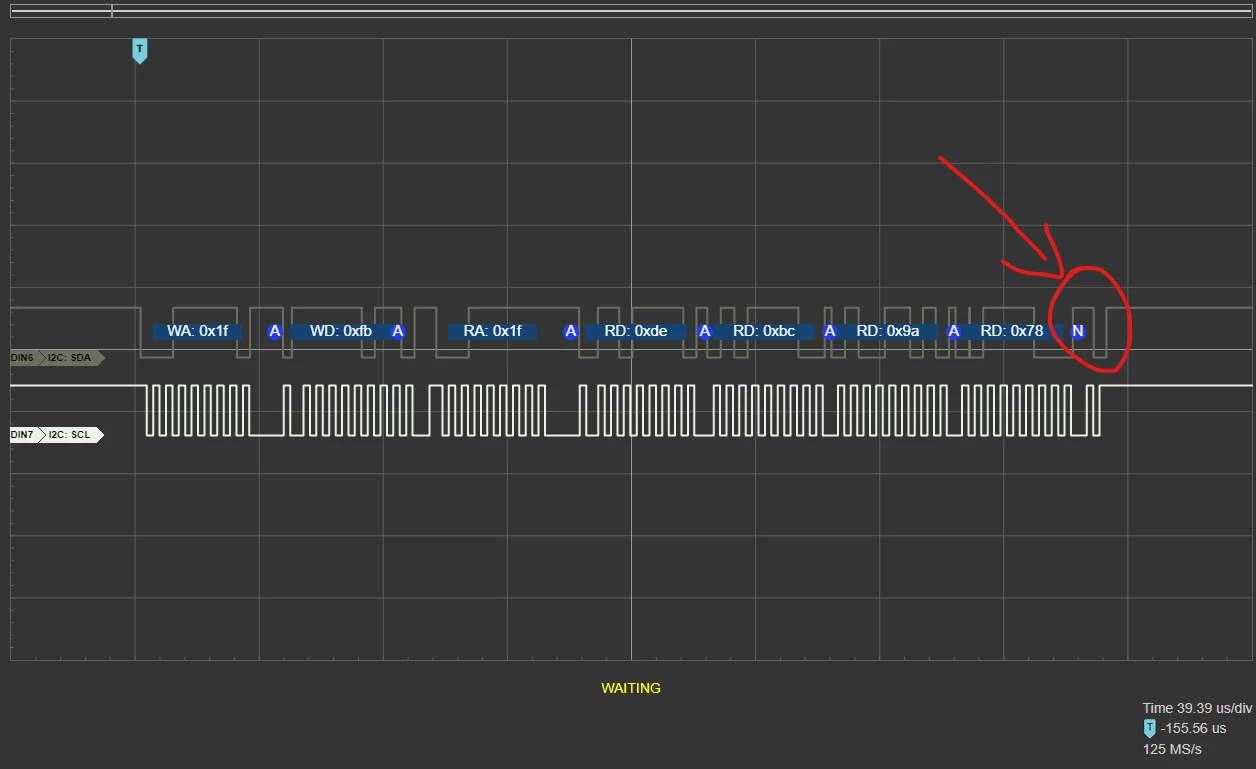
Here is the response when the master requests a buffer: You can see the NACK at the end right after the slave finishes sending the last byte
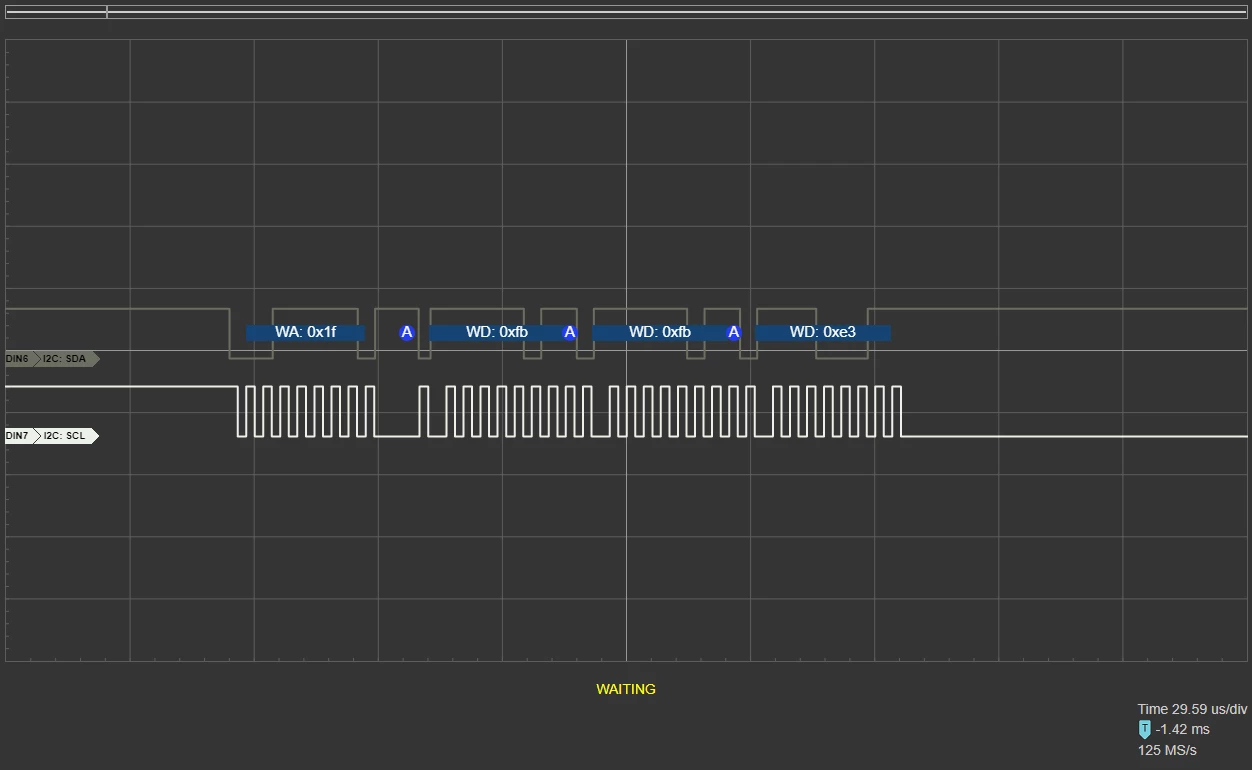
 for a master Write/Slave RCV operation: it goes wrong after writing the 2nd byte of the buffer. Why Am I having this? I'd scratched my head for months on this at this point
Here is the I2C code section of the STM32 slave:
/* USER CODE BEGIN Header */
/**
 ******************************************************************************
 * @file i2c.c
 * @brief This file provides code for the configuration
 * of the I2C instances.
 ******************************************************************************
 * @attention
 *
 * Copyright (c) 2022 STMicroelectronics.
 * All rights reserved.
 *
 * This software is licensed under terms that can be found in the LICENSE file
 * in the root directory of this software component.
 * If no LICENSE file comes with this software, it is provided AS-IS.
 *
 ******************************************************************************
 */
/* USER CODE END Header */
/* Includes ------------------------------------------------------------------*/
#include "i2c.h"

/* USER CODE BEGIN 0 */

/* USER CODE END 0 */

I2C_HandleTypeDef hi2c1;

/* I2C1 init function */
void MX_I2C1_Init(void)
{

 /* USER CODE BEGIN I2C1_Init 0 */
 // Get I2C address code from hardware jumpers
 // Address starts at I2C_ADDRESS_BASE and is offset by value read on jumpers array
 uint8_t I2C_Address = 0x0;
 I2C_Address = (I2C_ADDRESS_BASE + (
 (HAL_GPIO_ReadPin(AD0_GPIO_Port, AD0_Pin) << 0)|
 (HAL_GPIO_ReadPin(AD1_GPIO_Port, AD1_Pin) << 1)|
 (HAL_GPIO_ReadPin(AD2_GPIO_Port, AD2_Pin) << 2)|
 (HAL_GPIO_ReadPin(AD3_GPIO_Port, AD3_Pin) << 3)
 )) << 1;
 /* USER CODE END I2C1_Init 0 */

 /* USER CODE BEGIN I2C1_Init 1 */

 /* USER CODE END I2C1_Init 1 */
 hi2c1.Instance = I2C1;
 hi2c1.Init.Timing = 0x0000020B;
 hi2c1.Init.OwnAddress1 = I2C_Address;
 hi2c1.Init.AddressingMode = I2C_ADDRESSINGMODE_7BIT;
 hi2c1.Init.DualAddressMode = I2C_DUALADDRESS_ENABLE;
 hi2c1.Init.OwnAddress2 = (I2C_ADDRESS_BASE + 16) << 1;
 hi2c1.Init.OwnAddress2Masks = I2C_OA2_NOMASK;
 hi2c1.Init.GeneralCallMode = I2C_GENERALCALL_DISABLE;
 hi2c1.Init.NoStretchMode = I2C_NOSTRETCH_DISABLE;
 if (HAL_I2C_Init(&hi2c1) != HAL_OK)
 {
 Error_Handler();
 }

 /** Configure Analogue filter
 */
 if (HAL_I2CEx_ConfigAnalogFilter(&hi2c1, I2C_ANALOGFILTER_ENABLE) != HAL_OK)
 {
 Error_Handler();
 }

 /** Configure Digital filter
 */
 if (HAL_I2CEx_ConfigDigitalFilter(&hi2c1, 0) != HAL_OK)
 {
 Error_Handler();
 }
 /* USER CODE BEGIN I2C1_Init 2 */

 /* USER CODE END I2C1_Init 2 */

}

void HAL_I2C_MspInit(I2C_HandleTypeDef* i2cHandle)
{

 GPIO_InitTypeDef GPIO_InitStruct = {0};
 if(i2cHandle->Instance==I2C1)
 {
 /* USER CODE BEGIN I2C1_MspInit 0 */

 /* USER CODE END I2C1_MspInit 0 */

 __HAL_RCC_GPIOB_CLK_ENABLE();
 /**I2C1 GPIO Configuration
 PB6 ------> I2C1_SCL
 PB7 ------> I2C1_SDA
 */
 GPIO_InitStruct.Pin = GPIO_PIN_6|GPIO_PIN_7;
 GPIO_InitStruct.Mode = GPIO_MODE_AF_OD;
 GPIO_InitStruct.Pull = GPIO_NOPULL;
 GPIO_InitStruct.Speed = GPIO_SPEED_FREQ_HIGH;
 GPIO_InitStruct.Alternate = GPIO_AF4_I2C1;
 HAL_GPIO_Init(GPIOB, &GPIO_InitStruct);

 /* I2C1 clock enable */
 __HAL_RCC_I2C1_CLK_ENABLE();

 /* I2C1 interrupt Init */
 HAL_NVIC_SetPriority(I2C1_EV_IRQn, 5, 0);
 HAL_NVIC_EnableIRQ(I2C1_EV_IRQn);
 HAL_NVIC_SetPriority(I2C1_ER_IRQn, 5, 0);
 HAL_NVIC_EnableIRQ(I2C1_ER_IRQn);
 /* USER CODE BEGIN I2C1_MspInit 1 */

 /* USER CODE END I2C1_MspInit 1 */
 }
}

void HAL_I2C_MspDeInit(I2C_HandleTypeDef* i2cHandle)
{

 if(i2cHandle->Instance==I2C1)
 {
 /* USER CODE BEGIN I2C1_MspDeInit 0 */

 /* USER CODE END I2C1_MspDeInit 0 */
 /* Peripheral clock disable */
 __HAL_RCC_I2C1_CLK_DISABLE();

 /**I2C1 GPIO Configuration
 PB6 ------> I2C1_SCL
 PB7 ------> I2C1_SDA
 */
 HAL_GPIO_DeInit(GPIOB, GPIO_PIN_6);

 HAL_GPIO_DeInit(GPIOB, GPIO_PIN_7);

 /* I2C1 interrupt Deinit */
 HAL_NVIC_DisableIRQ(I2C1_EV_IRQn);
 HAL_NVIC_DisableIRQ(I2C1_ER_IRQn);
 /* USER CODE BEGIN I2C1_MspDeInit 1 */

 /* USER CODE END I2C1_MspDeInit 1 */
 }
}

/* USER CODE BEGIN 1 */

#define I2C_BUFFER_SIZE 8
uint8_t i2c_buffer[I2C_BUFFER_SIZE];
uint8_t reg_addr_rcvd = 0;
#define I2C_REG_ADD_SIZE 1
#define I2C_PAYLOAD_SIZE 4

extern void HAL_I2C_AddrCallback(I2C_HandleTypeDef *hi2c, uint8_t TransferDirection, uint16_t AddrMatchCode){
 UNUSED(AddrMatchCode);
 // If is master write, listen to necessary amount of bytes
 if(TransferDirection == I2C_DIRECTION_TRANSMIT){
 // First write request is always 1 byte of the requested reg address
 // Will saved it on the first position of I2C_buffer
 if(!reg_addr_rcvd){
 HAL_I2C_Slave_Sequential_Receive_IT(hi2c, (void*)i2c_buffer, I2C_REG_ADD_SIZE, I2C_FIRST_FRAME);

 } else {
 // If a subsequent write request is sent, will receve 4 bytes from master
 // Save it on the rest of the buffer
 HAL_I2C_Slave_Sequential_Receive_IT(hi2c, (void*)i2c_buffer, I2C_PAYLOAD_SIZE, I2C_NEXT_FRAME);
 }
 }
 else {
 // If a read request is sent by the master, return the value of the data in the requested register that was saved on 1st
 // position of the I2C buffer
 HAL_I2C_Slave_Sequential_Transmit_IT(hi2c, data_register[i2c_buffer[0]].mem_addr, data_register[i2c_buffer[0]].len, I2C_LAST_FRAME);
 }
 // Read address + data size. If it is a read command, data size will be zero
}


extern void HAL_I2C_SlaveRxCpltCallback(I2C_HandleTypeDef *hi2c){
 // This is called after a master 'write' request. first time around it will be a register.
 // Second time if its a write to register request, it will be a payload
 if(!reg_addr_rcvd){
 // If reg_addr_rcvd is false, means that it received a register
 reg_addr_rcvd = 1;
 } else {
 // If reg_addr_rcvd is set, means that this callback was returned after the payload data has been received
 reg_addr_rcvd = 0;
 }
 HAL_I2C_EnableListen_IT(hi2c);
 HAL_GPIO_TogglePin(LED_G_GPIO_Port, LED_G_Pin);
}

extern void HAL_I2C_ListenCpltCallback (I2C_HandleTypeDef *hi2c){
 HAL_I2C_EnableListen_IT(hi2c);
 HAL_GPIO_TogglePin(LED_B_GPIO_Port, LED_B_Pin);
}

extern void HAL_I2C_SlaveTxCpltCallback(I2C_HandleTypeDef *hi2c){
 // Reset reg_addr_rcvd after finish sending requested register
 reg_addr_rcvd = 0;
 HAL_I2C_EnableListen_IT(hi2c);
}


extern void HAL_I2C_ErrorCallback(I2C_HandleTypeDef *hi2c)
{
 HAL_GPIO_TogglePin(LED_R_GPIO_Port, LED_R_Pin);
 //HAL_I2C_ERROR_NONE 0x00000000U /*!< No error */
 //HAL_I2C_ERROR_BERR 0x00000001U /*!< BERR error */
 //HAL_I2C_ERROR_ARLO 0x00000002U /*!< ARLO error */
 //HAL_I2C_ERROR_AF 0x00000004U /*!< Ack Failure error */
 //HAL_I2C_ERROR_OVR 0x00000008U /*!< OVR error */
 //HAL_I2C_ERROR_DMA 0x00000010U /*!< DMA transfer error */
 //HAL_I2C_ERROR_TIMEOUT 0x00000020U /*!< Timeout Error */
 uint32_t error_code = HAL_I2C_GetError(hi2c);
 if (error_code != HAL_I2C_ERROR_AF){}
 HAL_I2C_EnableListen_IT(hi2c);
}
/* USER CODE END 1 */
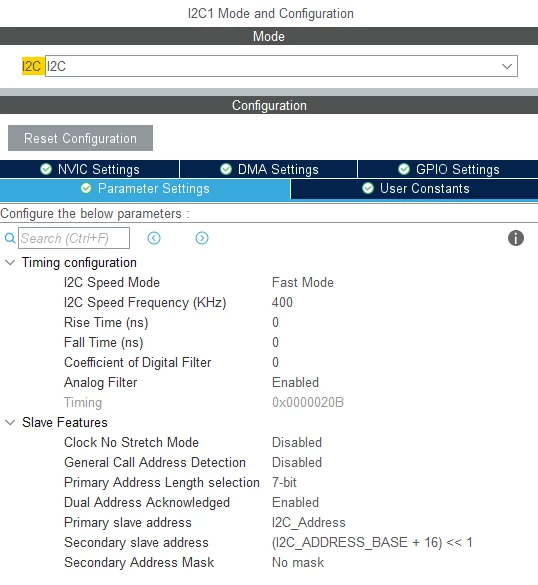
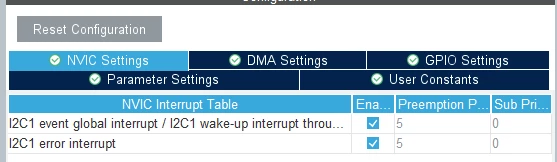
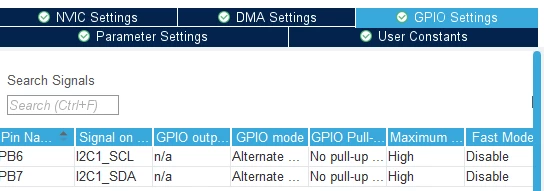
And here is cubeMX config for the I2C slave
 Appreciate any insight you guys could have. Thank you!
