


SDCard SDIO 4Bit with DMA using FatFs Q1: How to check if DMA is working? Q1: How to check if 4Bit Mode is set correctly?
Hi Community,
I use a STM32F405 to access a uSDCard.
Software: CubeMX V5.3 and SW4STM32 (Eclipse Neon.3 Release (4.6.3))
The good news, I can communicate with the SDCard (create files, write content and delete files. So far so good, but now the questions:
Q1: How to check if DMA is working?
Where can I see/check that I actually use the DMA which is added in CubeMX in the SDIO section?
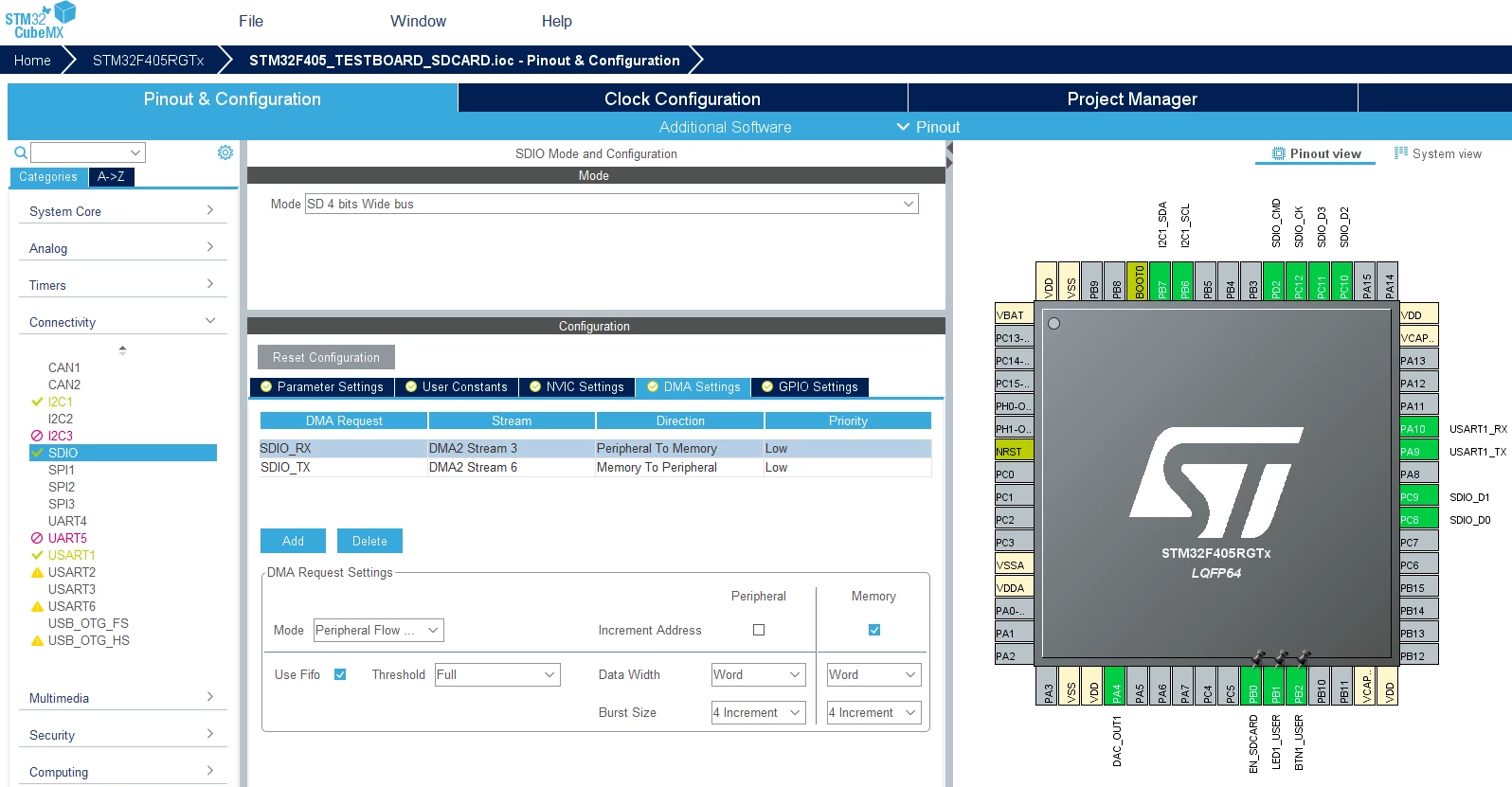
Because if I remove the two DMA lines for RX and TX and press the "GENERATE CODE" button again, after re-compiling my unchanged user-code is still working perfectly. I thought there should be a problem now...
Of course I checked the www for information and I found a tutorial on youtube (https://www.youtube.com/watch?v=0NbBem8U80Y) where the guy changes the content of the library functions BSP_SD_ReadBlocks_DMA() and BSP_SD_WriteBlocks_DMA() from bsp_driver_sd.c and he changes the content of SD_read() and SD_write() from sd_diskio.c to use the DMA.
Are these steps still necessary? (I haven`t changed my code so far!)
Regarding this steps I thought that the BSP_SD_ReadBlocks_DMA() and BSP_SD_WriteBlocks_DMA functions should be used somewhere in the f_write() or f_read() functions (out of the Middleware ff.c) that I use in my user-code too.
When I get through all the library-code of e.g. f_write() I couldn`t find one "DMA" function. That is why I`m wondering if I use the DMA after the code-changes at all.
Hopefully someone could explain the connection of f_write with "DMA" functions or ff.c with sd_diskio.c to me. I don`t get it unfortunately...
Q2: How to check if 4Bit Mode is set correctly?
After generating the library functions with CubeMX I found the first hint in the MX_SDIO_SD_Init() function:
hsd.Init.BusWide = SDIO_BUS_WIDE_1B;
I think this sets the bus to 1B for the very first initialize/communication?
After calling the BSP_SD_Init() to initialize my SDCard I see in the library-code that a wide operation is enabled.
/* Enable wide operation */
if (HAL_SD_ConfigWideBusOperation(&hsd, SDIO_BUS_WIDE_4B) != HAL_OK)
{
sd_state = MSD_ERROR;
}
Is this the final step to set the 4Bit SDIO data transfer or do I need something else?
I hope I could describe my issues in a proper way.
I`m looking for your answers.
All the best
Alexander