Question
[SOLVED] Very simple method to use the QSPI N25Q128A to store the application bitmaps
At this time I am developing a graphic touch screen application on STN32F746-DISCO.
This is a very simple method to store the bitmaps on QSPI N25Q128A in order to save flash space.
I have used the lcd-image-converter.exe to convert the bitmap files to a bitmap structure to pass to BSP_LCD_DrawBitmap().
Here the settings used for cd-image-converter.exe.
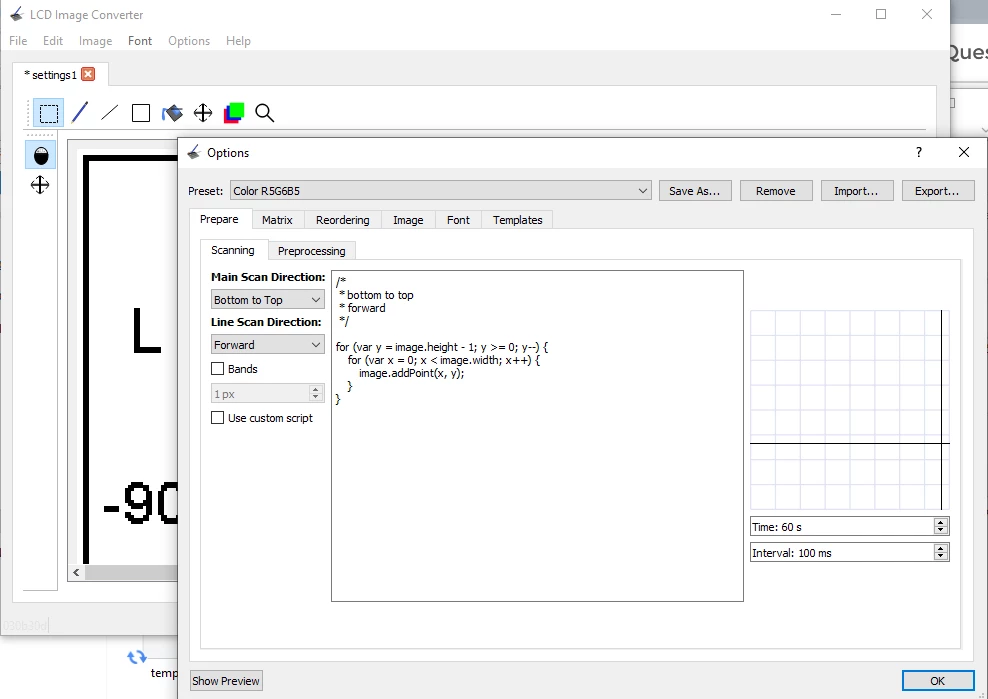
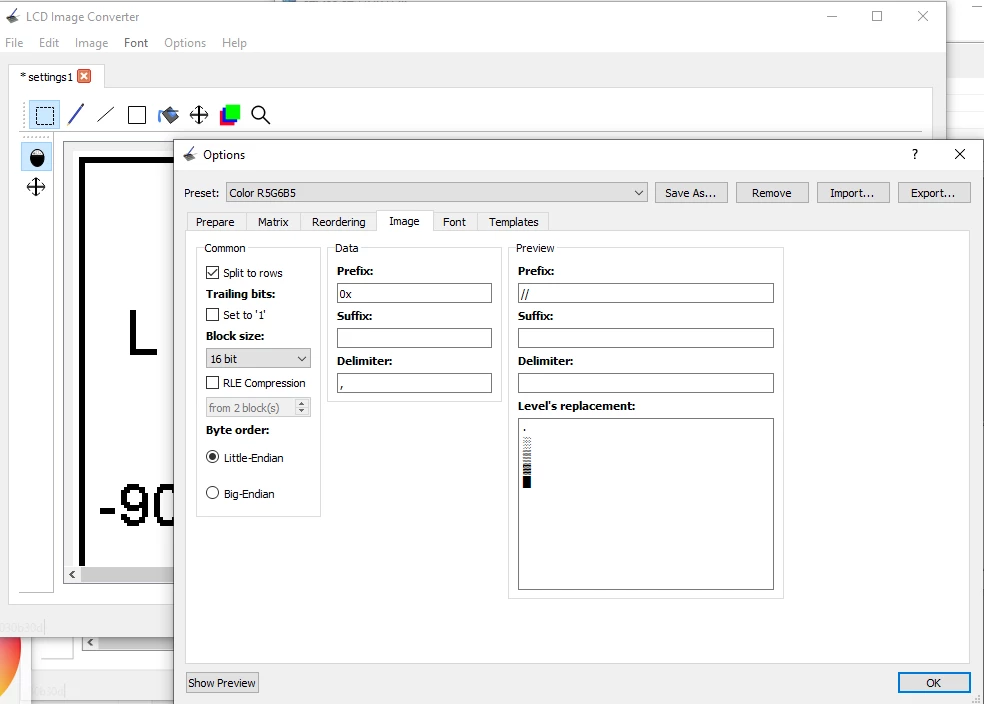
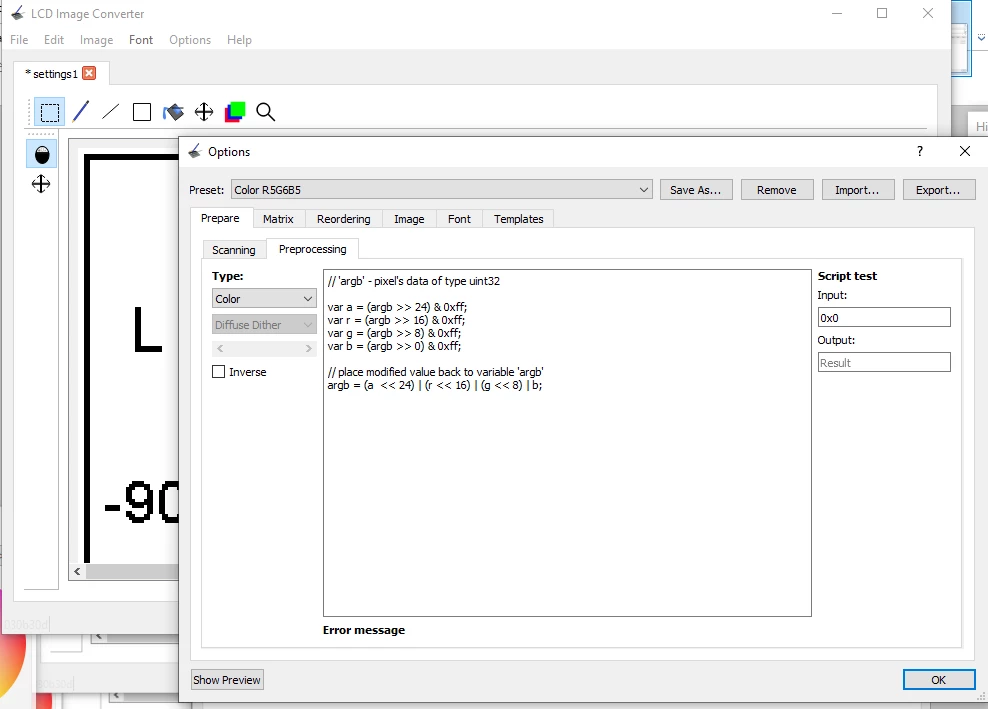
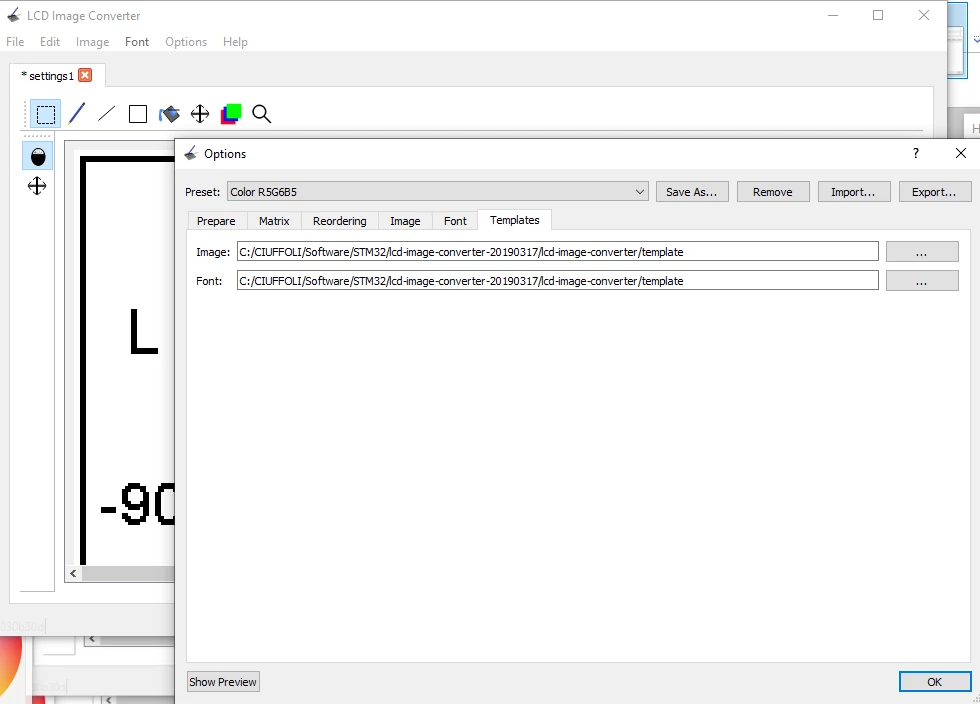
Here the logo.h file generated
#ifndef logo_H_
#define logo_H_

#include <stdint.h>

// struct packing, pragma for GCC !!!
#pragma pack(push, 1)

typedef struct logo_tagBITMAPFILEHEADER {
 uint16_t bfType;
 uint32_t bfSize;
 uint16_t bfReserved1;
 uint16_t bfReserved2;
 uint32_t bfOffBits;
} logo_BITMAPFILEHEADER; // size is 14 bytes

typedef struct logo_tagBITMAPINFOHEADER {
 uint32_t biSize;
 uint32_t biWidth;
 uint32_t biHeight;
 uint16_t biPlanes;
 uint16_t biBitCount;
 uint32_t biCompression;
 uint32_t biSizeImage;
 uint32_t biXPelsPerMeter;
 uint32_t biYPelsPerMeter;
 uint32_t biClrUsed;
 uint32_t biClrImportant;
} logo_BITMAPINFOHEADER; // size is 40 bytes

typedef struct logo_tag_Struct {
 // offset 0, size 14
 logo_BITMAPFILEHEADER fileHeader;
 // offset 14, size 40
 logo_BITMAPINFOHEADER infoHeader;
 // offset 54, size 51600 words
 uint16_t data[51600];
} logo_Struct;

const logo_Struct logo = {
 {
 0x4d42u,
 sizeof(logo_BITMAPINFOHEADER) + sizeof(logo_BITMAPFILEHEADER) + (51600 * 2),
 0x0000u,
 0x0000u,
 sizeof(logo_BITMAPINFOHEADER) + sizeof(logo_BITMAPFILEHEADER)
 },
 {
 sizeof(logo_BITMAPINFOHEADER),
 400,
 129,
 1u,
 16,
 0x00000003u,
 (51600 * 2),
 0x00000000ul,
 0x00000000ul,
 0x00000000ul,
 0x00000000ul
 },
 {
 0xffff, 0xffff, 0xffff, 0xffff, 0xffff, .....
}
};


// struct packing, pragma for GCC !!!
#pragma pack (pop)

#endif /* settings1_H_ */
Here the logo.h file modified by hand to use the QSPI
#include <stdint.h>

// struct packing, pragma for GCC !!!
#pragma pack(push, 1)

typedef struct logo_tagBITMAPFILEHEADER {
 uint16_t bfType;
 uint32_t bfSize;
 uint16_t bfReserved1;
 uint16_t bfReserved2;
 uint32_t bfOffBits;
} logo_BITMAPFILEHEADER; // size is 14 bytes

typedef struct logo_tagBITMAPINFOHEADER {
 uint32_t biSize;
 uint32_t biWidth;
 uint32_t biHeight;
 uint16_t biPlanes;
 uint16_t biBitCount;
 uint32_t biCompression;
 uint32_t biSizeImage;
 uint32_t biXPelsPerMeter;
 uint32_t biYPelsPerMeter;
 uint32_t biClrUsed;
 uint32_t biClrImportant;
} logo_BITMAPINFOHEADER; // size is 40 bytes

typedef struct logo_tag_Struct {
 // offset 0, size 14
 logo_BITMAPFILEHEADER fileHeader;
 // offset 14, size 40
 logo_BITMAPINFOHEADER infoHeader;
 // offset 54, size 51600 words
 uint16_t data[51600];
} logo_Struct;


#ifndef IMG_NO_DATA
#if defined ( __ICCARM__ )
#pragma location = ".textqspi"
#else
__attribute__((section(".textqspi")))
#endif

const logo_Struct logo = {
 {
 0x4d42u,
 sizeof(logo_BITMAPINFOHEADER) + sizeof(logo_BITMAPFILEHEADER) + (51600 * 2),
 0x0000u,
 0x0000u,
 sizeof(logo_BITMAPINFOHEADER) + sizeof(logo_BITMAPFILEHEADER)
 },
 {
 sizeof(logo_BITMAPINFOHEADER),
 400,
 129,
 1u,
 16,
 0x00000003u,
 (51600 * 2),
 0x00000000ul,
 0x00000000ul,
 0x00000000ul,
 0x00000000ul
 },
 {
 0xffff, 0xffff, 0xffff, 0xffff, 0xffff, .....
}
};

#else

extern const logo_Struct logo;

#endif

 // struct packing, pragma for GCC !!!
#pragma pack (pop)
create in the project a main_image.c file with only these lines
#include "logo.h"

void dummy_init (void);

void dummy_init (void)
{


}
in your main.c use these lines
 #define IMG_NO_DATA
 #include "logo.h"


 QSPI_HandleTypeDef hqspi;

 hqspi.Instance = QUADSPI;
 hqspi.Init.ClockPrescaler = 255;
 hqspi.Init.FifoThreshold = 1;
 hqspi.Init.SampleShifting = QSPI_SAMPLE_SHIFTING_NONE;
 hqspi.Init.FlashSize = 1;
 hqspi.Init.ChipSelectHighTime = QSPI_CS_HIGH_TIME_1_CYCLE;
 hqspi.Init.ClockMode = QSPI_CLOCK_MODE_0;
 hqspi.Init.FlashID = QSPI_FLASH_ID_1;
 hqspi.Init.DualFlash = QSPI_DUALFLASH_DISABLE;

 if (HAL_QSPI_Init(&hqspi) != HAL_OK)
 {
 Error_Handler();
 }

 int status = BSP_QSPI_Init();

 if (status == QSPI_NOT_SUPPORTED)
 {
 BSP_LCD_DisplayStringAt(20, 10, (uint8_t*)"QSPI Initialization : FAILED.", LEFT_MODE);
 }
 else if (status == QSPI_ERROR)
 {
 BSP_LCD_DisplayStringAt(20, 10, (uint8_t*)"QSPI Initialization : FAILED.", LEFT_MODE);
 }
 else
 {
 BSP_LCD_DisplayStringAt(20, 10, (uint8_t*)"QSPI Initialization : OK.", LEFT_MODE);
 }

 BSP_QSPI_MemoryMappedMode();
to display image use:


 BSP_LCD_DrawBitmap(1, 1, (uint8_t *)(&logo));
modify the file STM32F746NGHx_FLASH.ld in the CubeWorkspace
MEMORY
{
FLASH (rx) : ORIGIN = 0x08000000, LENGTH = 1024K
RAM (xrw) : ORIGIN = 0x20000000, LENGTH = 307K
QSPI (xrw) : ORIGIN = 0x90000000, LENGTH = 16M <<<<<<<< add this
Memory_B1(xrw) : ORIGIN = 0x2004C000, LENGTH = 0x80
Memory_B2(xrw) : ORIGIN = 0x2004C080, LENGTH = 0x80
Memory_B3(xrw) : ORIGIN = 0x2004C100, LENGTH = 0x17d0
Memory_B4(xrw) : ORIGIN = 0x2004D8D0, LENGTH = 0x17d0
}

/* Define output sections */
SECTIONS
{
 /* The startup code goes first into FLASH */
 .isr_vector :
 {
 . = ALIGN(4);
 KEEP(*(.isr_vector)) /* Startup code */
 . = ALIGN(4);
 } >FLASH

 .textqspi : <<<<<<<<<<<<<<<<<<<<< add this section
 {
 . = ALIGN(4);
 _qspi_start = .; /* create a global symbol at qspi start */
 *(.textqspi) /* .textqspi sections */
 *(.textqspi*) /* .textqspi* sections */
 . = ALIGN(4);
 _qspi_end = .; /* define a global symbols at end of textqspi */

 } >QSPI

 ...................


 .ARM.attributes 0 : { *(.ARM.attributes) }
 .textqspi : { *(.textqspi) } >QSPI <<<<<<<<<<<<<<<< add this
 .RxDecripSection : { *(.RxDescripSection) } >Memory_B1
 .TxDescripSection : { *(.TxDescripSection) } >Memory_B2
 .RxarraySection : { *(.RxBUF) } >Memory_B3
 .TxarraySection : { *(.TxBUF) } >Memory_B4
}
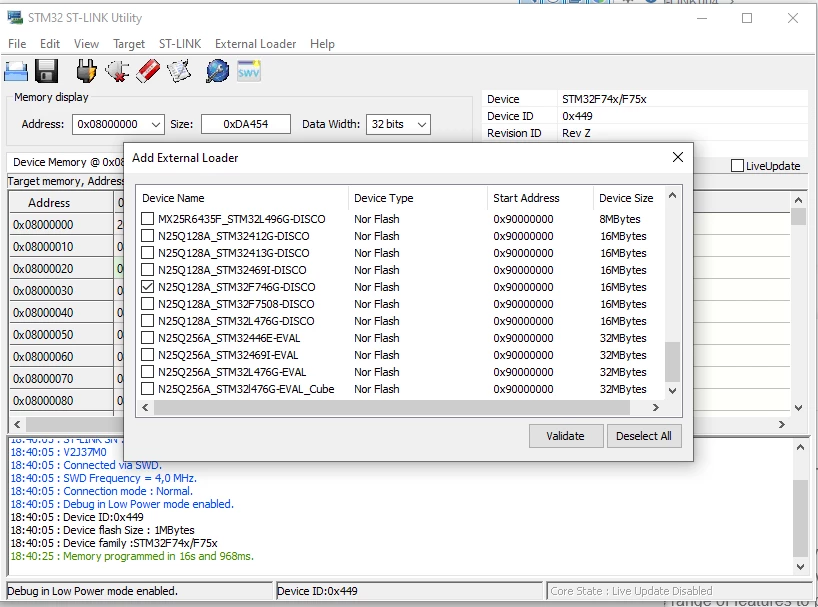
Install ST-Link Server and set these options in Project/Properties/Run-Debug section
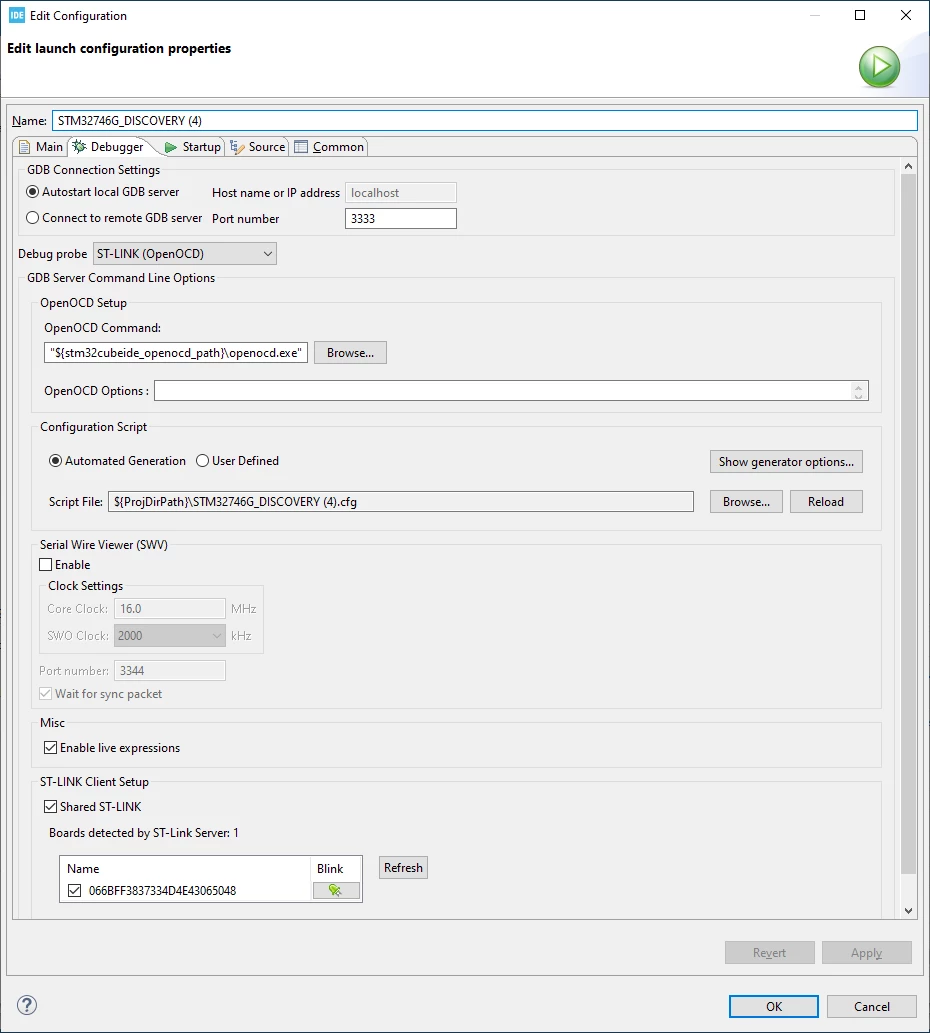 or use the external ST-LINK app with this set