Associate II
August 2, 2023
Question

Hardfault when accessing a global variable in a position independent program compiled with -fPIE

Hello board,

I seek to implement a position independent firmware to achieve a dual slot fota strategy:

  • The application firmware can be saved into one among two possible memory areas, the firmware does not know at compile time where it will be stored so it must be able to run regardless of the position.
  • A small bootloader is in charge of properly launching the firmware (the bootloader knows where the application firmware is stored).

I followed the steps described by the UM2609 guide for stm32CubeIDE chapter 2.8 which covers this exact requirement https://www.st.com/resource/en/user_manual/um2609-stm32cubeide-user-guide-stmicroelectronics.pdf .

  1. The application firmware is compiled with the -fPIE option
  2. The instruciton "bl __libc_init_array */"is eliminated from the application firmware  startup code
  3. .got is inserted into the main firmware linker inside the .text section among GOT_START and GOT_END
  4. Stack pointer is loaded at _estack in application firmware reset handler
  5. A ram section is dedicated to holding the application firmware vector table
  6. The bootloader copies the application firmware vector table to ram and applies the appropriate offset to each entry.
  7. The bootloader deinits all peripherals and HAL and jumps to the application firmware

At this point:

  1. The main firmware reset handler is reached,
  2. Startup code executes,
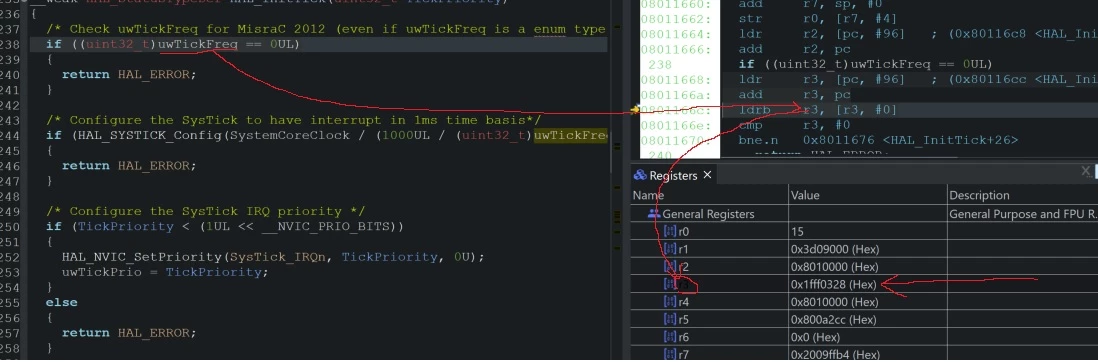
  3. When it reaches the function HAL_Init inside main the application firmware goes into hardfault upon accessing a global variable, whose loaded address is outside ram memory spaceinstruction that triggers hardfaultinstruction that triggers hardfault
    1. Funnily enough, this exact variable location is properly displayed by the expression monitor

    2. debugging 2.jpg

At this point I think I am maybe missing something regarding global variables relocation, or am I doing something else wrong?

I hope any of you can shed light on this mistery as online information regarding this subject is very scarce!

Regards, Matteo

    This topic has been closed for replies.

    12 replies

    Associate II
    August 10, 2023

    ++++ UPDATE ++++

    I have discovered that by disabling the -fpie option the code runs even if I load it in a different address than where it is supposed to be placed (by linker script) and does not crash the way it did with -fpie was enabled,

    • Removed -fPIE from compiler options
    • I eliminated the global offset table
    • Vector table reloacted to ram and all its addresses properly shifted by the bootloader considering where the firmware is loaded.
    • Relocated RoData init preninit finit sections to ram

    Things work like a charm, but I  do not understand:

    Why does my compiled code seem to be position independent with default when neither -fpic, -fpie or such are enabled?

    Bob S
    Super User
    August 10, 2023

    Do you have the program loaded into both areas?  Specially if the same image is loaded into both areas, code running in the 2nd area may "call" functions in the first area.

    For example, code is compiled/linked to start at 0x0800 0000.  Function MyInit() is at 0x0800 1000.  Code is loaded at 0x0800 0000 (1st area) and 0x0801 0000 (2nd area).  Yes, I know this doesn't allow for the bootloader that is probably really at 0x0800 0000.  So the bootloader starts running the program in the 2nd area.  It gets to the MyInit() call and calls the (fixed) address of MyInit() at 0x0800 1000, NOT what would be the position-independent address of 0x0801 1000.

    Associate II
    August 10, 2023

    Hi, no, the flash is formatted beforehand and I only upload the "application-fw" binary "manually"using stm32CubeProgrammer, then I upload and debug the bootloader using stm32cubeide (and I also load the application-fw debug information with it but without uploading the application of course).

    The main firmware and the bootloader share the stm32 libraries initializations but then they call different functions and print different texts on the terminal.

    In more detail:

    • The "application" linker settings would place it at 0x8020000
    • The application .data, .rodata .init .prenit, .fini sections are also reloacted to ram by linker settings
    • The application vector table is loaded from ram at an absolute address
    • I upload the application compiled .bin file at 0x8010000 using STM32CubeProgrammer (so there is a 0x10000 offset with the original linker placement).
    • The bootloader copies the irq table it finds in flash to ram at the address known by the application and shifts the irq table addresses by - 0x10000.
    • I set the bootloader to launch an application at 0x8010000
    Bob S
    Super User
    August 10, 2023

    Probably not the issue, but did you modify the startup code to copy "rodata' from Flash into RAM?  I don't THINK the stock startup will do that.

    The assembly code you showed looks a bit odd, specially the "add r3, pc" line.  Does that source code generate the same assembly without the -fPIE flag?  Though even subtracting out the PC value it STILL doesn't give the correct address.

    Associate II
    August 11, 2023
    • In the newer firmware (the one without fpie) I do copy rodata from flash to ram, in the older it didn't
    • in the current firmware (no fpie) the global variable address is correctly fetched, there is no "add r3, pc" it loads the variable address adding a fixed offset to the pc
      immagine.png

    Besides why fpie was shifting the load addresses in that manner, I would like also to know how come the code without fpie is still somewhat position independent as I see that functions are called and jumps are performed always relatively to the program counter!

    Associate II
    August 11, 2023

    Another Update: regarding my first firmware, the one with -fpie, I now notice that the disassembly loads the global offset table exactly 0x10000 away from where it is actually located. 0x10000 is coincideentally the offset at which I load the firmware with respect to the original linker placement....

    So I wonder, it looks like the program expects the GOT to be placed relatively to the PC with a fixed offset, but if the firmware gets uploaded in a different place than the linker's expected location, the GOT location calculated in that way becomes invalid.

    What is the point of having position independent code if the global offset table is loaded in a position-dependent manner?Am I missing something?

    Associate II
    August 11, 2023

    So, to answer my last message, the key is to use -fpic in conjunction with -msingle-pic-base (remove -fpie), this option will make the compiler reference the GOT from a fixed register (R9 by default).

    To allow this option to be effective the bootloader must load the correct ram address of the GOT (already relocated to ram and patched with the offset where necessary) into R9 right before launching the application firmware.

    (Another way would be to populate R9 in the startup code of the firmware itself)

    I am still experiencing some problems tho, i will update the post as soon as I discover something more

    Associate II
    August 21, 2023

    So, the problem now seems to be that static variables are somehow not listed by the .got.

    When trying to access one of these static zero-initialized variables (so living int he .bss section) , the program goes into hardfault because it loads it from the wrong address.

    matteoricciutelli_enel_0-1692613361226.png

    This is the content of the .got section and since .bss starts at 0x20000f20 and ends at 0x200015d8 you can see several entries belong to the .bss section, but others do not appear, like this one below

    matteoricciutelli_enel_1-1692613453292.png

    Which is this static array

    matteoricciutelli_enel_2-1692613769339.png

    When the program tries to access this variable it does so at 0x1fff15d8 whic is exactly 0x10000 away from where it actually is ( and 0x10000 is the offset by which I upload the code to test the position independence).
    This is because said variable is loaded by adding an offset to the program counter PC, if it were to be loaded via GOT this would not happen!
    So why are local static variables not addressed via GOT while global variables are? is there a way to ensure GOT coverage for all static variables?

    Bob S
    Super User
    August 21, 2023

    See the 2nd answer here:

    https://stackoverflow.com/questions/5093851/problems-with-static-local-variables-with-relocatable-code

    Talks about adding -mpic-data-is-text-relative

    Associate II
    August 23, 2023

    Update:

    It turns out the solution is to DISABLE the pic-data-is-text-relative option adding -mno-pic-data-is-text-relative, 

    source gcc board

    Now the local static variables are addressed (and added) to the global offset table just like global and global static variables!

    I don't know why the other stack overflow answers suggested the exact opposite...either a mistake or just different use case, anyway do not use -mpic-data-is-text-relative ! Disable it with -mno-pic-data-is-text-relative.

    However, the war is not over!
    The next obstacles turns out to be libc ( newlib-nano) functions, such as printf, sprintf etc, which by disassembly I see that they are definitiviely not position independent..the code jumps and fetches data not relative to program counter causing again hardfault.

    So I guess, is there an easy way with Stm32CubeIde to recompile newlib-nano in a position independent fashion? Or import any other libc variant suitable for this purpose?