


BStic.2
Senior
March 7, 2023
Question

STM32WB55 CPU2 Corrupts TL_RefTable while configuring BLE advertising (stack v1.15.0)

  • March 7, 2023
  • 21 replies
  • 4764 views

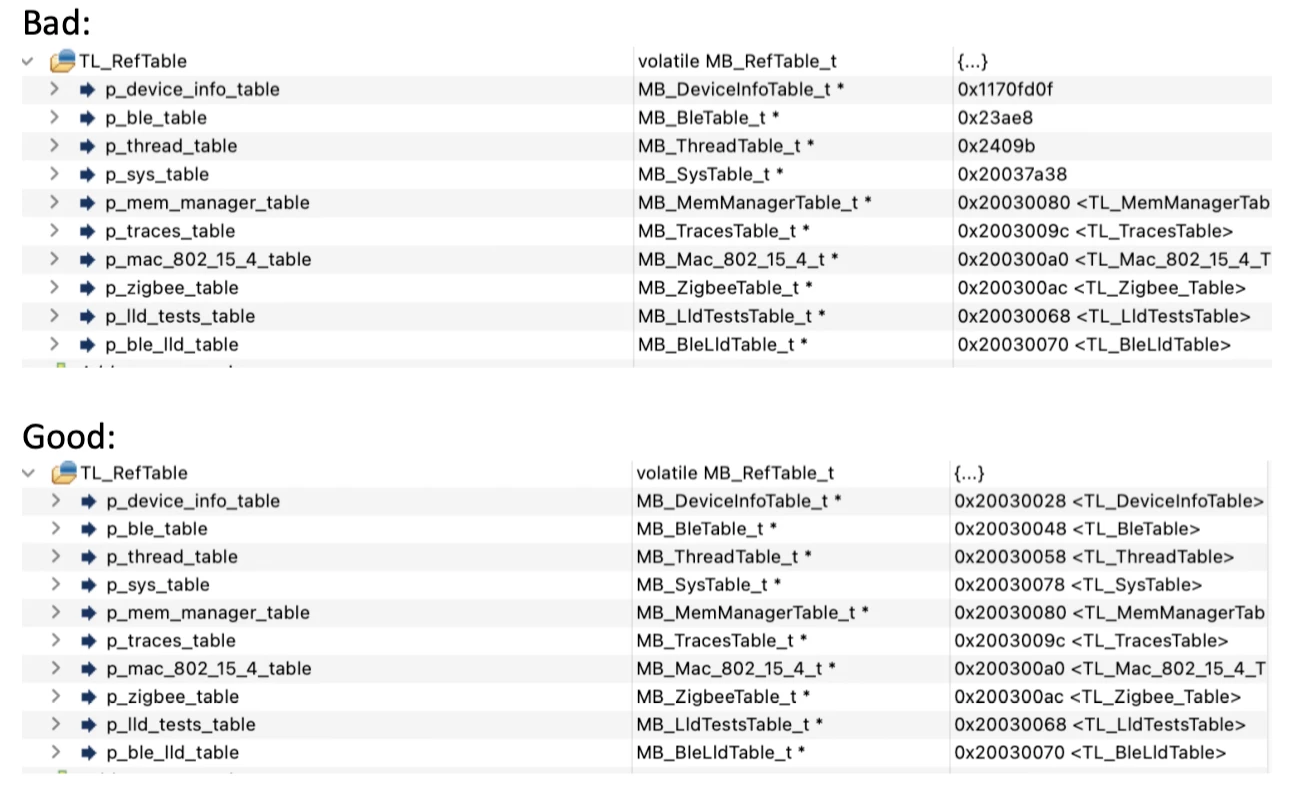
Ive seen this issue in various different forms over the last 2 years and it seems like CPU2 is corrupting the TL_RefTable structure while configuring advertising. We are using v1.15.0 of the stack on a STM32WB55. This happens every few hours in the following sequence.

aci_gap_set_non_discoverable();
// Wait 40 seconds
aci_hal_set_tx_power_level(1, powLevel);
aci_gap_set_discoverable(ADV_IND, RateMin, RateMax, addrType, NO_WHITE_LIST_USE, 0, NULL, 0, NULL, 0, 0);
aci_gap_update_adv_data(Manufacturing specific type)
aci_gap_update_adv_data(Name)
aci_gap_delete_ad_type(AD_TYPE_TX_POWER_LEVEL)
// Wait 20 seconds

Then the sequence repeats over and over until we get a connection. If I just let it run (over night for example) TL_RefTable gets corrupted and triggers an MPU fault on the next advertising sequence.
0693W00000aIOkwQAG.png 

Why is this happening? What can I do to stop it?

This topic has been closed for replies.

21 replies

AM.12
Associate III
March 11, 2023

Hello @BStic.2​ ,

Even I am facing the same issue, I am trying to rectify same for the past week. Did u find the root cause? How did you solved this problem?

Thank You.

BStic.2
BStic.2Author
Senior
March 11, 2023

I have not yet found a workaround, as far as I can tell, it has something to do with setting the advertising data after advertising has started. Which is strange, because it seems you cant setup the advertising data before you start advertising. Adding some delays seems to lower the occurrence, but I am about 99% sure they have a race condition in the stack code somewhere.

PS. This type of error seems to pop up over and over again. Ive seen instances of TL_RefTable getting corrupted as far back as v1.12 of the stack.

AM.12
Associate III
March 12, 2023

Hi @BStic.2​ ,

Thank you for responding, I am using the v1.16 stack. My application is when the button pressed start advertising and after 100ms stop advertising. After pressing the button more than 35 to 40 between this number of times device hangs on advertising. I am new to STM32, so please let me know if you found a workaround for this issue.

BStic.2
BStic.2Author
Senior
March 12, 2023

Ya, starting and stopping advertising seems to be an issue. I am going to refactor using the lower level HCI commands and see if thats any better. These are the functions. hci_le_set_advertising_data and hci_le_set_advertising_parameters

Remy ISSALYS
ST Technical Moderator
March 14, 2023

Hello,

According to your screenshot, you have an hardfault, indeed when the CPU2 enters in the hardfault interrupt handler, it writes the following data (extract of AN5289:(

@SRAM2A_BASE: 0x1170FD0F Keyword that identifies a hardfault issue

@SRAM2A_BASE + 4 Program counter value that generated the hardfault

@SRAM2A_BASE + 8 Link register value when the instruction that generated the hardfault has been executed

@SRAM2A_BASE + 12 Stack pointer value when the instruction that generated the hardfault has been executed

With this information, you can find which instruction generate the hard fault in your application.

Best Regards

BStic.2
BStic.2Author
Senior
March 14, 2023

Yes, the hard fault is generated when we deference the bad pointers in TL_RefTable the next time we attempt to send a command to CPU2. The problem is that CPU2 is corrupting the table. See the table in the above screenshot.

Also, I tried this in v1.16.0 stack and the problem is still there.

Remy ISSALYS
ST Technical Moderator
March 17, 2023

Hello,

Previous action generates the hardfault, so CPU2 write hardfault keyword in SRAM2A, then when you attempt to send a new command to CPU2, you see this hardfault keyword.

Which stack and which version are you using? When the hardfault occurred, can you check flash register value (FLASH_C2SR (CPU2) and FLASH_SR (CPU1) register)?

Best Regards

BStic.2
BStic.2Author
Senior
March 17, 2023

I am looking through traces to see what is happening on CPU1 when this occurs, but not much is happening. We are basically enabling and disabling advertising. I see this issue both on v1.15.3 and v1.16.0 of the stack. I have tried both the BLE_*full_fw and BLE*_full_extended_fw versions of the stack. I have even switched over from the legacy version of advertising to the extended. Same issue. I will check the flash registers.

AM.12
Associate III
March 23, 2023

Hello @BStic.2​ ,

Do you mean CFG_PRIVACY?

When I am trying in debug mode I don't face any problems so it's getting difficult in debugging for me.

BStic.2
BStic.2Author
Senior
March 23, 2023

Yes, my privacy is set to PRIVACY_ENABLED for random resolvable addresses. A.K.A, LE Privacy. If I disable it, the problem goes away.

AM.12
Associate III
March 24, 2023

Hi @BStic.2​ ,

In my configuration it's disabled, but still I face this problem. Strange is when I put it in debug mode I don't get any problem, 1 out of 1000 I got this problem.

Remy ISSALYS
ST Technical Moderator
March 24, 2023

Hello,

In most of case, the CPU2 hard fault occurs when the CPU1 corrupts the flash memory and then when the CPU2 try to access to the flash, it generates the hard fault, that's why I asked you to check this point.

Can you confirm that your screenshot in your post where the TL_RefTable contains the hardfault keyword is taken with the BLE Full Stack v1.15.0.3? If it's not the case, can you share a screenshot which contain the TL_RefTable and give the corresponding stack version?

Best Regards

BStic.2
BStic.2Author
Senior
March 24, 2023

Thank you for that information. Yes, the TL_RefTable from the original post is v1.15.0.3. Here is another one from v1.16.0.4. I just took a screenshot of the state of the IDE. TL_RefTable is in the lower right corner. 0693W00000aJfDcQAK.png 

Just as an FYI, the code I am running does not ever write flash.

Thanks,

Ben

Remy ISSALYS
ST Technical Moderator
March 27, 2023

Hello,

Thanks for your response with your screenshot. I have some follow up questions. Are you using the whitelist? Did you reproduce the issue on nucleo board or it's on your own board? If it's possible, can you share the source code of your application?

Best Regards

BStic.2
BStic.2Author
Senior
March 27, 2023

Hello, yes, we were configuring the resolving list and we did have a mode where we enabled the whitelist, but in this example we were not entering that mode. So, all of the adverting configuration used the NO_WHITE_LIST_USE for Advertising_Filter_Policy. Essentially, if we lost communication due to a connection timeout, we would enable the white list for a short amount of time to prefer previously connected devices. If nothing connected, we would disable the white list and transition to a period where we were slow advertising for a period, followed by a period of no advertising. This example just runs the period of slow advertising followed by no advertising and repeats that over and over.

This is on our custom board, we are using the STM32WB55VG.

Full source is proprietary, but I could update the support ticket (00174181) with the code that manages the advertising if you like.

Thanks again.

Ben

Remy ISSALYS
ST Technical Moderator
March 28, 2023

Hello,

Yes, if you can share the code that implements your scenario in the support ticket to try to reproduce the issue on my side. If you can also give all the details regarding commands and parameters used in your application. How did you manage the whitelist, when did you add your device into the whitelist? When the hard fault occurs there isn't any connection, only advertising without whitelist followed by no advertising and repeats, is it right? After how long do you reproduce the issue?

Best Regards

BStic.2
BStic.2Author
Senior
March 28, 2023

I have uploaded the code to the ticket. This issue takes a long time on my setup to reproduce. Sometimes it happens in hours, it could take up to a day. Rarely was I able to go overnight without the issue occurring. I tried various things like changing the way the advertising data was set or disabling STOP2 mode, the only thing that made the problem go away was to stop using random resolvable addresses and just rely on my static random address. So, just to be clear, we are a peripheral and we only support 1 connection at a time.

The code should have all the parameters passed to the BLE interface functions. If there is something missing you would like to see, shoot me a message.

I have created a basic flow chart of what our device is doing in this state.

 0693W00000aJs36QAC.png 

At the end of a connection, we fast advertise for a bit, then take a break and shift to slow advertising. We enable and disable slow advertising until a new connection is established. We are a battery limited device, so we are trying to optimize current consumption while not connected to anything. We are not connected when this issue occurs, we are just advertising.