
STM32WB Multi-channel ADC with DMA, buffer sequence issue
Hello geeks..
Hope all are doing well
I'm using multi channel ADC with STM32WB having DMA activated
My issue is, every time when i perform the power ON reset, at the same time the channel sequence getting change!
It means, the conversion buffer in HAL_ADC_ConvCpltCallback function sequence is getting change
I have verified the same thing manually by connecting the 3.3V & GND at the particular channels
For example, when i connect the 3.3v at PC4 then the allocated buffer variable shows 4096 samples. However when i do the power on reset then some different buffer shows the value 4096
I have activated the 6 channels here with DMA
I have shared ADC initialization code snippet here
Can any one help me here ?
All suggestions & comments welcome
Thanks
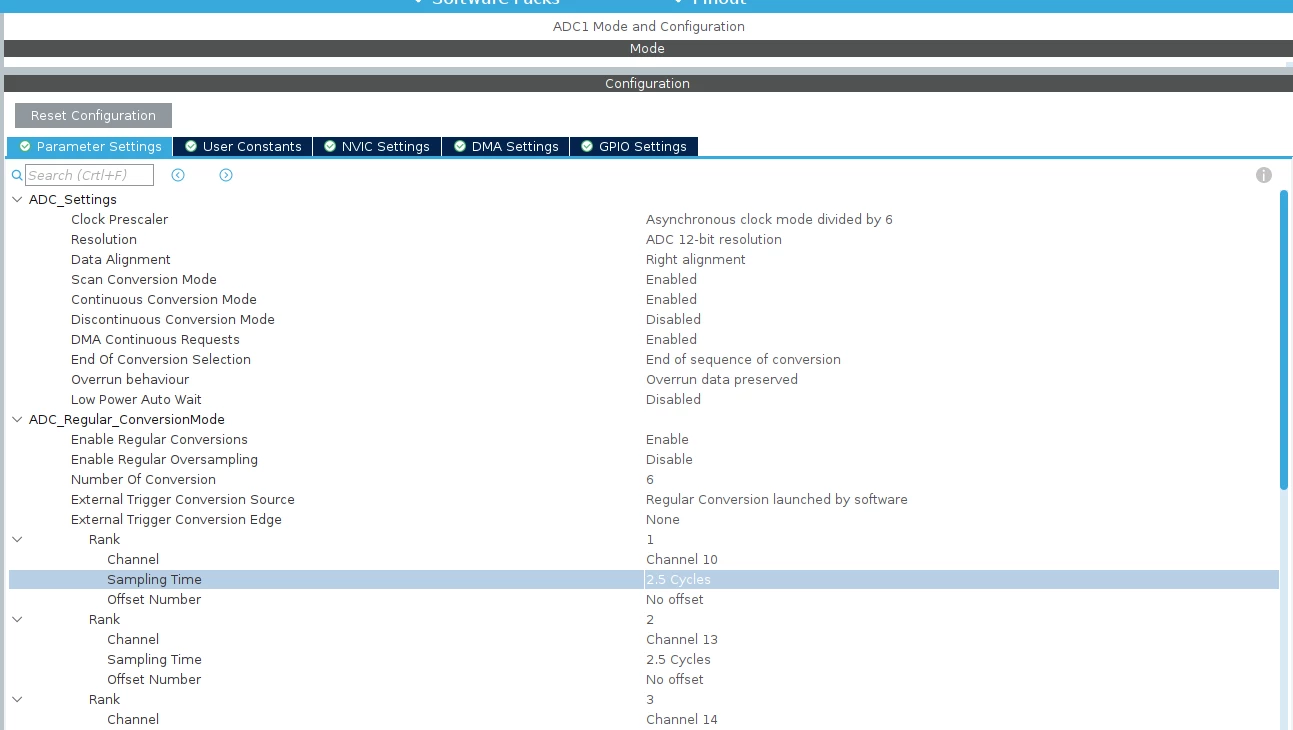
/**
 * @brief ADC1 Initialization Function
 * @param None
 * @retval None
 */
int32_t BSP_ADC1_Init(void) {

	/* USER CODE BEGIN ADC1_Init 0 */

	/* USER CODE END ADC1_Init 0 */

	ADC_ChannelConfTypeDef sConfig = { 0 };

	/* USER CODE BEGIN ADC1_Init 1 */

	/* USER CODE END ADC1_Init 1 */
	/** Common config
	 */
	hgasadc1.Instance = ADC1;
	hgasadc1.Init.ClockPrescaler = ADC_CLOCK_ASYNC_DIV6;
	hgasadc1.Init.Resolution = ADC_RESOLUTION_12B;
	hgasadc1.Init.DataAlign = ADC_DATAALIGN_RIGHT;
	hgasadc1.Init.ScanConvMode = ADC_SCAN_ENABLE;
	hgasadc1.Init.EOCSelection = ADC_EOC_SEQ_CONV;
	hgasadc1.Init.LowPowerAutoWait = DISABLE;
	hgasadc1.Init.ContinuousConvMode = ENABLE;
	hgasadc1.Init.NbrOfConversion = 6;
	hgasadc1.Init.DiscontinuousConvMode = DISABLE;
	hgasadc1.Init.ExternalTrigConv = ADC_SOFTWARE_START;
	hgasadc1.Init.ExternalTrigConvEdge = ADC_EXTERNALTRIGCONVEDGE_NONE;
	hgasadc1.Init.DMAContinuousRequests = ENABLE;
	hgasadc1.Init.Overrun = ADC_OVR_DATA_PRESERVED;
	hgasadc1.Init.OversamplingMode = DISABLE;
	if (HAL_ADC_Init(&hgasadc1) != HAL_OK) {
		Error_Handler();
	}
	/** Configure Regular Channel
	 */
	sConfig.Channel = ADC_CHANNEL_10;
	sConfig.Rank = ADC_REGULAR_RANK_1;
	sConfig.SamplingTime = ADC_SAMPLETIME_2CYCLES_5;
	sConfig.SingleDiff = ADC_SINGLE_ENDED;
	sConfig.OffsetNumber = ADC_OFFSET_NONE;
	sConfig.Offset = 0;
	if (HAL_ADC_ConfigChannel(&hgasadc1, &sConfig) != HAL_OK) {
		Error_Handler();
	}
	/** Configure Regular Channel
	 */
	sConfig.Channel = ADC_CHANNEL_13;
	sConfig.Rank = ADC_REGULAR_RANK_2;
	if (HAL_ADC_ConfigChannel(&hgasadc1, &sConfig) != HAL_OK) {
		Error_Handler();
	}
	/** Configure Regular Channel
	 */
	sConfig.Channel = ADC_CHANNEL_14;
	sConfig.Rank = ADC_REGULAR_RANK_3;
	if (HAL_ADC_ConfigChannel(&hgasadc1, &sConfig) != HAL_OK) {
		Error_Handler();
	}
	/** Configure Regular Channel
	 */
	sConfig.Channel = ADC_CHANNEL_15;
	sConfig.Rank = ADC_REGULAR_RANK_4;
	if (HAL_ADC_ConfigChannel(&hgasadc1, &sConfig) != HAL_OK) {
		Error_Handler();
	}
	/** Configure Regular Channel
	 */
	sConfig.Channel = ADC_CHANNEL_9;
	sConfig.Rank = ADC_REGULAR_RANK_5;
	if (HAL_ADC_ConfigChannel(&hgasadc1, &sConfig) != HAL_OK) {
		Error_Handler();
	}
	/** Configure Regular Channel
	 */
	sConfig.Channel = ADC_CHANNEL_16;
	sConfig.Rank = ADC_REGULAR_RANK_6;
	if (HAL_ADC_ConfigChannel(&hgasadc1, &sConfig) != HAL_OK) {
		Error_Handler();
	}
	/* USER CODE BEGIN ADC1_Init 2 */

	/* USER CODE END ADC1_Init 2 */

}
/**
* @brief Conversion complete callback in non-blocking mode.
* @param hadc ADC handle
* @retval None
*/
void HAL_ADC_ConvCpltCallback(ADC_HandleTypeDef *hadc) {
if (hadc->Instance == ADC1) {
adc_0 = AdcRawSamples[0]; /* -> PC4 -> BSP_GM_402B_CHANNEL */
adc_1 = AdcRawSamples[1]; /* -> PC5 -> BSP_GM_512B_CHANNEL */
adc_2 = AdcRawSamples[2]; /* -> PA8 -> BSP_GM_702B_CHANNEL */
adc_3 = AdcRawSamples[3]; /* -> PA9 -> BSP_TGS8100_CHANNEL */
adc_4 = AdcRawSamples[4]; /* -> PA4 -> BSP_GM_802B_CHANNEL */
adc_5 = AdcRawSamples[5]; /* -> PA5 -> BSP_GM_502B_CHANNEL */
}
}