


WWang.15
Associate II
July 22, 2026
Solved

How to reproduce the STM32WL33 datasheet RX sensitivity figures (-132dBm/-128dBm/-112dBm) using NUCLEO-WL33 + RadioExplorer GUI?

  • July 22, 2026
  • 6 replies
  • 149 views

Hello,

We have designed a custom RF module based on the STM32WL33, and one of our
customers is asking us to demonstrate that the RX sensitivity of our module
matches the values published in the datasheet:

  - RX sensitivity @ 1% BER:
      -132 dBm @ 300 bit/s, 433 MHz, OOK
      -128 dBm @ 300 bit/s, 868 MHz, 2(G)FSK
      -112 dBm @ 38.4 kbit/s, 868 MHz, 2(G)FSK

To validate this, we would like to reproduce the exact test conditions using
an official ST development board (e.g. NUCLEO-WL33) and the
STM32WL33 GUI, so the result is directly comparable to the
datasheet.

In the GUI's "Radio settings" tab we can set: fc, DR (ksps), Fdev (kHz),
CHF (channel filter bandwidth, kHz), modulation (OOK/2(G)FSK/4(G)FSK/ASK),
Spread Factor, and Pout.

Could you please help us with the following:

1. What DR / Fdev / CHF / Spread Factor values did ST use internally to
   characterize each of the three sensitivity points above? In particular:
     - For -132 dBm @ 300 bit/s / 433 MHz / OOK: Under the test conditions of 132 dBm @ 300 bit/s 433 MHz OK, what deviation, DR, Fdev, and CHF should I use to see -132 dBm?
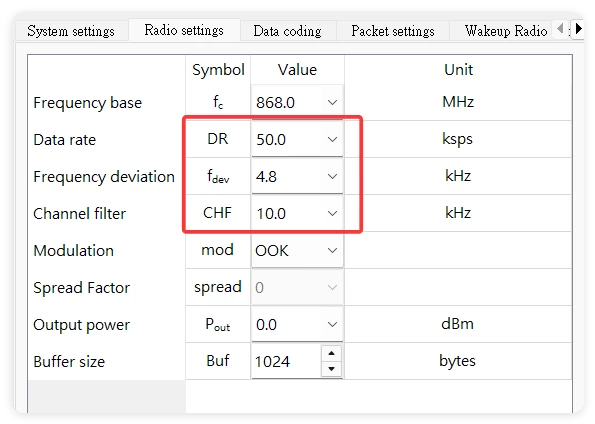

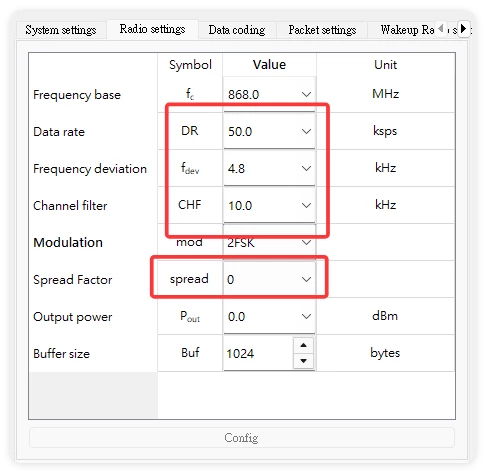
     - For -128 dBm @ 300 bit/s / 868 MHz / 2(G)FSK: what Fdev (modulation
       index) and CHF were used at this very low data rate?

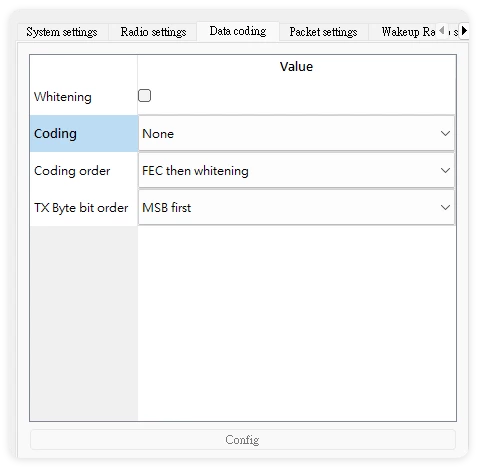
 Is FEC enabled?

Our goal is to give our customer a reproducible test procedure (hardware +
GUI settings + measurement method) that lets them independently confirm the
datasheet numbers on our custom module. Any pointers to the right
configuration values or documentation would be greatly appreciated.

Thank you!

Best answer by Filippo_Malleo

Hi WWang.15,


the frequency tolerance at 25°C can be compensated by the calibration. 

The frequency versus temperature drift of a typical XTAL is ± 12 ppm at -30°C to +85°C (The reference temperature shall be +25°C), so the receiver bandwidth must be chosen considering the worst case: center frequency ± 12 ppm, that for 868 MHz means ± 10 kHz.

With a CHF bandwidth of 1.7 kHz or 4 kHz you need to use a TCXO with low ppm drift in temperature with respect to the receiver bandwidth, to have the signal band inside the channel filter.

Another option is to characterize the drift in temperature and use the temperature sensor of the WL3 to adjust the XTAL drift at different temperatures.

BR,
Filippo


6 replies

ST Technical Moderator
July 22, 2026

Hello WWang.15,


the configuration you are looking for are in the datasheet itself:

  • Table 30. Sensitivity at 433 MHz (SMPS clock frequency= 4 MHz)
  •  Table 32. Sensitivity at 868.5 MHz (SMPS clock frequency = 4.27 MHz)

In the paragraph “6.3.5 RF receiver” you can find the test conditions. 

FEC and whitening are not enabled for these measurements. 
For the OOK modulation, Fdev is not used.


BR,
Filippo

In order to give better visibility on the answered topics, please click on 'Best answer' on the reply which solved your issue or answered your question. Thanks
WWang.15
WWang.15Author
Associate II
July 24, 2026

Hi ST Experts.

Thanks for your reply.

We tried using the original DK board with DR=1.2kHz and CHF=4kHz OOK modulation. We used an attenuator for attenuation, and data loss occurred at approximately -110dBm.

The frequency bias of this DK board are -1419Hz(DK1) and -3563Hz(DK2) using CW mode with spectrum.

When using OOK with DR=1.2kHz, is there a requirement for the center frequency bias, and if so, how many Hz should it be maintained within?

ST Technical Moderator
July 24, 2026

Hi WWang.15,


You got the point: when using a channel filter like 4 kHz, the offset between the nominal frequency and the actual frequency must be reduced. Otherwise, part of the signal power falls outside the channel filter bandwidth, resulting in lower sensitivity.

Considering that 1 ppm at 868 MHz means an 868 Hz offset, I suggest targeting 0.1 ppm after calibration. In this way, the channel filter is well centered on the incoming signal, and sensitivity improves.

BR,
Filippo

In order to give better visibility on the answered topics, please click on 'Best answer' on the reply which solved your issue or answered your question. Thanks
WWang.15
WWang.15Author
Associate II
July 27, 2026

Hi Experts.

I tried using XTAL offset on the original DK board to calibrate it to the correct frequency as much as possible. I used TX start (CW) and viewed the waveform through the spectrometer, but the thermal drift was much greater than 0.1ppm (86Hz).

Do you have any suggestions for a good calibration XTAL offsetrs method?

Also, did you use a constant temperature chamber (25 degrees Celsius) for your tests?

WWang.15
WWang.15Author
Associate II
July 27, 2026

Dear ST experts,

Thank you for your suggestion.

After calibrating the XTAL, I was able to test -131dBm using the original DK board in OOK mode.

Next, we will test in GFSK mode.

in GFSK mode, should we control the XTAL drift to 1/3 of the FDEV right?


Regarding the SMPS clock frequency of 4.27 MHz, should we set RCC_KRMR to 0x0000001F?

Filippo_MalleoBest answer
ST Technical Moderator
July 27, 2026

Hi WWang.15,


the frequency tolerance at 25°C can be compensated by the calibration. 

The frequency versus temperature drift of a typical XTAL is ± 12 ppm at -30°C to +85°C (The reference temperature shall be +25°C), so the receiver bandwidth must be chosen considering the worst case: center frequency ± 12 ppm, that for 868 MHz means ± 10 kHz.

With a CHF bandwidth of 1.7 kHz or 4 kHz you need to use a TCXO with low ppm drift in temperature with respect to the receiver bandwidth, to have the signal band inside the channel filter.

Another option is to characterize the drift in temperature and use the temperature sensor of the WL3 to adjust the XTAL drift at different temperatures.

BR,
Filippo


In order to give better visibility on the answered topics, please click on 'Best answer' on the reply which solved your issue or answered your question. Thanks