QSPI SRAM as framebuffer and Parallel or MIPI DSI?
Hi,
I have some questions regarding the implementation of an LCD with the STM32F479ii.
The display we want to use, has a 800x480 resolution at 60Hz and can have either 16 or 24 bit color depth.
A framebuffer for a display like that is of course not going to fit inside the 384kb of internal sram, so we will need external ram.
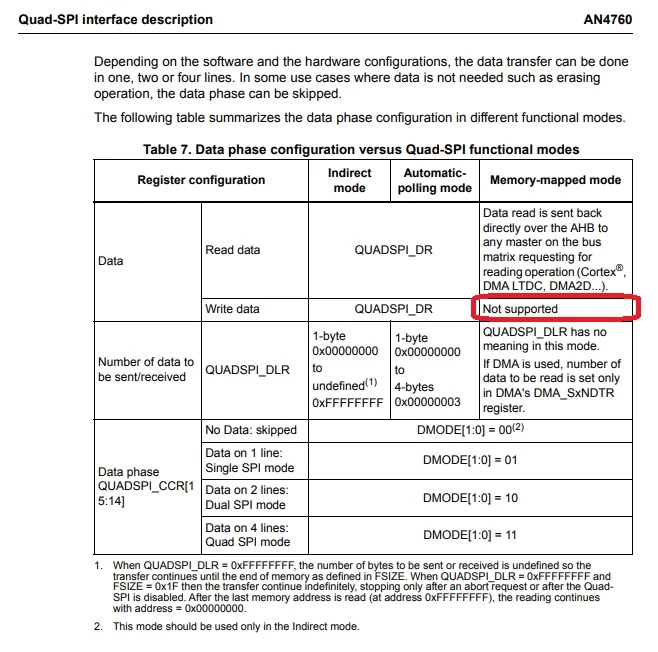
I have read the application note on the LTDC (AN4861) and it does mention that the F479ii supports mapped QSPI sram, but nowhere does it mention using QSPI sram for the framebuffer.
Of course QSPI will be slower than a parallel interface to the external ram, but QSPI certainly has a preference over the much simpler hardware design, even when comparing it to a 16 bit interface.
So question 1: Is QSPI sram fast enough to be used for the framebuffer, considering that it would be used for nothing but the framebuffer (everything else runs in internal sram)?
Then there is the interface to communicate with the display. The F4 supports both 24 bit parallel as well as MIPI DSI. I can't really find any real (dis)advantage for either one.
Most come down to hardware design, lots of pins vs only 6 pins, but at the cost of a much higher throughput and thus harder to debug and more hardware design constraints.
Question 2: Are there any major (dis)advantages to using MIPI DSI over a parallel interface that I'm missing?
Thanks in advance!