Associate
Oct 29, 2026 6:59 AM UTC
Question

STM32U585 VDD Fall Time Rate Violation and VBAT Drop During Overvoltage Failure Condition

Hello ST Team,

We are using the STM32U585 in a PCI security application and have encountered a question regarding the VDD fall-time specification during an abnormal power failure scenario.

Test Scenario

We are performing a security certification test similar to an "Operation Voltage Extreme High/Low Test".

An overvoltage is intentionally injected at the USB power input to create a system fault condition and verify:

  • Secure data protection functionality
  • Active Tamper functionality
  • Security behavior during abnormal power events

Observed Behavior

When the input voltage reaches approximately 11V, the front-end power IC fails and VDD33 becomes effectively shorted to GND.

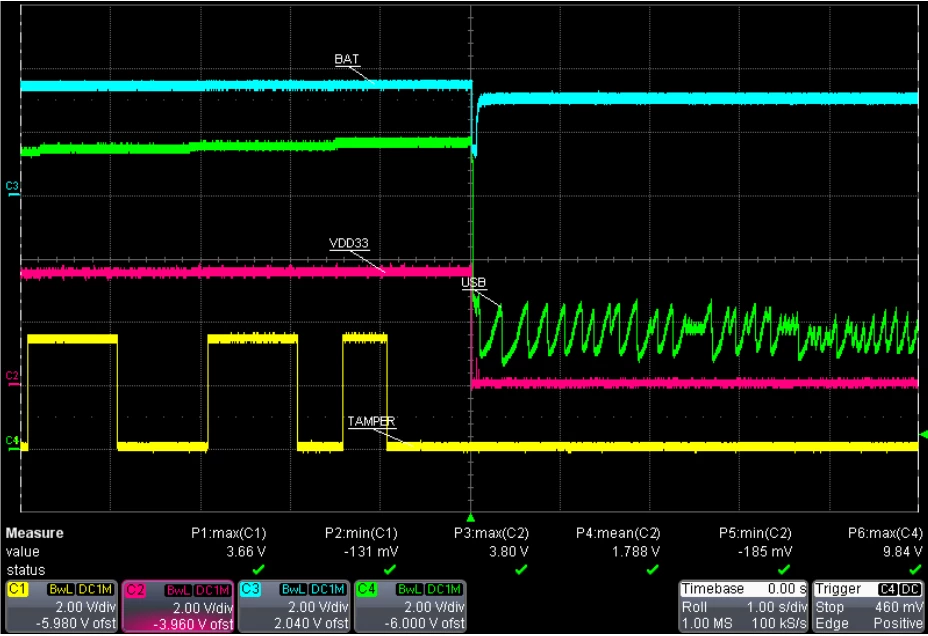
The measured power-down waveform shows:

  • VDD33 collapsing rapidly
  • VBAT also exhibiting a noticeable voltage drop
  • Measured VDD fall-time rate ≈ 2.6 µs/V

According to the STM32U585 datasheet, the VDD fall-time rate specification appears to require a slower ramp-down condition.

Questions

  1. What is the expected behavior of STM32U585 when the VDD fall-time rate is outside the datasheet specification?

    Possible concerns include:

    • Improper BOR/POR operation
    • Unexpected reset behavior
    • Loss of secure SRAM contents
    • Impact on Tamper detection logic
    • Other undefined operating states
  2. Why would VBAT also drop when VDD suddenly collapses?

    We would like to understand whether:

    • Internal protection structures could create a temporary current path between VDD and VBAT domains.
    • Backup domain circuitry may draw abnormal current during such a failure event.
    • This behavior is expected under catastrophic VDD failure conditions.
  3. Are there any application notes or design recommendations for handling extremely fast VDD collapse caused by external power-stage failure?

Device

  • MCU: STM32U585
  • Security Features Used:
    • Backup Battery (VBAT)
    • Active Tamper
    • Secure Data Storage


Any guidance would be greatly appreciated.

Thank you.

3 replies

mƎALLEm
ST Technical Moderator
Nov 4, 2026 11:16 AM UTC

Hello ​@Samuel_chung00967 and welcome to the ST community,

1- Hello ST Team,

This is a public community not a pear-to-pear support.

2- 

I’m not sure to understand how did you inject that overvoltage.

We are performing a security certification test similar to an "Operation Voltage Extreme High/Low Test".

An overvoltage is intentionally injected at the USB power input to create a system fault condition


When the input voltage reaches approximately 11V, the front-end power IC fails and VDD33 becomes effectively shorted to GND.


Better to share schematics + sketch on how you’ve injected that voltage and on which point.

As you can see, your post is here since 6 days ago and no one in this community was encouraged to help you.  So you need to provide more details so others can be motivated to help you.

Thank you for your understanding.

To give better visibility on the answered topics, please click "Best answer" on the reply which solved your issue or answered your question.
Associate
Nov 6, 2026 7:48 AM UTC

Test Methodology:
Connect the VDD} and GND outputs of the adjustable power supply to the VDD and GND pins of the board-level USB connector.
Apply power starting from 5V, and gradually increase the voltage in 0.1V steps every 10 seconds until the front-end DC-DC step-down IC fails due to overvoltage/overheating.

Failure Phenomenon:
After the DC-DC IC failed, measurements showed that its output terminal Vout was permanently shorted to GND.

Hardware Design Background:
According to the backup power architecture design of the STM32U585: When the main power supply VDD drops out or falls below a preset threshold, the internal power switch automatically switches to the VBAT domain (which is externally connected to a 3.0V coin battery).

Core Issue:Why does a transient voltage drop (undervoltage) clearly occur on the independently powered VBAT rail when the DC-DC failure causes an instantaneous short-circuit of the MCU's VDDto ground (with an extremely fast dV/dt?


BAT = IC pin VBAT voltage

VDD33 = DC Vout

USB = Power supply voltage


Associate
Nov 6, 2026 8:58 AM UTC

Test Methodology:
Connect the VDD} and GND outputs of the adjustable power supply to the VDD and GND pins of the board-level USB connector.
Apply power starting from 5V, and gradually increase the voltage in 0.1V steps every 10 seconds until the front-end DC-DC step-down IC fails due to overvoltage/overheating.

Failure Phenomenon:
After the DC-DC IC failed, measurements showed that its output terminal Vout was permanently shorted to GND.

Hardware Design Background:
According to the backup power architecture design of the STM32U585: When the main power supply VDD drops out or falls below a preset threshold, the internal power switch automatically switches to the VBAT domain (which is externally connected to a 3.0V coin battery).

Core Issue:Why does a transient voltage drop (undervoltage) clearly occur on the independently powered VBAT rail when the DC-DC failure causes an instantaneous short-circuit of the MCU's VDDto ground (with an extremely fast dV/dt?


BAT = IC pin VBAT voltage

VDD33 = DC Vout for MCU power

USB = Power supply voltage (USB connector input)