

Marato Gebremichael
Associate
June 1, 2018
Solved

STM32L4x6 GPIO PA3 Reset Value

  • June 1, 2018
  • 1 reply
  • 3897 views
Posted on June 01, 2018 at 15:36

Hi guys,

I'm having some troubles understanding the behavior of the ST GPIO on start-up, specifically PA3 on STM32L496VE micro.

Background:

I'm trying to program/flash a SiLabs BT121 (Bluetooth module) chip and have the following configuration on my board:
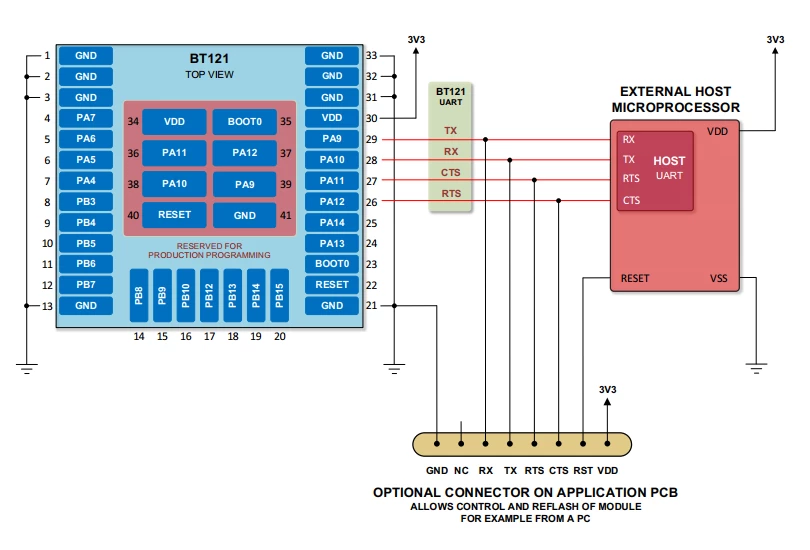
0690X0000060KwwQAE.png

I'm using a dev kit offered by SiLabs, DKBT, to program the BT The dev kit acts as a USB to UART converter to interface the UART on the BT

On the MPU host side I have PA0 to PA3 configured as UART as follows:
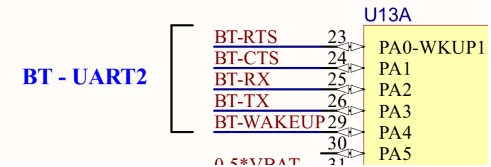
0690X0000060L4VQAU.png

When programming the BT121 the datasheet advises to keep the host MPU in reset state to keep lines floating.

Here's my issue: whenever I try to program the BT121 w/ a MPU that's erased/not programmed it fails.

If I keep the MPU in reset manually (pulled the NRST pin low) thenprogrammingis successful.

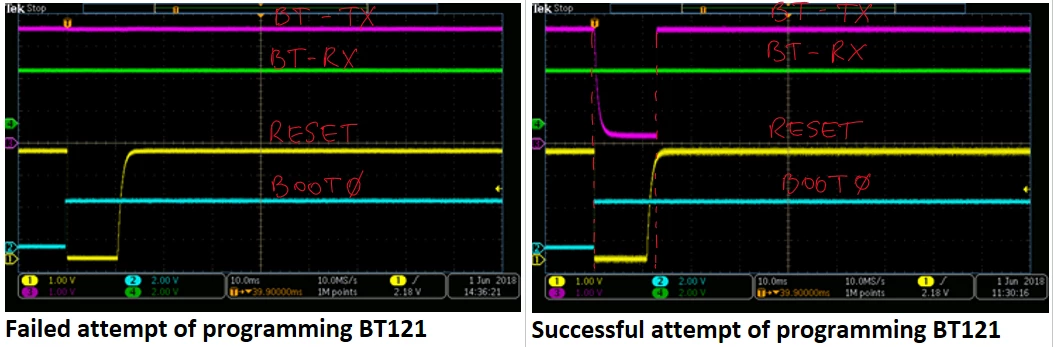
Following capture is for the TX (pink), RX (green), RESET (yellow) and BOOT0 (blue) pins on the initial reset dip that puts the BT121 in the DFU mode which allows me to program it.

NOTE: Reset and BOOT0 are the pins on the BT121 chip and not the STM micro.
0690X0000060L4MQAU.png

What I'm seeing from the captures is that a failed attempt to program the BT121 is caused when the BT-TX line does not go low in line with the RESET pin.

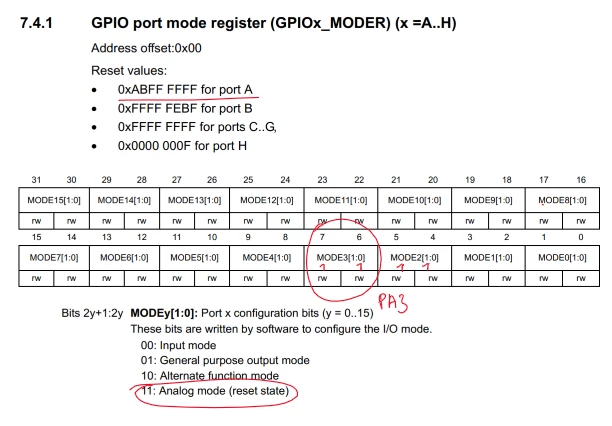
From my understanding on an erased MPU all the lines (except the JTAG pins) are supposed to be configured as analog input floating. I verified that with the reference manual:
0690X0000060KskQAE.png

I went ahead and programmed the specific pin on the MPU as analog mode then as input Push-pull and both seem to work, I was able to program the BT But then I realized that even if I flash and empty program into the MPU the programming of BT121 works.

Finally, Ifigured out that by just simply connecting to the MPU via the ST-Linkto the JTAG brings the MPU into a state where I'm able to program the BT121 chip.

Am I missing something? By the looks of it PA3 is not configured as floating analog inputwhen completely erased.

Thank you! I appreciate any input.

edit: added note for the scope captures.

#uart #gpio #stm32l496ve

Note: this post was migrated and contained many threaded conversations, some content may be missing.

This topic has been closed for replies.
Best answer by Tesla DeLorean
Posted on June 04, 2018 at 21:41

Create a minimal FLASH vector table that a) loads SP/PC and points to a 'B .' loop, b) loads SP/PC with values pointing at System Loader, c) have code in Reset_Handler that sets board hardware and then jumps to ROM

Note where aberrant behaviour recurs

1 reply

Tesla DeLorean
Guru
June 1, 2018
Posted on June 01, 2018 at 16:29

With BOOT0 High it is going to be running what is in ROM, not what's in your FLASH (or not). The BOOT0 pin of the STM32 should be pulled low for normal operation, letting it float will result in unexpected behaviour.

You should review the App Notes related to the System Loader, and its pin utilization and expectations.

Tips, Buy me a coffee, or three.. PayPal VenmoUp vote any posts that you find helpful, it shows what's working..
Marato Gebremichael
Associate
June 1, 2018
Posted on June 01, 2018 at 16:33

My apologies, the BOOT0 pin and the RESET pins in the captures are for the BT121 module and not the STM micro.

Max
ST Employee
June 1, 2018
Posted on June 01, 2018 at 18:02

You may be impacted by the bootloader in system memory as it can be executed automatically when the flash is empty. This is depending on your option bytes settings (see

http://www.st.com/content/ccc/resource/technical/document/reference_manual/02/35/09/0c/4f/f7/40/03/DM000835pdf/files/DM000835pdf/jcr:content/translations/en.DM000835pdf

chapter 2.6.2 for details).

The bootloader will configure the STM32 to be reprogrammed through a set of serial interfaces. This may impact your application.

You can find details about what is configured by the bootloader and on which pin in

http://www.st.com/content/ccc/resource/technical/document/application_note/b9/9b/16/3a/12/1e/40/0c/CD001675pdf/files/CD001675pdf/jcr:content/translations/en.CD001675pdf

, as suggested by

Turvey.Clive.002

.