

Solved
STM32H7 SAI DMA; Transfer Error
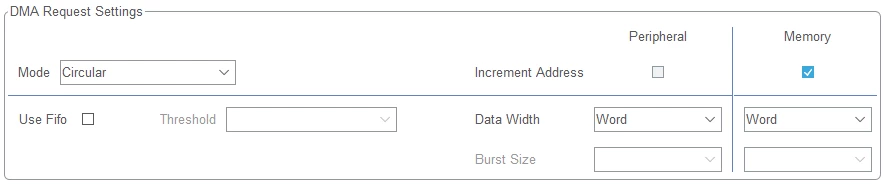
/* Peripheral DMA init*/

 hdma_sai1_a.Instance = DMA1_Stream0;
 hdma_sai1_a.Init.Request = DMA_REQUEST_SAI1_A;
 hdma_sai1_a.Init.Direction = DMA_PERIPH_TO_MEMORY;
 hdma_sai1_a.Init.PeriphInc = DMA_PINC_DISABLE;
 hdma_sai1_a.Init.MemInc = DMA_MINC_ENABLE;
 hdma_sai1_a.Init.PeriphDataAlignment = DMA_PDATAALIGN_WORD;
 hdma_sai1_a.Init.MemDataAlignment = DMA_MDATAALIGN_WORD;
 hdma_sai1_a.Init.Mode = DMA_CIRCULAR;
 hdma_sai1_a.Init.Priority = DMA_PRIORITY_HIGH;
 hdma_sai1_a.Init.FIFOMode = DMA_FIFOMODE_DISABLE;
 if (HAL_DMA_Init(&hdma_sai1_a) != HAL_OK)
 {
 Error_Handler();
 }

 /* Several peripheral DMA handle pointers point to the same DMA handle.
 Be aware that there is only one channel to perform all the requested DMAs. */
 __HAL_LINKDMA(hsai,hdmarx,hdma_sai1_a);

 __HAL_LINKDMA(hsai,hdmatx,hdma_sai1_a);

 }
int main(void)
{
/* USER CODE BEGIN 1 */
/* USER CODE END 1 */
/* USER CODE BEGIN Boot_Mode_Sequence_0 */
int32_t timeout;
/* USER CODE END Boot_Mode_Sequence_0 */
/* USER CODE BEGIN Boot_Mode_Sequence_1 */
/* Wait until CPU2 boots and enters in stop mode or timeout*/
timeout = 0xFFFF;
while((__HAL_RCC_GET_FLAG(RCC_FLAG_D2CKRDY) != RESET) && (timeout-- > 0));
if ( timeout < 0 )
{
Error_Handler();
}
/* USER CODE END Boot_Mode_Sequence_1 */
/* MCU Configuration--------------------------------------------------------*/
/* Reset of all peripherals, Initializes the Flash interface and the Systick. */
HAL_Init();
/* USER CODE BEGIN Init */
/* USER CODE END Init */
/* Configure the system clock */
SystemClock_Config();
/* USER CODE BEGIN Boot_Mode_Sequence_2 */
/* When system initialization is finished, Cortex-M7 will release Cortex-M4 by means of
HSEM notification */
/*HW semaphore Clock enable*/
__HAL_RCC_HSEM_CLK_ENABLE();
/*Take HSEM */
HAL_HSEM_FastTake(HSEM_ID_0);
/*Release HSEM in order to notify the CPU2(CM4)*/
HAL_HSEM_Release(HSEM_ID_0,0);
/* wait until CPU2 wakes up from stop mode */
timeout = 0xFFFF;
while((__HAL_RCC_GET_FLAG(RCC_FLAG_D2CKRDY) == RESET) && (timeout-- > 0));
if ( timeout < 0 )
{
Error_Handler();
}
/* USER CODE END Boot_Mode_Sequence_2 */
/* USER CODE BEGIN SysInit */
/* USER CODE END SysInit */
/* Initialize all configured peripherals */
MX_GPIO_Init();
MX_DMA_Init();
MX_SAI1_Init();
MX_CRC_Init();
MX_PDM2PCM_Init();
MX_USART3_UART_Init();
/* USER CODE BEGIN 2 */
//volatile shared_data_t * const shared_data = (shared_data_t *)0x38000000;
/* USER CODE END 2 */
/* Infinite loop */
/* USER CODE BEGIN WHILE */
__HAL_SAI_ENABLE(&hsai_BlockA1);
if(HAL_SAI_Receive_DMA(&hsai_BlockA1, (uint8_t*)pdmBuffer, AUDIO_BUFFER_SIZE) != HAL_OK){
Error_Handler();
}
while (1)
{
while(dmaFlag != HALF){}
dmaFlag = NONE;
while(dmaFlag != FULL){}
dmaFlag = NONE;
/* USER CODE END WHILE */
/* USER CODE BEGIN 3 */
}
/* USER CODE END 3 */
}ALIGN_32BYTES (uint16_t pdmBuffer[AUDIO_BUFFER_SIZE]) __attribute__((section(".RAM_D3")));
ALIGN_32BYTES (uint16_t pcmBuffer[AUDIO_BUFFER_SIZE]);I'm following the SAI DMA example in the project file for one of the stm32h7's. The issue is, no matter what I am always getting a Transfer Error immediately after I start HAL_SAI_Receive_DMA(); I placed a break point at the IRQ_Handler. I am completely confused on what else I need to do.
Things I made sure to do
- DMA Word Align
- DMA Increment Memory
- 32Byte Align Buffers
- Put the DMAbuffer, pdm, in RAM3
Right now, I'm not even trying to read data, just trying to get the DMA ping pong to work. I know about the cache coherency for when I do need to read the data, but like I said I can't even get DMA to cycle through my main program.
