STM32G431 TIM2 (32bit) strange behavior
Heyho,
working on a new project with a STM32G431, for now on a Nucleo-32 board.
I have lots of things running (bare-metal, mostly no HAL), then I needed a timer with a higher resolution than the SysTick (running at 1 ms, looks valid).
The only 32-bit timer is TIM2, so I set it up to simply count up, no interrupts, only with pre-scaler set to get 1 counter period of 10 us at a clock of 96 MHz.
The code below is changed to a period of 1 ms, for simpler comparison to the 1 ms tick.
Here’s the setup:
/* ++++++++++++++++++++++++++++++++++++++++++++++++++++++++++++++++++++++++++++++ */
/* TIM2
 *	32 bit timer
 *	init function
 *	10 us timer -> NO interrupt
 */
void TimComInit(void)
{
	/* peripheral clock enable */
	__IO uint32_t u32TmpReg;

	RCC->APB1ENR1 |= RCC_APB1ENR1_TIM2EN;
	u32TmpReg = ( RCC->APB1ENR1 & RCC_APB1ENR1_TIM2EN );
	(void)u32TmpReg;

	TIM2->CR1	= 0;
	TIM2->CR2	= 0;
	TIM2->SMCR	= 0;
	TIM2->CCER	= 0;
	TIM2->CCMR1	= 0;
	TIM2->CCMR2	= 0;
	TIM2->CCMR3	= 0;
	TIM2->DIER	= 0;
	TIM2->SR	= 0;
	TIM2->EGR	= 0;
	TIM2->OR	= 0;

	TIM2->PSC	= (uint32_t)((float)u32CpuClock / 2E3f) - 1UL;
	TIM2->ARR	= 0xFFFFFFFF;

	/* timer enable */
	TIM2->CNT 	= 0;
	TIM2->CR1 	|= TIM_CR1_CEN;
}
Here’s the strange behavior (which was the same when set up for 10 us):
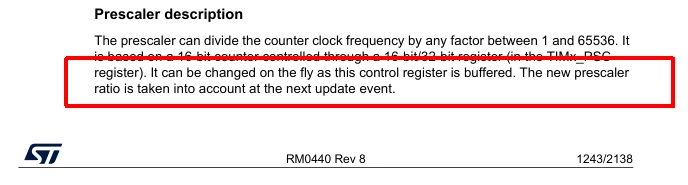
- after init, the timer runs with full clock speed, ignoring the pre-scaler
- after the first overflow, the pre-scaler is used
Here’s the UART output (which I confirmed with some timer controlled GPIO, where I actually found this problem, because the TIM2 controlled pulses where super-short after start-up, then okay):
directly after start:

T2    276587682    <- TIM2->CNT
TimMs 5762         <- TIM7 also set to 1 ms
Tick  5762

...

T2    476524324
TimMs 9927
Tick  9927

later, after 1st overflow, now OK: difference between T2 and Tick readings is about the same

T2    289650
TimMs 379129
Tick  379129

T2    294491
TimMs 383969
Tick  383969
What am I doing wrong?
As you can see, this set up code is so simple, only PSC set, then enable. Must something really stooopid…
Thanks in advance!