

STM32F446 synced timers with phase shift
Hello,
I'm using a Nucleo F446ZE to test timer capabilities to make a peak-and-hold PWM driver. I already have the core functionality where TIM1 uses DMA to run through a buffer of variable duty cycles at a higher frequency (e.g. 5 kHz) for the high-side mosfet. TIM2 is triggered by TIM1 to produce a synchronized signal that is low frequency (e.g. 1 Hz) for the low-side mosfet.
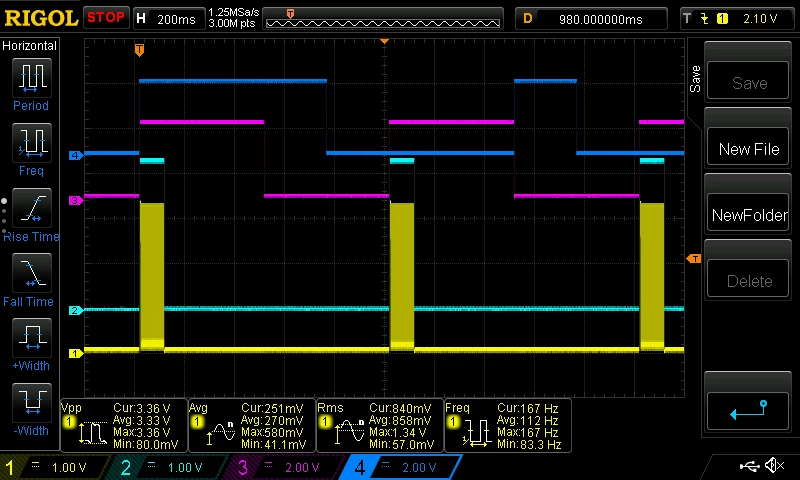
The problem I have now is making a third timer output that is synchronized to the first two but with a programmable phase shift. In reality I do have code that will make a synchronized, phase-shifted signal as shown in the image but there is an issue.
Image legend: TIM1 high-frequency (yellow), TIM2 low-frequency (cyan), TIM2 phase-shift falling-edge trigger (magenta), and TIM3 phase-shifted signal (blue).
What’s supposed to happen is that the blue line goes high on the falling edge of the magenta line, as seen in the 2nd half of the scope image. And this method does work except for the very first output cycle as seen in the 1st half of the scope image; the blue line goes high with all other timer outputs instead of being delayed.
My method to produce this is (code is below):
- Set TIM1 trigger output as enable (CNT_EN)
- Set TIM2 slave mode as trigger with source ITR0
- TIM2 CH1 is phase-shift falling-edge trigger. Output is PWM generation, where CCR1 sets the phase shift
- Set TIM2 trigger output as Compare Pulse (OC1). Corresponds to CH1 falling-edge.
- TIM2 CH2 is low-frequency PWM output
- Set TIM3 slave mode as trigger with source ITR1
- TIM3 CH1 is phase-shift signal
I just can’t figure out why the blue output is starting early for the first cycle. I tried changing the order of enabling the timers and capture compare channels, but that didn’t work. I also tried clearing the TIM2 SR_CC1IF, SR_TIF and EGR_TG bits just in case the TIM2 trigger output was being fired, all to no success.
I know there are other threads here that show using one pulse mode to do this. I tried that, but the problem is that there is a minimum non-zero delay with one pulse. I’m using this with a high-speed camera, and the majority of my time I’ll need no delay so that won’t work. This solution has no delay when programmed to do so, except for the first pulse.
Code to start timers
HAL_TIM_PWM_Start(&htim2, TIM_CHANNEL_1); // arm TIM2 CH1: phase-shift falling-edge trigger
HAL_TIM_PWM_Start(&htim2, TIM_CHANNEL_2); // arm TIM2 CH2: low-side mosfet
HAL_TIM_PWM_Start(&htim3, TIM_CHANNEL_1); // arm TIM3 CH1: phase-shift sync signal
HAL_TIM_PWM_Start_DMA(&htim1, TIM_CHANNEL_1, (uint32_t *)pData1, sizeof(pData1) / sizeof(pData1[0])); // start TIM1, triggers TIM2
TIM1 init
static void MX_TIM1_Init(void)
{

 /* USER CODE BEGIN TIM1_Init 0 */

 /* USER CODE END TIM1_Init 0 */

 TIM_ClockConfigTypeDef sClockSourceConfig = {0};
 TIM_MasterConfigTypeDef sMasterConfig = {0};
 TIM_OC_InitTypeDef sConfigOC = {0};
 TIM_BreakDeadTimeConfigTypeDef sBreakDeadTimeConfig = {0};

 /* USER CODE BEGIN TIM1_Init 1 */

 /* USER CODE END TIM1_Init 1 */
 htim1.Instance = TIM1;
 htim1.Init.Prescaler = 319;
 htim1.Init.CounterMode = TIM_COUNTERMODE_UP;
 htim1.Init.Period = 99;
 htim1.Init.ClockDivision = TIM_CLOCKDIVISION_DIV1;
 htim1.Init.RepetitionCounter = 0;
 htim1.Init.AutoReloadPreload = TIM_AUTORELOAD_PRELOAD_DISABLE;
 if (HAL_TIM_Base_Init(&htim1) != HAL_OK)
 {
 Error_Handler();
 }
 sClockSourceConfig.ClockSource = TIM_CLOCKSOURCE_INTERNAL;
 if (HAL_TIM_ConfigClockSource(&htim1, &sClockSourceConfig) != HAL_OK)
 {
 Error_Handler();
 }
 if (HAL_TIM_PWM_Init(&htim1) != HAL_OK)
 {
 Error_Handler();
 }
 sMasterConfig.MasterOutputTrigger = TIM_TRGO_ENABLE;
 sMasterConfig.MasterSlaveMode = TIM_MASTERSLAVEMODE_ENABLE;
 if (HAL_TIMEx_MasterConfigSynchronization(&htim1, &sMasterConfig) != HAL_OK)
 {
 Error_Handler();
 }
 sConfigOC.OCMode = TIM_OCMODE_PWM1;
 sConfigOC.Pulse = 0;
 sConfigOC.OCPolarity = TIM_OCPOLARITY_HIGH;
 sConfigOC.OCNPolarity = TIM_OCNPOLARITY_HIGH;
 sConfigOC.OCFastMode = TIM_OCFAST_DISABLE;
 sConfigOC.OCIdleState = TIM_OCIDLESTATE_RESET;
 sConfigOC.OCNIdleState = TIM_OCNIDLESTATE_RESET;
 if (HAL_TIM_PWM_ConfigChannel(&htim1, &sConfigOC, TIM_CHANNEL_1) != HAL_OK)
 {
 Error_Handler();
 }
 sBreakDeadTimeConfig.OffStateRunMode = TIM_OSSR_DISABLE;
 sBreakDeadTimeConfig.OffStateIDLEMode = TIM_OSSI_DISABLE;
 sBreakDeadTimeConfig.LockLevel = TIM_LOCKLEVEL_OFF;
 sBreakDeadTimeConfig.DeadTime = 0;
 sBreakDeadTimeConfig.BreakState = TIM_BREAK_DISABLE;
 sBreakDeadTimeConfig.BreakPolarity = TIM_BREAKPOLARITY_HIGH;
 sBreakDeadTimeConfig.AutomaticOutput = TIM_AUTOMATICOUTPUT_DISABLE;
 if (HAL_TIMEx_ConfigBreakDeadTime(&htim1, &sBreakDeadTimeConfig) != HAL_OK)
 {
 Error_Handler();
 }
 /* USER CODE BEGIN TIM1_Init 2 */

 /* USER CODE END TIM1_Init 2 */
 HAL_TIM_MspPostInit(&htim1);

}
TIM2 init
static void MX_TIM2_Init(void)
{

 /* USER CODE BEGIN TIM2_Init 0 */

 /* USER CODE END TIM2_Init 0 */

 TIM_ClockConfigTypeDef sClockSourceConfig = {0};
 TIM_SlaveConfigTypeDef sSlaveConfig = {0};
 TIM_MasterConfigTypeDef sMasterConfig = {0};
 TIM_OC_InitTypeDef sConfigOC = {0};

 /* USER CODE BEGIN TIM2_Init 1 */

 /* USER CODE END TIM2_Init 1 */
 htim2.Instance = TIM2;
 htim2.Init.Prescaler = 7999;
 htim2.Init.CounterMode = TIM_COUNTERMODE_UP;
 htim2.Init.Period = 9999;
 htim2.Init.ClockDivision = TIM_CLOCKDIVISION_DIV1;
 htim2.Init.AutoReloadPreload = TIM_AUTORELOAD_PRELOAD_DISABLE;
 if (HAL_TIM_Base_Init(&htim2) != HAL_OK)
 {
 Error_Handler();
 }
 sClockSourceConfig.ClockSource = TIM_CLOCKSOURCE_INTERNAL;
 if (HAL_TIM_ConfigClockSource(&htim2, &sClockSourceConfig) != HAL_OK)
 {
 Error_Handler();
 }
 if (HAL_TIM_PWM_Init(&htim2) != HAL_OK)
 {
 Error_Handler();
 }
 sSlaveConfig.SlaveMode = TIM_SLAVEMODE_TRIGGER;
 sSlaveConfig.InputTrigger = TIM_TS_ITR0;
 if (HAL_TIM_SlaveConfigSynchro(&htim2, &sSlaveConfig) != HAL_OK)
 {
 Error_Handler();
 }
 sMasterConfig.MasterOutputTrigger = TIM_TRGO_OC1;
 sMasterConfig.MasterSlaveMode = TIM_MASTERSLAVEMODE_DISABLE;
 if (HAL_TIMEx_MasterConfigSynchronization(&htim2, &sMasterConfig) != HAL_OK)
 {
 Error_Handler();
 }
 sConfigOC.OCMode = TIM_OCMODE_PWM1;
 sConfigOC.Pulse = 0;
 sConfigOC.OCPolarity = TIM_OCPOLARITY_HIGH;
 sConfigOC.OCFastMode = TIM_OCFAST_DISABLE;
 if (HAL_TIM_PWM_ConfigChannel(&htim2, &sConfigOC, TIM_CHANNEL_1) != HAL_OK)
 {
 Error_Handler();
 }
 if (HAL_TIM_PWM_ConfigChannel(&htim2, &sConfigOC, TIM_CHANNEL_2) != HAL_OK)
 {
 Error_Handler();
 }
 /* USER CODE BEGIN TIM2_Init 2 */

 /* USER CODE END TIM2_Init 2 */
 HAL_TIM_MspPostInit(&htim2);

}
TIM3 init
static void MX_TIM3_Init(void)
{

 /* USER CODE BEGIN TIM3_Init 0 */

 /* USER CODE END TIM3_Init 0 */

 TIM_ClockConfigTypeDef sClockSourceConfig = {0};
 TIM_SlaveConfigTypeDef sSlaveConfig = {0};
 TIM_MasterConfigTypeDef sMasterConfig = {0};
 TIM_OC_InitTypeDef sConfigOC = {0};

 /* USER CODE BEGIN TIM3_Init 1 */

 /* USER CODE END TIM3_Init 1 */
 htim3.Instance = TIM3;
 htim3.Init.Prescaler = 7999;
 htim3.Init.CounterMode = TIM_COUNTERMODE_UP;
 htim3.Init.Period = 9999;
 htim3.Init.ClockDivision = TIM_CLOCKDIVISION_DIV1;
 htim3.Init.AutoReloadPreload = TIM_AUTORELOAD_PRELOAD_DISABLE;
 if (HAL_TIM_Base_Init(&htim3) != HAL_OK)
 {
 Error_Handler();
 }
 sClockSourceConfig.ClockSource = TIM_CLOCKSOURCE_INTERNAL;
 if (HAL_TIM_ConfigClockSource(&htim3, &sClockSourceConfig) != HAL_OK)
 {
 Error_Handler();
 }
 if (HAL_TIM_PWM_Init(&htim3) != HAL_OK)
 {
 Error_Handler();
 }
 sSlaveConfig.SlaveMode = TIM_SLAVEMODE_TRIGGER;
 sSlaveConfig.InputTrigger = TIM_TS_ITR1;
 if (HAL_TIM_SlaveConfigSynchro(&htim3, &sSlaveConfig) != HAL_OK)
 {
 Error_Handler();
 }
 sMasterConfig.MasterOutputTrigger = TIM_TRGO_RESET;
 sMasterConfig.MasterSlaveMode = TIM_MASTERSLAVEMODE_DISABLE;
 if (HAL_TIMEx_MasterConfigSynchronization(&htim3, &sMasterConfig) != HAL_OK)
 {
 Error_Handler();
 }
 sConfigOC.OCMode = TIM_OCMODE_PWM1;
 sConfigOC.Pulse = 2499;
 sConfigOC.OCPolarity = TIM_OCPOLARITY_HIGH;
 sConfigOC.OCFastMode = TIM_OCFAST_DISABLE;
 if (HAL_TIM_PWM_ConfigChannel(&htim3, &sConfigOC, TIM_CHANNEL_1) != HAL_OK)
 {
 Error_Handler();
 }
 /* USER CODE BEGIN TIM3_Init 2 */

 /* USER CODE END TIM3_Init 2 */
 HAL_TIM_MspPostInit(&htim3);

}