


STM32F44: UART Noise/Frame error with externel CPU clock
Hi
I have a self designed board (STM32F44 MCU) with an UART communication. It works well as long as I configure it to use the internal clock. As soon as I switch to the external clock (oscillator), the UART communication gives a noise and frame error after each received byte. The software is the same except the clock config:
static void initExternalClock(void) {

 RCC_OscInitTypeDef RCC_OscInitStruct = {0};
 RCC_ClkInitTypeDef RCC_ClkInitStruct = {0};

 /** Configure the main internal regulator output voltage
 */
 __HAL_RCC_PWR_CLK_ENABLE();
 __HAL_PWR_VOLTAGESCALING_CONFIG(PWR_REGULATOR_VOLTAGE_SCALE3);

 /** Initializes the RCC Oscillators according to the specified parameters
 * in the RCC_OscInitTypeDef structure.
 */
 RCC_OscInitStruct.OscillatorType = RCC_OSCILLATORTYPE_LSI|RCC_OSCILLATORTYPE_HSE;
 RCC_OscInitStruct.HSEState = RCC_HSE_ON;
 RCC_OscInitStruct.LSIState = RCC_LSI_ON;
 RCC_OscInitStruct.PLL.PLLState = RCC_PLL_ON;
 RCC_OscInitStruct.PLL.PLLSource = RCC_PLLSOURCE_HSE;
 RCC_OscInitStruct.PLL.PLLM = 12;
 RCC_OscInitStruct.PLL.PLLN = 80;
 RCC_OscInitStruct.PLL.PLLP = RCC_PLLP_DIV2;
 RCC_OscInitStruct.PLL.PLLQ = 2;
 RCC_OscInitStruct.PLL.PLLR = 2;
 if (HAL_RCC_OscConfig(&RCC_OscInitStruct) != HAL_OK)
 {
 printLogError(ERR_HalClockError, "Configuration of system clock failed");
 errorHandler();
 }

 /** Initializes the CPU, AHB and APB buses clocks
 */
 RCC_ClkInitStruct.ClockType = RCC_CLOCKTYPE_HCLK|RCC_CLOCKTYPE_SYSCLK
 |RCC_CLOCKTYPE_PCLK1|RCC_CLOCKTYPE_PCLK2;
 RCC_ClkInitStruct.SYSCLKSource = RCC_SYSCLKSOURCE_PLLCLK;
 RCC_ClkInitStruct.AHBCLKDivider = RCC_SYSCLK_DIV1;
 RCC_ClkInitStruct.APB1CLKDivider = RCC_HCLK_DIV2;
 RCC_ClkInitStruct.APB2CLKDivider = RCC_HCLK_DIV2;

 if (HAL_RCC_ClockConfig(&RCC_ClkInitStruct, FLASH_LATENCY_2) != HAL_OK)
 {
 printLogError(ERR_HalClockError, "Configuration of system clock failed");
 errorHandler();
 }
}
static void initInternalClock(void) {
RCC_OscInitTypeDef RCC_OscInitStruct = {0};
RCC_ClkInitTypeDef RCC_ClkInitStruct = {0};
/** Configure the main internal regulator output voltage
*/
__HAL_RCC_PWR_CLK_ENABLE();
__HAL_PWR_VOLTAGESCALING_CONFIG(PWR_REGULATOR_VOLTAGE_SCALE3);
/** Initializes the RCC Oscillators according to the specified parameters
* in the RCC_OscInitTypeDef structure.
*/
RCC_OscInitStruct.OscillatorType = RCC_OSCILLATORTYPE_HSI|RCC_OSCILLATORTYPE_LSI;
RCC_OscInitStruct.HSIState = RCC_HSI_ON;
RCC_OscInitStruct.HSICalibrationValue = RCC_HSICALIBRATION_DEFAULT;
RCC_OscInitStruct.LSIState = RCC_LSI_ON;
RCC_OscInitStruct.PLL.PLLState = RCC_PLL_ON;
RCC_OscInitStruct.PLL.PLLSource = RCC_PLLSOURCE_HSI;
RCC_OscInitStruct.PLL.PLLM = 8;
RCC_OscInitStruct.PLL.PLLN = 80;
RCC_OscInitStruct.PLL.PLLP = RCC_PLLP_DIV2;
RCC_OscInitStruct.PLL.PLLQ = 2;
RCC_OscInitStruct.PLL.PLLR = 2;
if (HAL_RCC_OscConfig(&RCC_OscInitStruct) != HAL_OK)
{
printLogError(ERR_HalClockError, "Configuration of system clock failed");
errorHandler();
}
/** Initializes the CPU, AHB and APB buses clocks
*/
RCC_ClkInitStruct.ClockType = RCC_CLOCKTYPE_HCLK|RCC_CLOCKTYPE_SYSCLK
|RCC_CLOCKTYPE_PCLK1|RCC_CLOCKTYPE_PCLK2;
RCC_ClkInitStruct.SYSCLKSource = RCC_SYSCLKSOURCE_PLLCLK;
RCC_ClkInitStruct.AHBCLKDivider = RCC_SYSCLK_DIV1;
RCC_ClkInitStruct.APB1CLKDivider = RCC_HCLK_DIV2;
RCC_ClkInitStruct.APB2CLKDivider = RCC_HCLK_DIV2;
if (HAL_RCC_ClockConfig(&RCC_ClkInitStruct, FLASH_LATENCY_2) != HAL_OK)
{
printLogError(ERR_HalClockError, "Configuration of system clock failed");
errorHandler();
}
}
The configuration is done in a way that the core frequency is always 80MHz and does not depend on the selected clock source. I also measured the oscillator (forwarded to a GPIO ouput), it has 24MHz.
The UART configuration itself:
HAL_StatusTypeDef initUSART2xUART(void) {

 huart2.Instance = USART2;
 huart2.Init.BaudRate = 4800;
 huart2.Init.WordLength = UART_WORDLENGTH_8B;
 huart2.Init.StopBits = UART_STOPBITS_1;
 huart2.Init.Parity = UART_PARITY_EVEN;
 huart2.Init.Mode = UART_MODE_TX_RX;
 huart2.Init.HwFlowCtl = UART_HWCONTROL_NONE;
 huart2.Init.OverSampling = UART_OVERSAMPLING_16;

 if (HAL_UART_Init(&huart2) != HAL_OK) {
 printLogError(ERR_HalUartError,
 "RS485 initialization of UART3 failed, error code %u",
 huart2.ErrorCode);
 errorHandler();
 }

 initRs485DEnRePin();
 rs485SetDEnRE(ReceiverEnable);

 //Prepare for the first message
 if (HAL_UART_Receive_IT(&huart2, (uint8_t*) (&uart2Data), 1) != HAL_OK) {
 printLogError(ERR_HalUartError,
 "Initialization of interrupt receiving of UART2 failed, error code %u",
 huart2.ErrorCode);
 errorHandler();
 }

 //All errors are captured with error handler
 return HAL_OK;
}
I measured the hardware signal at the MCU input, it looks perfectly fine.
The setup: The MCU is the master, sends a message and an external device answers. The external device uses the same UART settings. The strange thing: There is an easy workaround. If I set the baud rate on the MCU to 4850 (but not on the external device), it works. For me, this seems to be some kind of sampling problem. I already tried UART_OVERSAMPLING_8, makes no difference.
Does anyone has an idea why this happens, why only with the external clock and what the solution is?
I found in the errara sheet this entry:
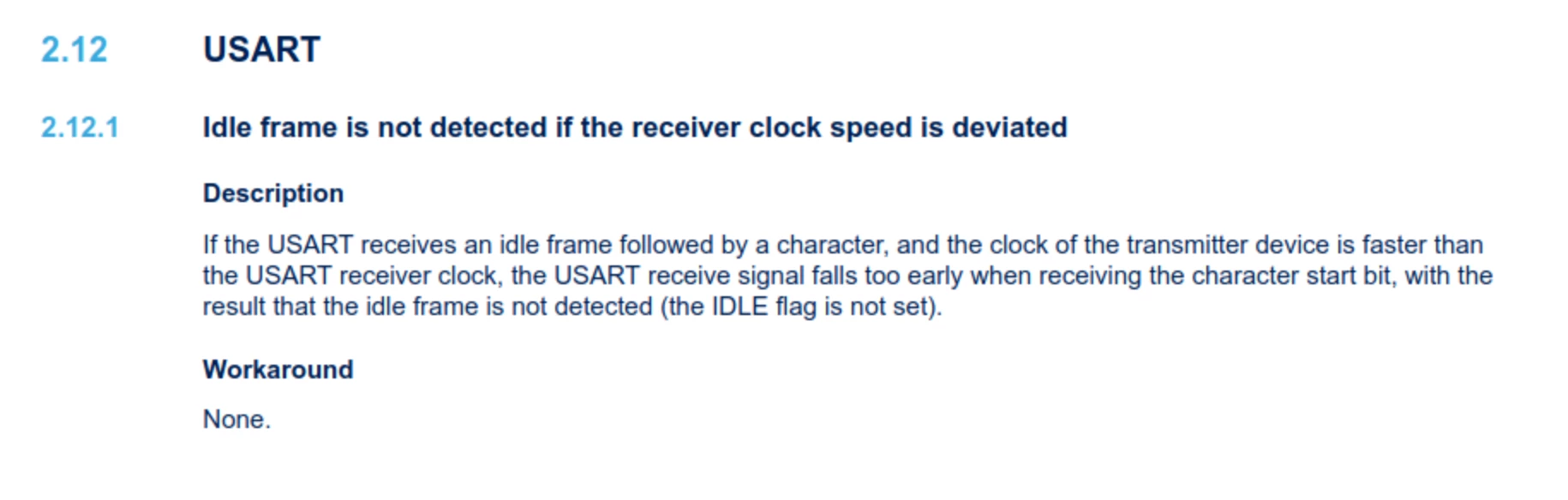
Is this somehow related?
Thank you.