

Visitor II
May 8, 2026
Solved

STM32C5 different information about LPUART features in datasheet and refmanual

  • May 8, 2026
  • 2 replies
  • 172 views

Hello,

I realized, that there are different informations about the features of LPUART1 in the datasheet and refmanual.
The datasheets (at least DS15125 and DS15136) probably falsely specify in Table 8, that the LPUART1 features receiver timeout interrupt, modbus com and auto baudrate detection.
In the refmanual (RM0522, Table 439) these features are specified as not supported. This seams to be the right information, when looking into CubeMX2, where the RTO for LPUART1 can not be activated.
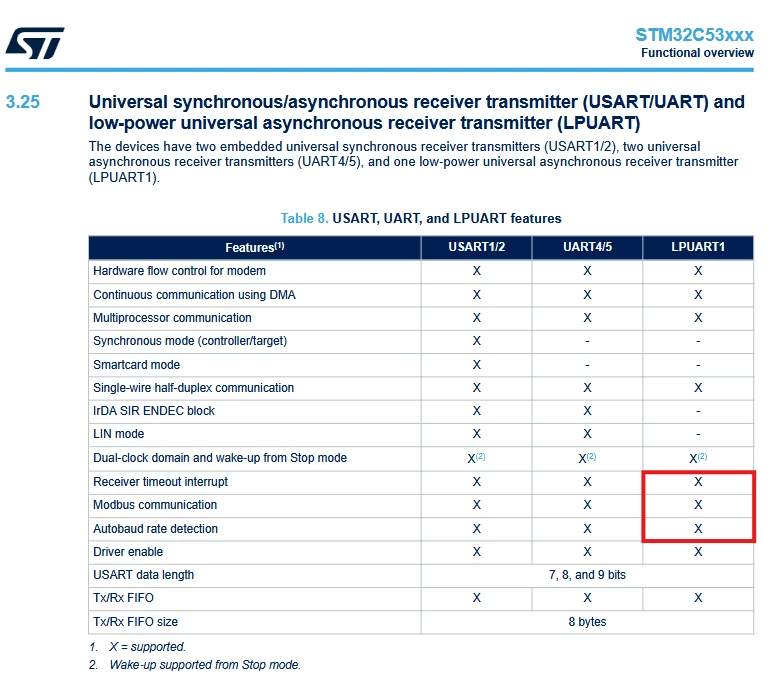
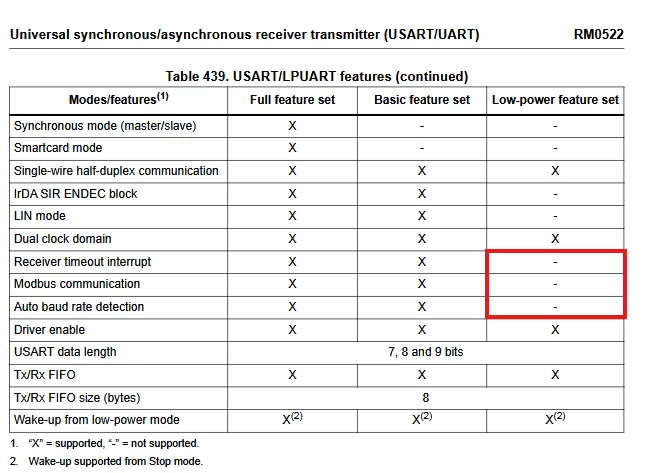
Screenshot 2026-05-08 153238.png


Screenshot 2026-05-08 153352.png


Best answer by mƎALLEm

Hello,

The reference manual is correct, the datasheet needs to be updated.

We agreed to remove the “Receiver timeout interrupt”, “Modbus communication”, “Auto baud rate detection” from Low-power feature set column in table USART, UART, and LPUART features. The document will be updated in one of the next releases of the document.

Hope I’ve answered your question.
 

2 replies

mƎALLEm
ST Technical Moderator
May 8, 2026

Hello @PhilRic and welcome to the ST community,

I'll escalate this for analysis and get back to you as soon I have any feedback. In ternal ticket for follow-up: CDM0062504.

Thank you for your contribution.

To give better visibility on the answered topics, please click "Best answer" on the reply which solved your issue or answered your question.
mƎALLEm
mƎALLEmBest answer
ST Technical Moderator
June 26, 2026

Hello,

The reference manual is correct, the datasheet needs to be updated.

We agreed to remove the “Receiver timeout interrupt”, “Modbus communication”, “Auto baud rate detection” from Low-power feature set column in table USART, UART, and LPUART features. The document will be updated in one of the next releases of the document.

Hope I’ve answered your question.
 

To give better visibility on the answered topics, please click "Best answer" on the reply which solved your issue or answered your question.