Associate II
April 15, 2024
Question

SPI - not recieving a response on MISO line

  • April 15, 2024
  • 20 replies
  • 11057 views

Hello everyone!

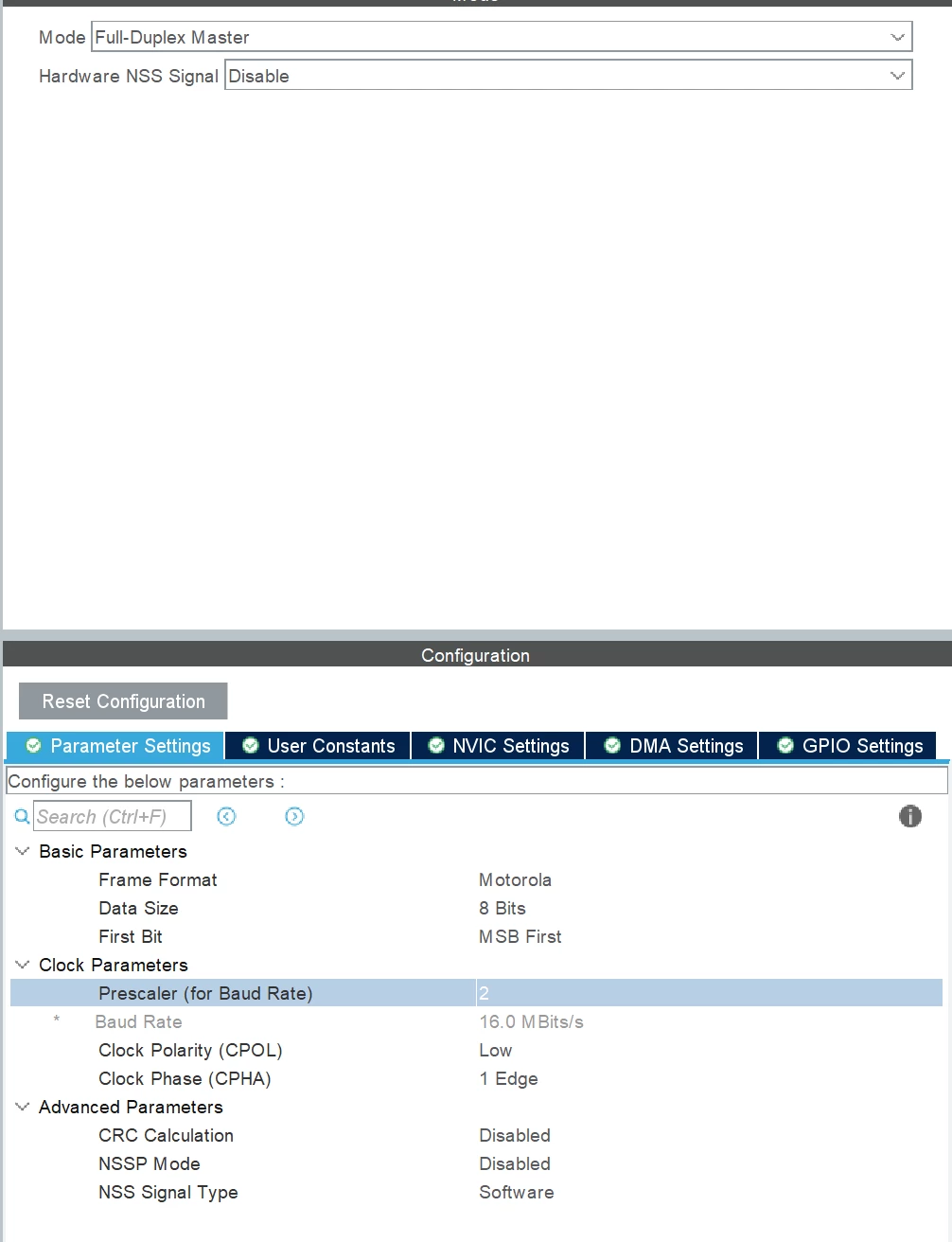
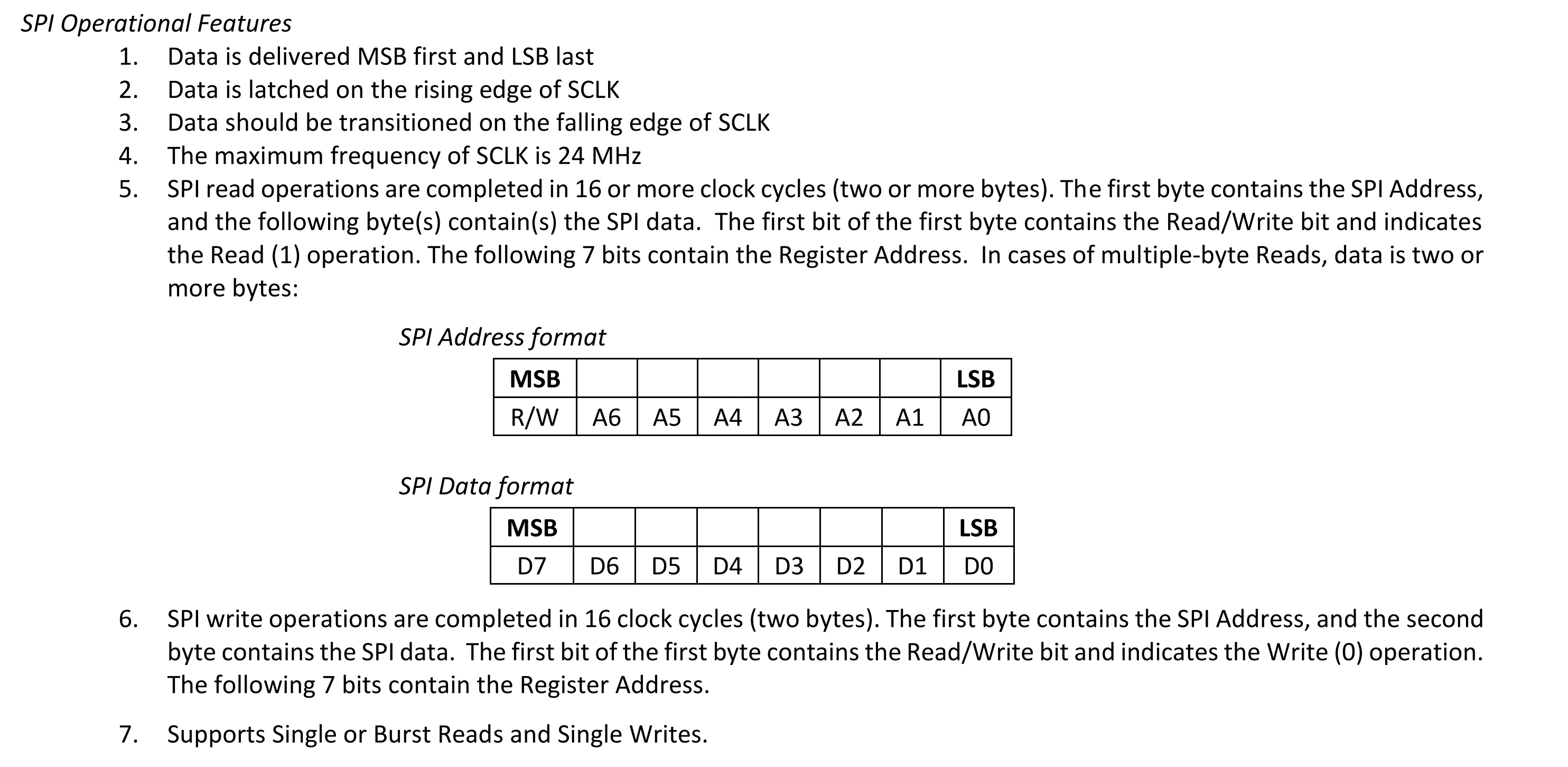
I'm trying to communicate with a slave device (ICM-42688-P: https://invensense.tdk.com/wp-content/uploads/2020/04/ds-000347_icm-42688-p-datasheet.pdf), but I don't recieve anything on the MISO line. I'm using the nucleo-wb55rg for the master device. The ICM-42688 typically needs 1.8V for the VDD and VDDIO, but the datasheet says it can be used between the range of 1.71V and 3.6V. Therefore I just used the nucleo's 3.3V pin output to power both. After that I configured the SPI following the datasheet:
AndrasToth_2-1713191910613.png

AndrasToth_3-1713191981610.png

The code I wrote for excercise is a read from the whoAmI register, which is at address 0x75 and contains the value of 0x47. However I only get 0s from the MISO line.

The code from main.c:

int main(void)
{
 /* USER CODE BEGIN 1 */

 /* USER CODE END 1 */

 /* MCU Configuration--------------------------------------------------------*/

 /* Reset of all peripherals, Initializes the Flash interface and the Systick. */
 HAL_Init();

 /* USER CODE BEGIN Init */

 /* USER CODE END Init */

 /* Configure the system clock */
 SystemClock_Config();

/* Configure the peripherals common clocks */
 PeriphCommonClock_Config();

 /* USER CODE BEGIN SysInit */

 /* USER CODE END SysInit */

 /* Initialize all configured peripherals */
 MX_GPIO_Init();
 MX_USART1_UART_Init();
 MX_USB_PCD_Init();
 MX_MEMORYMAP_Init();
 MX_SPI1_Init();
 /* USER CODE BEGIN 2 */
 char spi_buff[16] = {0};
 uint8_t addr = 0x00;
 uint8_t data[2] = {0};

 HAL_GPIO_WritePin(GPIOA, GPIO_PIN_4, GPIO_PIN_SET);

 // Set bank addr 0x76
 addr = 0x76;
 data[1] = 0x00 | addr;
 data[0] = 0x00;
 HAL_GPIO_WritePin(GPIOA, GPIO_PIN_4, GPIO_PIN_RESET);
 HAL_SPI_Transmit(&hspi1, (uint8_t *)data, 2, 100);
 HAL_GPIO_WritePin(GPIOA, GPIO_PIN_4, GPIO_PIN_SET);

 //Soft reset addr 0x11
 addr = 0x11;
 data[1] = 0x00 | addr;
 data[0] = 0x01;
 HAL_GPIO_WritePin(GPIOA, GPIO_PIN_4, GPIO_PIN_RESET);
 HAL_SPI_Transmit(&hspi1, (uint8_t *)data, 2, 100);
 HAL_GPIO_WritePin(GPIOA, GPIO_PIN_4, GPIO_PIN_SET);
 HAL_Delay(1);
 /* USER CODE END 2 */

 /* Infinite loop */
 /* USER CODE BEGIN WHILE */
 while (1)
 {
 /* USER CODE END WHILE */

 /* USER CODE BEGIN 3 */

	 // Get WhoIAM addr 0x75, value 0x47
	 addr = 0x75;
	 data[1] = 0x80 | addr;
	 data[0] = 0;
	 HAL_GPIO_WritePin(GPIOA, GPIO_PIN_4, GPIO_PIN_RESET);
	 HAL_SPI_Transmit(&hspi1, (uint8_t *)data, 2, 100);
	 HAL_SPI_Receive(&hspi1, (uint8_t *)spi_buff, 2, 100);
	 HAL_GPIO_WritePin(GPIOA, GPIO_PIN_4, GPIO_PIN_SET);
 }
 /* USER CODE END 3 */
}

What am I missing here? Did I messed up something in the code or it is more likely a hardver issue?


I am looking forward for your answers!


Yours faithfully,

AndrasToth



This topic has been closed for replies.

20 replies

MNapi
Senior II
April 15, 2024

the most common problem is that you try to read too fast after sending command

try:

HAL_GPIO_WritePin(GPIOA, GPIO_PIN_4, GPIO_PIN_RESET);
HAL_SPI_Transmit(&hspi1, (uint8_t *)data, 2, 100);


HAL_Delay(100);  //keep lowering delay to see if it still works or try higher setting


HAL_SPI_Receive(&hspi1, (uint8_t *)spi_buff, 2, 100);

HAL_Delay(100); 
HAL_GPIO_WritePin(GPIOA, GPIO_PIN_4, GPIO_PIN_SET);


also try interrupt mode sometimes it works better


Andrew Neil
Super User
April 15, 2024

The datasheet doesn't suggest any need for delays:

AndrewNeil_0-1713194625358.png


A complex system that works is invariably found to have evolved from a simple system that worked.A complex system designed from scratch never works and cannot be patched up to make it work.
MNapi
Senior II
April 15, 2024

look closer the SDO line is shifted a little bit to the right

so maybe you need only HAL_Delay(1) to do the job


he also deselects the chip too fast

HAL_GPIO_WritePin(GPIOA, GPIO_PIN_4, GPIO_PIN_SET);

before it can process the response.

if you are pounding it so fast in while() loop it might not work.

the response is never instantaneous it needs time to process data and request.

Andrew Neil
Super User
April 15, 2024

Have you used a logic analyser or oscilloscope to see what's actually happening on the wires?

A complex system that works is invariably found to have evolved from a simple system that worked.A complex system designed from scratch never works and cannot be patched up to make it work.
Associate II
April 17, 2024

Yes, I checked every line with oscilloscope and everything were working except the MISO line. On the MISO line I couldn't see anything.

Uwe Bonnes
Chief
April 15, 2024

Test your code on e.g. a Nucleo board and connect MOSI to MISO with a jumper wire.

AScha.3
Super User
April 15, 2024

Hi,

(after 30 mins on ds ...)

1. spi clk mode is wrong:

AScha3_0-1713198839245.png

set : cpol hi + cpha 2edge (as i see from this timing diagram)

AScha3_1-1713199138329.png

+ set in Cube/ioc : 

AScha3_3-1713200235542.png


2. command / response

AScha3_2-1713199377814.png

I would use :


/*HAL_SPI_TransmitReceive(SPI_HandleTypeDef *hspi, const uint8_t *pTxData, uint8_t *pRxData,
 uint16_t Size, uint32_t Timeout) */
uint8_t TxData[16], RxData[16];
so:
TxData[0] = 0x91 ; // read : whoami
HAL_SPI_TransmitReceive(&hspi1, TxData, RxData, 2 , 50);


The response should be in Rxdata[1] then.


3. set spi clk to 1 MHz or so, faster is no problem - if it works fine.


If you feel a post has answered your question, please click on " Best Answer ".
Associate II
April 17, 2024

I tried out your suggestion and it worked (on both cpol low & cpha 1 and cpol high & cpha 2). Now I can see data on the MISO line on the oscilloscope and the debugger. However I read on the MISO line 0x40 in spite of the WhoAmI register should contain 0x47. Do you have and idea where that 0x07 goes?

Andrew Neil
Super User
April 17, 2024

@AndrasToth wrote:

 I read on the MISO line 0x40 in


Is that the value you see on your scope, or the value you receive in your software?

A complex system that works is invariably found to have evolved from a simple system that worked.A complex system designed from scratch never works and cannot be patched up to make it work.
Associate II
April 18, 2024