

SPI issue. CLK Signal with a Level
Posted on November 25, 2013 at 16:08
Hi everyone,
I am trying to implement the SPI1 by hardware in my STM32F407VGT6, I did everything and actually it seems to work. But I was trying to read the ID from my SPI device (which is a Flash Memory) and it doesn't work. So I used my
oscilloscope
to watch the signal clock , and I got a CLK signal with a level on the bottom of it. Take a look, this picture shows my clk signal on my oscilloscope:
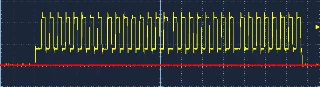
As you can see the Signal has a level at the moment to start the clock signal. So, What do you think is happening with this?, and what are the hardware considerations to implement the SPI?, Should I use External Resistors?
This is my code:
//=================================================================
// SPI1 MEMORIA TRABAJO FLASH
//=================================================================
#define PORT_SPI1_SCLK GPIOA ///
#define PIN_SPI1_SCLK GPIO_Pin_5 ///
#define PORT_SPI1_SCLK_CLK RCC_AHB1Periph_GPIOA ///
#define PIN_SPI1_SCLK_Source GPIO_PinSource5 ///
#define PORT_SPI1_MISO GPIOA ///
#define PIN_SPI1_MISO GPIO_Pin_6 ///
#define PORT_SPI1_MISO_CLK RCC_AHB1Periph_GPIOA ///
#define PIN_SPI1_MISO_Source GPIO_PinSource6 ///
#define PORT_SPI1_MOSI GPIOA ////
#define PIN_SPI1_MOSI GPIO_Pin_7 ////
#define PORT_SPI1_MOSI_CLK RCC_AHB1Periph_GPIOA ///
#define PIN_SPI1_MOSI_Source GPIO_PinSource7 ///
#define PORT_SPI1_CS GPIOA ///
#define PIN_SPI1_CS GPIO_Pin_4 ///
#define PORT_SPI1_CS_CLK RCC_AHB1Periph_GPIOA ///
#define PORT_WM_RST GPIOC ////
#define PIN_WM_RST GPIO_Pin_4 ////
#define PORT_WM_RST_CLK RCC_AHB1Periph_GPIOC /
//=======================MACROS====================================
#define SPI1_WM SPI1
#define SPI1_WM_AF GPIO_AF_SPI1
#define SPI1_WM_CLK RCC_APB2Periph_SPI1
#define SPI1_WM_CLK_CMD RCC_APB2PeriphClockCmd
#define WM_CS_LOW GPIO_SetBits(PORT_SPI1_CS,PIN_SPI1_CS)
#define WM_CS_HIGH GPIO_ResetBits(PORT_SPI1_CS,PIN_SPI1_CS)
//=======================COMMANDS====================================
#define WREN 0x06 //Write Enable
#define WRDI 0x04 //Write Disable
#define RDID 0x9F //Read Identification
#define RDSR 0x05 //Read Status Register
#define READ 0x03 //Read Data Bytes
#define FAST_READ 0x0B //Read Data Bytes at Higher Speed
#define PW 0x0A //Page Write
#define PP 0x02 //Page Program
#define PE 0xDB //Page Erase
#define SE 0xD8 //Sector Erase
#define DP 0xB9 //Deep Power-Down
#define RDP 0xAB //Release from Deep Power-Down
/* The main program */
int main(void)
{
Spi1_Open();
while(1)
{
WorkMemory_ID();
Delayms(30);
}
}
//====================READ STATUS=============================================
uint32_t WorkMemory_ID(void) { uint32_t ret = 0x00000000; int dat = 0x00; WM_CS_LOW; Spi1_Write(0x9F); dat = Spi1_Read(); ret = ( dat << 16) & 0x00FF0000; dat = Spi1_Read(); ret |= (dat << 8 ) & 0x0000FF00; dat = Spi1_Read(); ret |= (dat << 0 ) & 0x000000FF; WM_CS_HIGH; return ret; }
//======================SPI INIT===========================================
void Spi1_Open(void)
{ GPIO_InitTypeDef GPIO_InitStruct;
SPI_InitTypeDef SPI_InitStruct;
SPI1_WM_CLK_CMD(SPI1_WM_CLK, ENABLE); //Enable Clock SPI1
GPIO_CLK_CMD(PORT_SPI1_SCLK_CLK, ENABLE); //Enable Clock SCKL
GPIO_CLK_CMD(PORT_SPI1_MISO_CLK, ENABLE); //Enable Clock MISO
GPIO_CLK_CMD(PORT_SPI1_MOSI_CLK, ENABLE); //Enable Clock MOSI
GPIO_CLK_CMD(PORT_SPI1_CS_CLK, ENABLE); //Enable Clock CS
//********** Configure the Chip Select************//
GPIO_InitStruct.GPIO_Pin = PIN_SPI1_CS;
GPIO_InitStruct.GPIO_Mode = GPIO_Mode_OUT;
GPIO_InitStruct.GPIO_OType = GPIO_OType_PP;
GPIO_InitStruct.GPIO_Speed = GPIO_Speed_100MHz;
GPIO_InitStruct.GPIO_PuPd = GPIO_PuPd_UP;
GPIO_Init(PORT_SPI1_CS, &GPIO_InitStruct);
WM_CS_HIGH;
//************* Configure the SCLK****************//
GPIO_InitStruct.GPIO_Pin = PIN_SPI1_SCLK;
GPIO_InitStruct.GPIO_Mode= GPIO_Mode_AF;
GPIO_InitStruct.GPIO_OType = GPIO_OType_PP;
GPIO_InitStruct.GPIO_PuPd = GPIO_PuPd_NOPULL;
GPIO_InitStruct.GPIO_Speed = GPIO_Speed_100MHz;
GPIO_Init(PORT_SPI1_SCLK, &GPIO_InitStruct);
//************* Configure the MISO****************//
GPIO_InitStruct.GPIO_Pin = PIN_SPI1_MISO;
GPIO_InitStruct.GPIO_Mode= GPIO_Mode_AF;
GPIO_InitStruct.GPIO_OType = GPIO_OType_OD;
GPIO_InitStruct.GPIO_Speed = GPIO_Speed_100MHz;
GPIO_Init(PORT_SPI1_MISO, &GPIO_InitStruct);
//************* Configure the MOSI****************//
GPIO_InitStruct.GPIO_Pin = PIN_SPI1_MOSI ;
GPIO_InitStruct.GPIO_Mode= GPIO_Mode_AF;
GPIO_InitStruct.GPIO_OType = GPIO_OType_PP;
GPIO_InitStruct.GPIO_Speed = GPIO_Speed_100MHz;
GPIO_Init(PORT_SPI1_MOSI, &GPIO_InitStruct);
//**************Alternate Function SPI**********************//
GPIO_PinAFConfig(PORT_SPI1_MOSI, PIN_SPI1_MOSI_Source, SPI1_WM_AF);
GPIO_PinAFConfig(PORT_SPI1_MISO, PIN_SPI1_MISO_Source, SPI1_WM_AF);
GPIO_PinAFConfig(PORT_SPI1_SCLK, PIN_SPI1_SCLK_Source, SPI1_WM_AF);
//************** SPI Config ***************************//
SPI_InitStruct.SPI_Direction = SPI_Direction_2Lines_FullDuplex; // set to full duplex mode, seperate MOSI and MISO lines
SPI_InitStruct.SPI_Mode = SPI_Mode_Master; // transmit in master mode, NSS pin has to be always high
SPI_InitStruct.SPI_DataSize = SPI_DataSize_8b; // one packet of data is 8 bits wide
SPI_InitStruct.SPI_CPOL = SPI_CPOL_Low; // clock is low when idle
SPI_InitStruct.SPI_CPHA = SPI_CPHA_1Edge; // data sampled at first edge
SPI_InitStruct.SPI_NSS = SPI_NSS_Soft;// | SPI_NSSInternalSoft_Set; // set the NSS management to internal and pull internal NSS high
SPI_InitStruct.SPI_BaudRatePrescaler = SPI_BaudRatePrescaler_8; // SPI frequency is APB2 frequency / 4
SPI_InitStruct.SPI_FirstBit = SPI_FirstBit_MSB;// data is transmitted MSB first
SPI_Init(SPI1_WM, &SPI_InitStruct);
SPI_Cmd(SPI1_WM, ENABLE); // enable SPI1
}
#spi #stm32 #spi #stm32 #signal #clk #clk #signal #spi1
