Solved
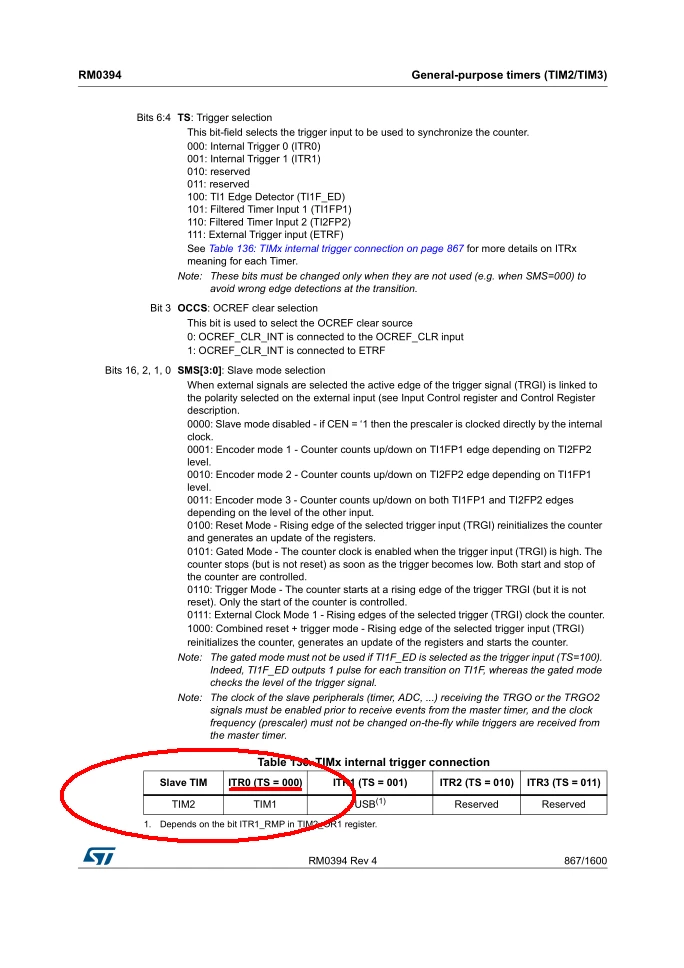
PWM gating by other timer on STM32L412
Hello,
In my project I need to generate 1s on, 1s off PWM signal in hardware.
First I checked if my PWM works with simple project, and it does.
But following AN4776 for N-pulse waveform generation application example - part 1.
LL_APB2_GRP1_EnableClock(LL_APB2_GRP1_PERIPH_TIM1);
LL_APB1_GRP1_EnableClock(LL_APB1_GRP1_PERIPH_TIM2);

 LL_TIM_DeInit(TIM1);
 LL_TIM_DeInit(TIM2);

 uint32_t Tim2Prescaler= (uint16_t) (80000000 / 1000000) - 1;
 uint32_t Period2 = 1000000 / 20000;

 TIM2->PSC = Tim2Prescaler;
 TIM2->ARR = Period2-1;
 TIM2->RCR = ((uint32_t) 32768) -1;
 TIM2->CCR1 = Period2 / 2;
 TIM2->CR1 &= ~ TIM_CR1_CKD;
 TIM2->CR1 |= LL_TIM_CLOCKDIVISION_DIV1;
 TIM2->CR1 &= ~(TIM_CR1_DIR | TIM_CR1_CMS);
 TIM2->CR1 |= LL_TIM_COUNTERMODE_UP;
 TIM2->CCMR1 &= ~TIM_CCMR1_OC1M;
 TIM2->CCMR1 &= ~TIM_CCMR1_CC1S;
 TIM2->CCMR1 |= LL_TIM_OCMODE_PWM1;
 TIM2->CR1 |= TIM_CR1_OPM;
 TIM2->SMCR &= ~TIM_SMCR_TS;
 TIM2->SMCR |= LL_TIM_TS_ITR1;
 TIM2->SMCR &= ~TIM_SMCR_SMS;
 TIM2->SMCR |= LL_TIM_SLAVEMODE_TRIGGER;
 TIM2->CCMR1 |= TIM_CCMR1_OC1PE;
 TIM2->EGR |= TIM_EGR_UG;
 TIM2->BDTR |= TIM_BDTR_MOE;
 TIM2->CCER &= ~TIM_CCER_CC1P;
 TIM2->CCER |= LL_TIM_OCPOLARITY_LOW;
 TIM2->CCER |= TIM_CCER_CC1E;
 TIM2->CR1 |= TIM_CR1_CEN;

 uint32_t Tim1Prescaler= (uint16_t) ((80000000 ) / 1000000) - 1;
 uint32_t Period = 1000000/50; /* configure the period */
 TIM1->ARR = Period-1;
 TIM1->PSC = Tim1Prescaler;
 TIM1->CR1 &= ~ TIM_CR1_CKD;
 TIM1->CR1 |= LL_TIM_CLOCKDIVISION_DIV1;
 TIM1->CR1 &= ~(TIM_CR1_DIR | TIM_CR1_CMS);
 TIM1->CR1 |= LL_TIM_COUNTERMODE_UP;

 TIM2->CR2 &= ~ TIM_CR2_MMS;
 TIM1->CR2 |= LL_TIM_TRGO_UPDATE;

 TIM1->CR1 |= TIM_CR1_CEN;
So my Master Timer is timer 1 to generate events to generate n-th signals from TIM2. But the problem is, i just get nothing. PA15 is also enabled with based on working example with just TIM2 pwm generation:
 LL_GPIO_InitTypeDef GPIO_InitStruct = {0};
 LL_AHB2_GRP1_EnableClock(LL_AHB2_GRP1_PERIPH_GPIOA);
 //PA15 (JTDI) ------> TIM2_CH1
 GPIO_InitStruct.Pin = LL_GPIO_PIN_15;
 GPIO_InitStruct.Mode = LL_GPIO_MODE_ALTERNATE;
 GPIO_InitStruct.Speed = LL_GPIO_SPEED_FREQ_LOW;
 GPIO_InitStruct.OutputType = LL_GPIO_OUTPUT_PUSHPULL;
 GPIO_InitStruct.Pull = LL_GPIO_PULL_NO;
 GPIO_InitStruct.Alternate = LL_GPIO_AF_1;
 LL_GPIO_Init(GPIOA, &GPIO_InitStruct);
Any one could spot the problem ?