Interpreting “lowest power” as the lowest typical current in the device’s lowest-power mode, the best recommendation is STM32L412C8T6. It was identified with a typical lowest-power supply current of 0.01 µA, a 1.71 V to 3.6 V supply range, and a typical run-mode current of 70 µA/MHz.
Detailed Explanation
Recommended part
STM32L412C8T6
Metric
Value
Product line
Ultra Low Power
Lowest-power supply current, typ
0.01 µA
Run-mode supply current, typ
70 µA/MHz
Supply voltage range
1.71 V to 3.6 V
Why I recommend it
Among the STM32 parts compared, STM32L412C8T6 is the one identified with the lowest typical supply current in the lowest-power mode at 0.01 µA. If your application spends most of its time sleeping and wakes only occasionally, this is the strongest recommendation from the available data.
Important nuance: “lowest power” can mean different things
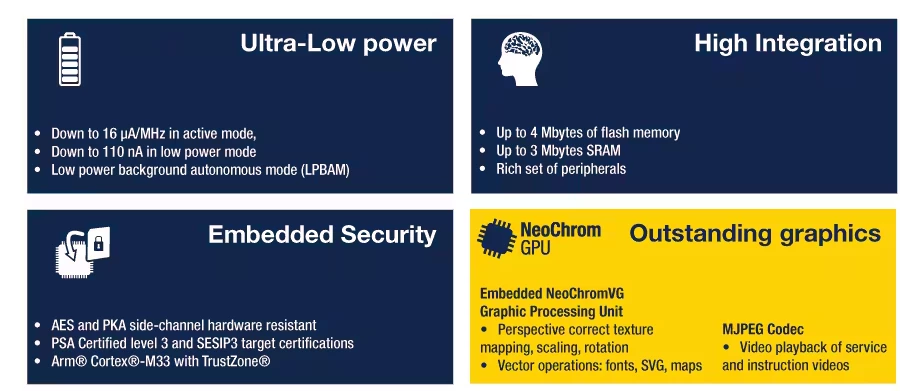
If by “lowest power” you mean lowest current in active/run mode, then STM32U5 is also a strong candidate: it can go down to 16.3 µA/MHz in active mode, while also offering 200 nA in standby, 1.4 µA in Stop 3 with 16 KB SRAM, and 4.6 µA in Stop 2 with 274 KB RAM.
If you mean lowest documented shutdown current from the ultra-low-power series documents, STM32U0 is extremely low as well: 16 nA in shutdown without RTC, 30 nA in standby without RTC, 630 nA in Stop 2 with full retention and RTC, and 52 µA/MHz at 48 MHz in Run mode.
Practical recommendation
Choose STM32L412C8T6 if your priority is the absolute lowest deepest-sleep current from the compared STM32 portfolio.
Choose STM32U5 if you want a very low-power MCU with especially strong active-mode efficiency and multiple retained-memory stop modes.
Choose STM32U0 if you want an ultra-low-power option with documented nA-level shutdown and standby figures.
Now, what is the MCU among this list is having the SDMMC interface. The answer is the STM32U5 series (an Ultra Low Power MCU):
I have some advice in relation to power consumption and bitrate.
Wear-leveling
SD-cards do wear-leveling in the background that can lock up the SD-card for a few hundred milliseconds. This information may be outdated, but the last time I worked with a class 10 SD-card it periodically locked up for 200 milliseconds and sometimes twice in a row for a total of 400 milliseconds. In my application I needed a high bitrate of data streaming to the SD-card. The wear-leveling delay was killing, but I was able to resolve it by using large circular buffers to cache the data (if I recall I used 64k in buffers). How much RAM you use affects power consumption. And while the SD-card is busy you might be able to sleep. If you are busy waiting while the SD-card is waiting this will consume unnecessary current.
Pre-allocate files
If you pre-allocate files and erase its sectors (setting the bytes to 0xFF) you can save a lot of time while writing data. Having to constantly resize the file and erase sectors during writing can take time, which reduces effective bitrate and reduces time spend sleeping.
SD-card current consumption
SD-cards are not low power devices. They can consume a lot of current even while idle. If you don’t need to always use the SD-card I recommend an electronic switch to switch the SD-card power off while your application is idle.
"Kudo posts if you have the same problem and kudo replies if the solution works.Click ""Accept as Solution"" if a reply solved your problem. If no solution was posted please answer with your own."
@HKPhysicist Note that you don’t necessarily have to use a file system.
Again, this is a tradeoff that you will have to make depending on your specific requirements & constraints.
A complex system that works is invariably found to have evolved from a simple system that worked.A complex system designed from scratch never works and cannot be patched up to make it work.
Since you've narrowed your choice to STM32U5, I'd suggest evaluating the STM32U5A5ZJT6Q. Its Cortex-M33 core runs at up to 160 MHz. It provides two SDMMC peripherals. Its DMA capabilities reduce continuous CPU involvement. Its 2.5 MB SRAM provides substantial buffering capacity. Its ultra-low-power architecture offers several low-power operating modes.