

GSpre.1
Associate II
August 26, 2020
Solved

Performance characteristics of SDRAM on STM32F7508-DISCO board

  • August 26, 2020
  • 1 reply
  • 5292 views

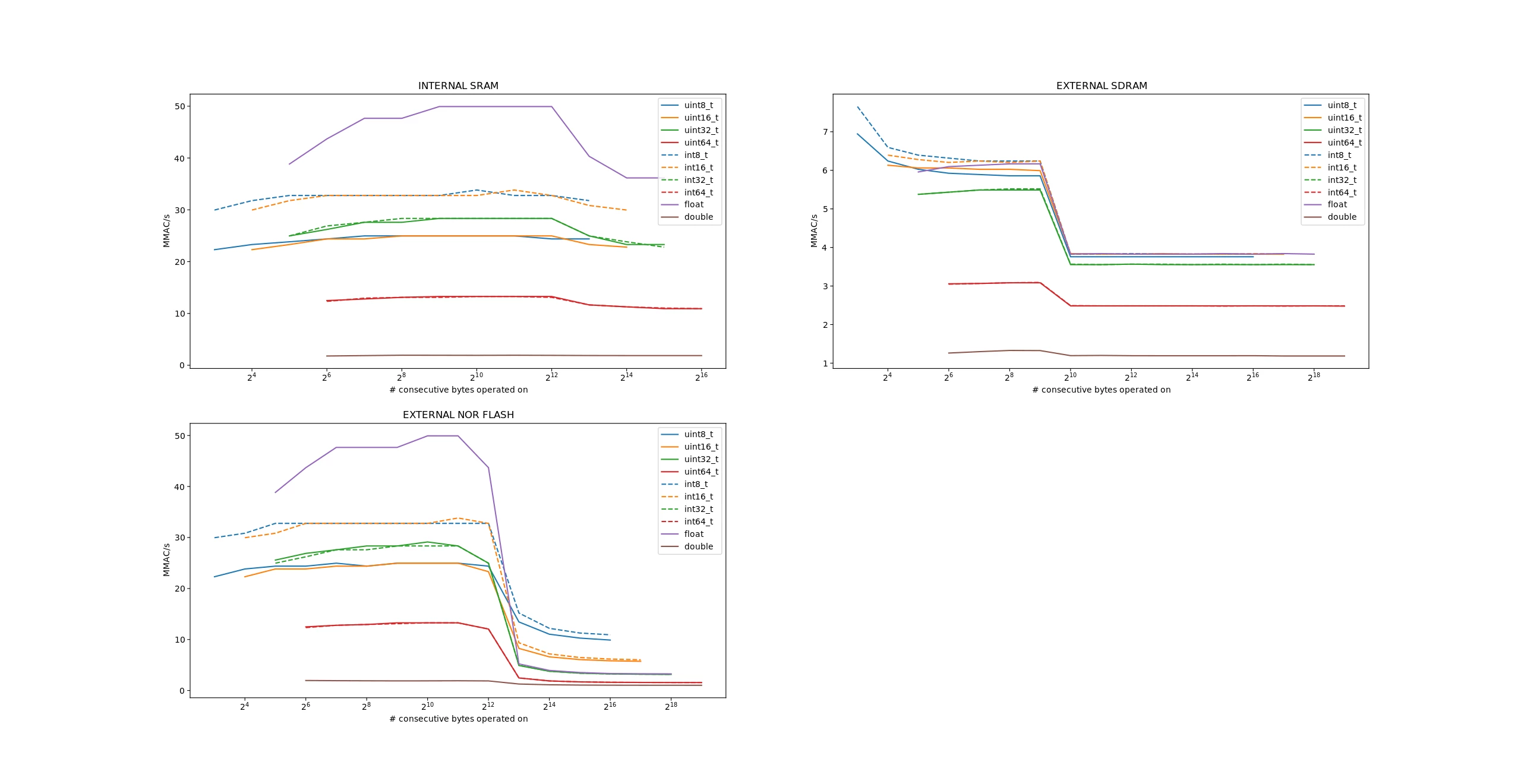
Below is my benchmarking of multply-accumulate performance on contiguous memory blocks on the STM32F7508-DK board for three different types of memory (on-chip SRAM, external SDRAM managed by the FMC, and QSPI-connected NOR flash):
0693W000002lEueQAE.png

The horizontal axes give the size of the contiguous memory region operated on, and the vertical axes gives the number of millions of multiply-accumulates per second.

One observation that makes sense to me is that performance in all cases drops markedly once the contiguous memory block grows beyond 2^12 B = 4 kiB = the cache size.

The primary thing I don't understand is why the external SDRAM performance is so much worse in the small-size region. Can someone elaborate on this?

The board, SDRAM and NOR flash are all initialized by the STM32CubeF7's BSP functions and templates for the STM32F7508-DISCO board.

While the absolute numbers differ, the overall qualitative behavior is the same across optimization levels from -O0 to -O3.


This topic has been closed for replies.
Best answer by Tesla DeLorean

Diagram looks to show SDRAM is an order of magnitude slow than SRAM, if I'm reading it right.

More likely something in the MPU settings as to whether the memory is bufferable/cacheable

1 reply

TDK
Super User
August 27, 2020

Do you have instruction and data cache enabled? It could be that the larger sizes produce more cache misses. Can you share the actual code being tested?

"If you feel a post has answered your question, please click ""Accept as Solution""."
Tesla DeLorean
Tesla DeLoreanBest answer
Guru
August 27, 2020

Diagram looks to show SDRAM is an order of magnitude slow than SRAM, if I'm reading it right.

More likely something in the MPU settings as to whether the memory is bufferable/cacheable

Tips, Buy me a coffee, or three.. PayPal VenmoUp vote any posts that you find helpful, it shows what's working..
GSpre.1
GSpre.1Author
Associate II
August 27, 2020

Exactly. And an order of magnitude slower than the NOR flash. This is indeed what's puzzling me.

I will look into the MPU settings about bufferable/cacheable memory. Thank you for the hint!