Associate
May 16, 2024
Question

Overwrite 4 Bytes at given location in Hex file

Write 4 Bytes at given location in Hex file (Flash segment)

I tried this:

const uint32_t __attribute__ ((section(".checksumdata"), used)) CodeChecksum = 0x12345678;

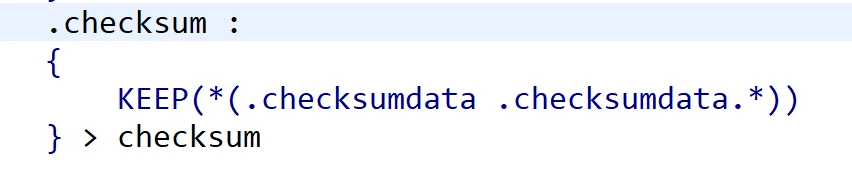
Jayant_0-1715865618048.png


Jayant_1-1715865693572.png

But when I build code, It doesn't changes only ".checksumdata", but also other intermittent bytes in hex file. How we can resolve this issue?

This topic has been closed for replies.

7 replies

Peter BENSCH
ST Technical Moderator
May 16, 2024

Welcome @Jayant, to the community!

A hex file in Intel format consists not only of the data bytes, address and length, but also the checksum of the respective record. So if you change the value of CodeChecksum, the checksum at the end of the record will inevitably change as well.

Have you made a text comparison of such hex files and what exactly is the difference?

Regards
/Peter

In order to give better visibility on the answered topics, please click on Accept as Solution on the reply which solved your issue or answered your question.
JayantAuthor
Associate
May 17, 2024

But when I build code, It doesn't changes only ".checksumdata", but also other intermittent line in hex file. How we can resolve this issue?

const uint32_t __attribute__ ((section(".checksumdata"), used)) CodeChecksum = 0x61d6714;

Expected:

Jayant_1-1715921898381.png

Not expected:

Jayant_0-1715921852126.png


Lead II
May 17, 2024

Writing any flash device is always done via "pages": you cannot write a single word in a flash device:

It works this way:

  • read a page (the page size depends on the device, e.g. 1K or often 4K)
  • when read to memory: modify the single word (in RAM copy)
  • go to flash and erase the page
  • write the entire page back (from the modified RAM copy)

Flash memories are not RAMs! They are always managed by "pages" (or sectors).

JayantAuthor
Associate
May 20, 2024

I don't want to write in runtime, I need to right variable in FLASH memory at the time of building code when creating hex file

Senior III
May 17, 2024

One simple trick is to create a pointer with uint32_t *var1 = (uint32_t *)0x0800FC00;

Then assign the value in your main() function as var1 = 0x12345678;

"If you feel a post has answered your question, please click ""Accept as Solution""."
Andreas Bolsch
Lead III
May 21, 2024

As I wanted to have CRC at very end of flash, too, I did the  following: In ld script:

/* CRC32 checksum goes into FLASH at the very end */
.chcksm ORIGIN(FLASH) + LENGTH(FLASH) - 4 :
{
. = ALIGN(4);
KEEP(*(.chcksm))
. = ALIGN(4);
} >FLASH

I.e. no extra memory section required. Then 'objcopy -O srec --gap-fill 0xFF file.elf file.hex'. This will emit the line with the checksum in a fixed 16-byte record. Finally my Makefile gets start and end addresses, calculates the actual checksum incl. the required srecord stuff and injects that into the srecord file:

BEG=$$(nm $< | sed -n -E 's/^(\w+).*_sidata$$/\1/p' | tr [:lower:] [:upper:]); \
END=$$(nm $< | sed -n -E 's/^(\w+).*chcksm$$/\1/p' | tr [:lower:] [:upper:]); \
CHCKSM=$$(./$(BUILD_DIR)/calc_crc32 $@ 0x$${BEG} 0x$${END}); \
sed -i -E "s/^S3..$${END}.*$$/$${CHCKSM}/" $@;

Slightly cumbersome, but once it works, it does work as desired.