Solved
Nucleo STM32H723ZG - CAN not working
Hello,
i have a question about the stm32h723. I tried setting up the CAN peripheral and it's not working. I absolutely don't know why. Can anybody help me out please?
My Sourcecode looks like the following:
/* USER CODE BEGIN Header */
/**
 ******************************************************************************
 * @file : main.c
 * @brief : Main program body
 ******************************************************************************
 * @attention
 *
 * Copyright (c) 2024 STMicroelectronics.
 * All rights reserved.
 *
 * This software is licensed under terms that can be found in the LICENSE file
 * in the root directory of this software component.
 * If no LICENSE file comes with this software, it is provided AS-IS.
 *
 ******************************************************************************
 */
/* USER CODE END Header */
/* Includes ------------------------------------------------------------------*/
#include "main.h"

/* Private includes ----------------------------------------------------------*/
/* USER CODE BEGIN Includes */

/* USER CODE END Includes */

/* Private typedef -----------------------------------------------------------*/
/* USER CODE BEGIN PTD */

/* USER CODE END PTD */

/* Private define ------------------------------------------------------------*/
/* USER CODE BEGIN PD */
/* USER CODE END PD */

/* Private macro -------------------------------------------------------------*/
/* USER CODE BEGIN PM */

/* USER CODE END PM */

/* Private variables ---------------------------------------------------------*/

FDCAN_HandleTypeDef hfdcan2;

/* USER CODE BEGIN PV */
FDCAN_RxHeaderTypeDef RxHeader;
uint8_t RxData[8];
/* USER CODE END PV */

/* Private function prototypes -----------------------------------------------*/
void SystemClock_Config(void);
static void MX_GPIO_Init(void);
static void MX_FDCAN2_Init(void);
/* USER CODE BEGIN PFP */

/* USER CODE END PFP */

/* Private user code ---------------------------------------------------------*/
/* USER CODE BEGIN 0 */

/* USER CODE END 0 */

/**
 * @brief The application entry point.
 * @retval int
 */
int main(void)
{
 /* USER CODE BEGIN 1 */

 /* USER CODE END 1 */

 /* MCU Configuration--------------------------------------------------------*/

 /* Reset of all peripherals, Initializes the Flash interface and the Systick. */
 HAL_Init();

 /* USER CODE BEGIN Init */

 /* USER CODE END Init */

 /* Configure the system clock */
 SystemClock_Config();

 /* USER CODE BEGIN SysInit */

 /* USER CODE END SysInit */

 /* Initialize all configured peripherals */
 MX_GPIO_Init();
 MX_FDCAN2_Init();
 /* USER CODE BEGIN 2 */
 FDCAN_TxHeaderTypeDef hdr = {
		 .Identifier = 0x700,
		 .IdType = FDCAN_STANDARD_ID,
		 .TxFrameType = FDCAN_DATA_FRAME,
		 .DataLength = FDCAN_DLC_BYTES_2,

		 .ErrorStateIndicator = FDCAN_ESI_ACTIVE,
		 .BitRateSwitch = FDCAN_BRS_OFF,
		 .FDFormat = FDCAN_CLASSIC_CAN,
		 .TxEventFifoControl = FDCAN_STORE_TX_EVENTS,
		 .MessageMarker = 0x0

 };
 uint16_t x = 0xff22;
 HAL_FDCAN_AddMessageToTxFifoQ(&hfdcan2, &hdr, &x);

 /* USER CODE END 2 */

 /* Infinite loop */
 /* USER CODE BEGIN WHILE */
 while (1)
 {

 /* USER CODE END WHILE */

 /* USER CODE BEGIN 3 */
 }
 /* USER CODE END 3 */
}

/**
 * @brief System Clock Configuration
 * @retval None
 */
void SystemClock_Config(void)
{
 RCC_OscInitTypeDef RCC_OscInitStruct = {0};
 RCC_ClkInitTypeDef RCC_ClkInitStruct = {0};

 /** Supply configuration update enable
 */
 HAL_PWREx_ConfigSupply(PWR_LDO_SUPPLY);

 /** Configure the main internal regulator output voltage
 */
 __HAL_PWR_VOLTAGESCALING_CONFIG(PWR_REGULATOR_VOLTAGE_SCALE3);

 while(!__HAL_PWR_GET_FLAG(PWR_FLAG_VOSRDY)) {}

 /** Initializes the RCC Oscillators according to the specified parameters
 * in the RCC_OscInitTypeDef structure.
 */
 RCC_OscInitStruct.OscillatorType = RCC_OSCILLATORTYPE_HSI;
 RCC_OscInitStruct.HSIState = RCC_HSI_DIV1;
 RCC_OscInitStruct.HSICalibrationValue = 64;
 RCC_OscInitStruct.PLL.PLLState = RCC_PLL_ON;
 RCC_OscInitStruct.PLL.PLLSource = RCC_PLLSOURCE_HSI;
 RCC_OscInitStruct.PLL.PLLM = 4;
 RCC_OscInitStruct.PLL.PLLN = 12;
 RCC_OscInitStruct.PLL.PLLP = 2;
 RCC_OscInitStruct.PLL.PLLQ = 4;
 RCC_OscInitStruct.PLL.PLLR = 2;
 RCC_OscInitStruct.PLL.PLLRGE = RCC_PLL1VCIRANGE_3;
 RCC_OscInitStruct.PLL.PLLVCOSEL = RCC_PLL1VCOWIDE;
 RCC_OscInitStruct.PLL.PLLFRACN = 0;
 if (HAL_RCC_OscConfig(&RCC_OscInitStruct) != HAL_OK)
 {
 Error_Handler();
 }

 /** Initializes the CPU, AHB and APB buses clocks
 */
 RCC_ClkInitStruct.ClockType = RCC_CLOCKTYPE_HCLK|RCC_CLOCKTYPE_SYSCLK
 |RCC_CLOCKTYPE_PCLK1|RCC_CLOCKTYPE_PCLK2
 |RCC_CLOCKTYPE_D3PCLK1|RCC_CLOCKTYPE_D1PCLK1;
 RCC_ClkInitStruct.SYSCLKSource = RCC_SYSCLKSOURCE_HSI;
 RCC_ClkInitStruct.SYSCLKDivider = RCC_SYSCLK_DIV1;
 RCC_ClkInitStruct.AHBCLKDivider = RCC_HCLK_DIV1;
 RCC_ClkInitStruct.APB3CLKDivider = RCC_APB3_DIV2;
 RCC_ClkInitStruct.APB1CLKDivider = RCC_APB1_DIV2;
 RCC_ClkInitStruct.APB2CLKDivider = RCC_APB2_DIV2;
 RCC_ClkInitStruct.APB4CLKDivider = RCC_APB4_DIV2;

 if (HAL_RCC_ClockConfig(&RCC_ClkInitStruct, FLASH_LATENCY_1) != HAL_OK)
 {
 Error_Handler();
 }
}

/**
 * @brief FDCAN2 Initialization Function
 * @PAram None
 * @retval None
 */
static void MX_FDCAN2_Init(void)
{

 /* USER CODE BEGIN FDCAN2_Init 0 */
	 FDCAN_FilterTypeDef sFilterConfig;
 /* USER CODE END FDCAN2_Init 0 */

 /* USER CODE BEGIN FDCAN2_Init 1 */

 /* USER CODE END FDCAN2_Init 1 */
 hfdcan2.Instance = FDCAN2;
 hfdcan2.Init.FrameFormat = FDCAN_FRAME_CLASSIC;
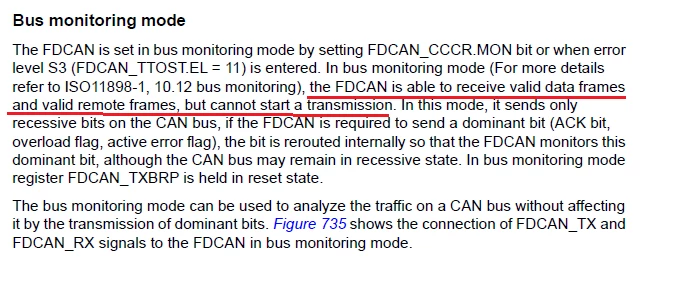
 hfdcan2.Init.Mode = FDCAN_MODE_BUS_MONITORING;
 hfdcan2.Init.AutoRetransmission = ENABLE;
 hfdcan2.Init.TransmitPause = DISABLE;
 hfdcan2.Init.ProtocolException = DISABLE;
 hfdcan2.Init.NominalPrescaler = 12;
 hfdcan2.Init.NominalSyncJumpWidth = 1;
 hfdcan2.Init.NominalTimeSeg1 = 13;
 hfdcan2.Init.NominalTimeSeg2 = 2;
 hfdcan2.Init.DataPrescaler = 12;
 hfdcan2.Init.DataSyncJumpWidth = 1;
 hfdcan2.Init.DataTimeSeg1 = 13;
 hfdcan2.Init.DataTimeSeg2 = 2;
 hfdcan2.Init.MessageRAMOffset = 0;
 hfdcan2.Init.StdFiltersNbr = 4;
 hfdcan2.Init.ExtFiltersNbr = 4;
 hfdcan2.Init.RxFifo0ElmtsNbr = 3;
 hfdcan2.Init.RxFifo0ElmtSize = FDCAN_DATA_BYTES_8;
 hfdcan2.Init.RxFifo1ElmtsNbr = 0;
 hfdcan2.Init.RxFifo1ElmtSize = FDCAN_DATA_BYTES_8;
 hfdcan2.Init.RxBuffersNbr = 0;
 hfdcan2.Init.RxBufferSize = FDCAN_DATA_BYTES_8;
 hfdcan2.Init.TxEventsNbr = 3;
 hfdcan2.Init.TxBuffersNbr = 0;
 hfdcan2.Init.TxFifoQueueElmtsNbr = 3;
 hfdcan2.Init.TxFifoQueueMode = FDCAN_TX_FIFO_OPERATION;
 hfdcan2.Init.TxElmtSize = FDCAN_DATA_BYTES_8;
 if (HAL_FDCAN_Init(&hfdcan2) != HAL_OK)
 {
 Error_Handler();
 }
 /* USER CODE BEGIN FDCAN2_Init 2 */
 /* Configure Rx filter */
 sFilterConfig.IdType = FDCAN_STANDARD_ID;
 sFilterConfig.FilterIndex = 0;
 sFilterConfig.FilterType = FDCAN_FILTER_MASK;
 sFilterConfig.FilterConfig = FDCAN_FILTER_TO_RXFIFO0;
 sFilterConfig.FilterID1 = 0x321;
 sFilterConfig.FilterID2 = 0x7FF;
 if (HAL_FDCAN_ConfigFilter(&hfdcan2, &sFilterConfig) != HAL_OK)
 {
 /* Filter configuration Error */
 Error_Handler();
 }

 /* Start the FDCAN module */
 if (HAL_FDCAN_Start(&hfdcan2) != HAL_OK)
 {
 /* Start Error */
 Error_Handler();
 }

 if (HAL_FDCAN_ActivateNotification(&hfdcan2, FDCAN_IT_RX_FIFO0_NEW_MESSAGE, 0) != HAL_OK)
 {
 /* Notification Error */
 Error_Handler();
 }
 /* USER CODE END FDCAN2_Init 2 */

}

/**
 * @brief GPIO Initialization Function
 * @PAram None
 * @retval None
 */
static void MX_GPIO_Init(void)
{

 /* GPIO Ports Clock Enable */
 __HAL_RCC_GPIOB_CLK_ENABLE();

}

/* USER CODE BEGIN 4 */
void HAL_FDCAN_RxFifo0Callback(FDCAN_HandleTypeDef *hfdcan, uint32_t RxFifo0ITs)
{
 if((RxFifo0ITs & FDCAN_IT_RX_FIFO0_NEW_MESSAGE) != RESET)
 {
 /* Retreive Rx messages from RX FIFO0 */
 if (HAL_FDCAN_GetRxMessage(hfdcan, FDCAN_RX_FIFO0, &RxHeader, RxData) != HAL_OK)
 {
 /* Reception Error */
 Error_Handler();
 }

 /* Display LEDx */
 if ((RxHeader.Identifier == 0x321) && (RxHeader.IdType == FDCAN_STANDARD_ID) && (RxHeader.DataLength == FDCAN_DLC_BYTES_2))
 {
 volatile int x = 0;
 }

 if (HAL_FDCAN_ActivateNotification(hfdcan, FDCAN_IT_RX_FIFO0_NEW_MESSAGE, 0) != HAL_OK)
 {
 /* Notification Error */
 Error_Handler();
 }
 }
}
/* USER CODE END 4 */

/**
 * @brief This function is executed in case of error occurrence.
 * @retval None
 */
void Error_Handler(void)
{
 /* USER CODE BEGIN Error_Handler_Debug */
 /* User can add his own implementation to report the HAL error return state */
 __disable_irq();
 while (1)
 {
 }
 /* USER CODE END Error_Handler_Debug */
}

#ifdef USE_FULL_ASSERT
/**
 * @brief Reports the name of the source file and the source line number
 * where the assert_param error has occurred.
 * @PAram file: pointer to the source file name
 * @PAram line: assert_param error line source number
 * @retval None
 */
void assert_failed(uint8_t *file, uint32_t line)
{
 /* USER CODE BEGIN 6 */
 /* User can add his own implementation to report the file name and line number,
 ex: printf("Wrong parameters value: file %s on line %d\r\n", file, line) */
 /* USER CODE END 6 */
}
#endif /* USE_FULL_ASSERT */