
Solved
Nucleo L476RG - Turn on LED
I am using a NUCLEO-L476RG development board, I am learning to write GPIO drivers for STM32 family I am implementing a simple logic in which I need to turn on an LED when a push button is pressed.
I have a strange issue: The Bread board LED turns ON when the line temp=10 line is commented, it doesn't turn ON when the line temp=10 is uncommented.
What could be the issue?
The issue doesn't solve after changing the location of the line
The connection to the bread board looks like the image below , I have not configured any clock source in my code, meaning it would take the default clock(MSI at 4MHz) for its operations. I have powered it using the Mini USB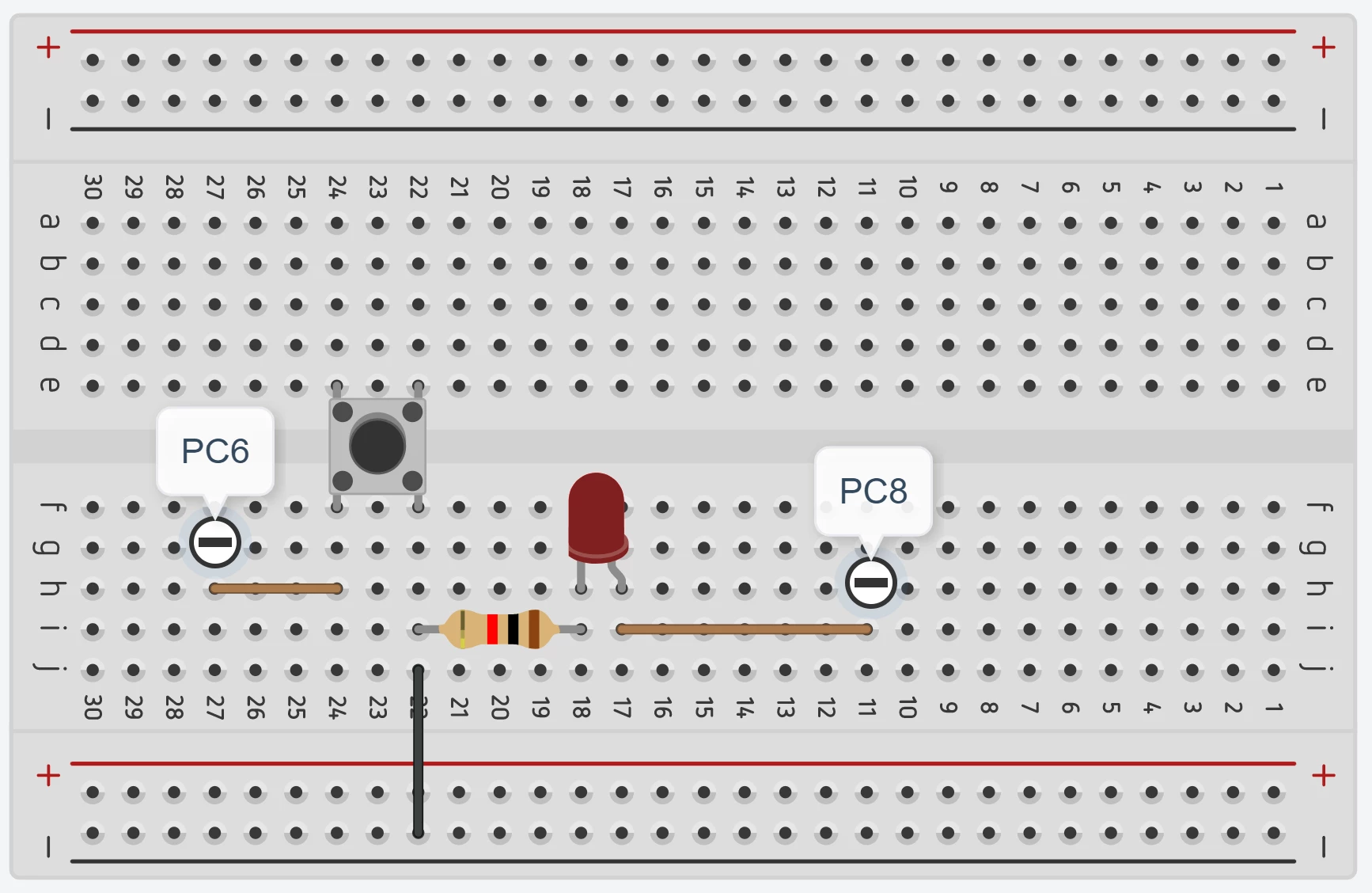
#include <stdint.h>
#include "stm32l476xx.h"
#include "stm32l476xx_gpoi_driver.h"
#if !defined(__SOFT_FP__) && defined(__ARM_FP)
 #warning "FPU is not initialized, but the project is compiling for an FPU. Please initialize the FPU before use."
#endif

#define delay() {;}
//#define delay() for(uint32_t i=0; i<=50000; i++);

int main(void)
{
	GPIO_Handle_t NucleoUserLED,NucleoUserPB,BreadBoardLED,BreadBoardPB;
	volatile uint8_t inputVal,BBinpVal;
	uint32_t temp;

	//User green led in the nucleo board connected to PA5
	NucleoUserLED.pGPIO 							= GPIOA;
	NucleoUserLED.GPIO_Pin_Cfg.GPIO_PinNumber 		= GPIO_PIN_5;
	NucleoUserLED.GPIO_Pin_Cfg.GPIO_PinMode 		= GPIO_MODE_OP;
	NucleoUserLED.GPIO_Pin_Cfg.GPIO_PinPuPdControl = GPIO_IP_NO_PUPD;
	NucleoUserLED.GPIO_Pin_Cfg.GPIO_PinOpType 		= GPIO_OP_TYPE_PP;

	//User blue button in the nucleo connected to PC13
	NucleoUserPB.pGPIO 								= GPIOC;
	NucleoUserPB.GPIO_Pin_Cfg.GPIO_PinNumber 		= GPIO_PIN_13;
	NucleoUserPB.GPIO_Pin_Cfg.GPIO_PinMode 		= GPIO_MODE_IP;
	NucleoUserPB.GPIO_Pin_Cfg.GPIO_PinPuPdControl 	= GPIO_IP_NO_PUPD;

	//User led in the bread board connected to PC8
	BreadBoardLED.pGPIO 							= GPIOC;
	BreadBoardLED.GPIO_Pin_Cfg.GPIO_PinNumber 		= GPIO_PIN_8;
	BreadBoardLED.GPIO_Pin_Cfg.GPIO_PinMode 		= GPIO_MODE_OP;
	BreadBoardLED.GPIO_Pin_Cfg.GPIO_PinPuPdControl = GPIO_IP_NO_PUPD;
	BreadBoardLED.GPIO_Pin_Cfg.GPIO_PinOpType 		= GPIO_OP_TYPE_PP;

	//User DPDT connected in the breadboard connected to PC6
	BreadBoardPB.pGPIO 								= GPIOC;
	BreadBoardPB.GPIO_Pin_Cfg.GPIO_PinNumber 		= GPIO_PIN_6;
	BreadBoardPB.GPIO_Pin_Cfg.GPIO_PinMode 		= GPIO_MODE_IP;
	BreadBoardPB.GPIO_Pin_Cfg.GPIO_PinPuPdControl 	= GPIO_IP_PU;


	GPIO_PeriClkCtrl(GPIOA, ENABLE);
	GPIO_PeriClkCtrl(GPIOC, ENABLE);

	GPIO_Init(&NucleoUserLED);
	GPIO_Init(&NucleoUserPB);
	GPIO_Init(&BreadBoardLED);
	GPIO_Init(&BreadBoardPB);

	while(1)
	{

		/*****************************************************************
		 * 	 Controlling the IO present in the nucleo board			 *
		 *****************************************************************/
		inputVal = GPIO_ReadInputPin(NucleoUserPB.pGPIO, NucleoUserPB.GPIO_Pin_Cfg.GPIO_PinNumber);
		BBinpVal = GPIO_ReadInputPin(BreadBoardPB.pGPIO, BreadBoardPB.GPIO_Pin_Cfg.GPIO_PinNumber);


		if(inputVal == 0)
		{

			GPIO_ToggleOutputPin(NucleoUserLED.pGPIO, NucleoUserLED.GPIO_Pin_Cfg.GPIO_PinNumber);
		}

		/*****************************************************************
		 * 	 Controlling the IO present in the bread board			 *
		 *****************************************************************/

		temp = 10;
		if (BBinpVal == 0 )
		{
			GPIO_WriteOutputPin(BreadBoardLED.pGPIO, BreadBoardLED.GPIO_Pin_Cfg.GPIO_PinNumber, 1);
		}
		else
		{
			GPIO_WriteOutputPin(BreadBoardLED.pGPIO, BreadBoardLED.GPIO_Pin_Cfg.GPIO_PinNumber, 0);
		}


	}

	return 0;
}