

LPTIM with external clock (no synchronization – STM32L0)
Dear all,
I am working on a project with an L081KZ and want to count pulses with a frequency higher than the clock. In the post here (community.st.com/s/question/0D53W00001EyzG5SAJ/) I thankfully got the tip to use the LPTIM as it has an asynchronous feature.
Sadly I cant get the LPTIM to run at all with an external clock and would like your help. There must be a fundamental problem I am overlooking.
I apply a signal (quite slow with 1kHz and 3Vpp) onto PB5 / LPTIM but neither do I get a 1/20th of the signal (counting to 10 and 2 times because of the toggle-function) on PB3 / TOGGLE nor do I reach the breakpoints in “LPTIM1_IRQHandler�?. In “Instance�? → “CNT�? is always 0.
Looking at the “Low-power timer block diagram“ i get i want the „LPTIM_IN1„ as input and not the trigger so I don’t get constrains by the Mux. Do I need to specify anywhere that it is PB5 or is it implied as there is no other pin possible? Also I activated the interrupt checkbox NVIC.
I configured the LPTIM via the CubeIDE as shown in the image and tried the minimal code shown below.
I would really appreciate a hint on what I am missing or where my assumptions are wrong.
Best wishes
Tobias
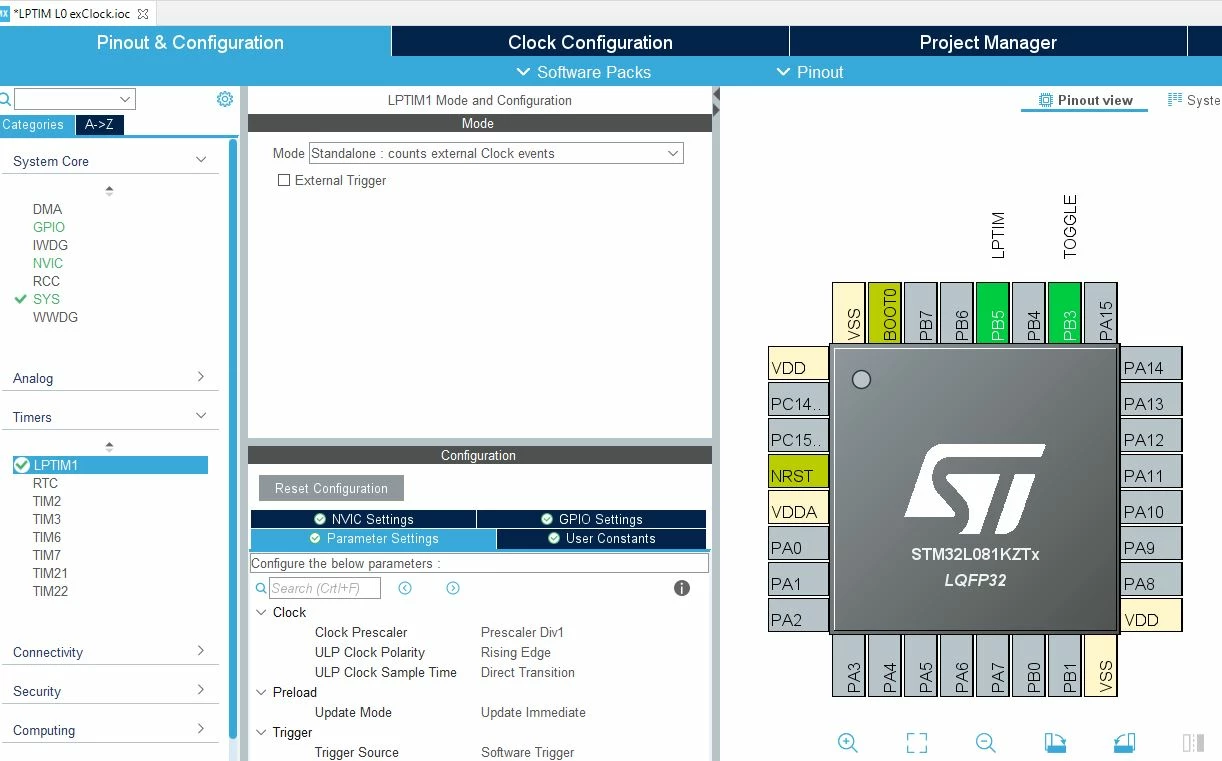
#include "main.h"

LPTIM_HandleTypeDef hlptim1;

void SystemClock_Config(void);
static void MX_GPIO_Init(void);
static void MX_LPTIM1_Init(void);

/* USER CODE BEGIN*/
void HAL_LPTIM_AutoReloadMatchCallback(LPTIM_HandleTypeDef *hlptim)
{
	HAL_GPIO_TogglePin(GPIOB, GPIO_PIN_3);
}
/* USER CODE END*/

int main(void)
{
 HAL_Init();
 SystemClock_Config();
 MX_GPIO_Init();
 MX_LPTIM1_Init();
 /* USER CODE BEGIN*/
 HAL_LPTIM_Counter_Start_IT(&hlptim1, 10);
 /* USER CODE END*/
 while (1)
 {
 }
}

void SystemClock_Config(void)
{
 RCC_OscInitTypeDef RCC_OscInitStruct = {0};
 RCC_ClkInitTypeDef RCC_ClkInitStruct = {0};
 RCC_PeriphCLKInitTypeDef PeriphClkInit = {0};
 __HAL_PWR_VOLTAGESCALING_CONFIG(PWR_REGULATOR_VOLTAGE_SCALE1);
 RCC_OscInitStruct.OscillatorType = RCC_OSCILLATORTYPE_HSI;
 RCC_OscInitStruct.HSIState = RCC_HSI_ON;
 RCC_OscInitStruct.HSICalibrationValue = RCC_HSICALIBRATION_DEFAULT;
 RCC_OscInitStruct.PLL.PLLState = RCC_PLL_NONE;
 if (HAL_RCC_OscConfig(&RCC_OscInitStruct) != HAL_OK)
 {
 Error_Handler();
 }
 RCC_ClkInitStruct.ClockType = RCC_CLOCKTYPE_HCLK|RCC_CLOCKTYPE_SYSCLK
 |RCC_CLOCKTYPE_PCLK1|RCC_CLOCKTYPE_PCLK2;
 RCC_ClkInitStruct.SYSCLKSource = RCC_SYSCLKSOURCE_HSI;
 RCC_ClkInitStruct.AHBCLKDivider = RCC_SYSCLK_DIV16;
 RCC_ClkInitStruct.APB1CLKDivider = RCC_HCLK_DIV1;
 RCC_ClkInitStruct.APB2CLKDivider = RCC_HCLK_DIV1;

 if (HAL_RCC_ClockConfig(&RCC_ClkInitStruct, FLASH_LATENCY_0) != HAL_OK)
 {
 Error_Handler();
 }
 PeriphClkInit.PeriphClockSelection = RCC_PERIPHCLK_LPTIM1;
 PeriphClkInit.LptimClockSelection = RCC_LPTIM1CLKSOURCE_PCLK;

 if (HAL_RCCEx_PeriphCLKConfig(&PeriphClkInit) != HAL_OK)
 {
 Error_Handler();
 }
}

static void MX_LPTIM1_Init(void)
{
 hlptim1.Instance = LPTIM1;
 hlptim1.Init.Clock.Source = LPTIM_CLOCKSOURCE_ULPTIM;
 hlptim1.Init.Clock.Prescaler = LPTIM_PRESCALER_DIV1;
 hlptim1.Init.UltraLowPowerClock.Polarity = LPTIM_CLOCKPOLARITY_RISING;
 hlptim1.Init.UltraLowPowerClock.SampleTime = LPTIM_CLOCKSAMPLETIME_DIRECTTRANSITION;
 hlptim1.Init.Trigger.Source = LPTIM_TRIGSOURCE_SOFTWARE;
 hlptim1.Init.OutputPolarity = LPTIM_OUTPUTPOLARITY_HIGH;
 hlptim1.Init.UpdateMode = LPTIM_UPDATE_IMMEDIATE;
 hlptim1.Init.CounterSource = LPTIM_COUNTERSOURCE_EXTERNAL;
 if (HAL_LPTIM_Init(&hlptim1) != HAL_OK)
 {
 Error_Handler();
 }
}

static void MX_GPIO_Init(void)
{
 GPIO_InitTypeDef GPIO_InitStruct = {0};
 __HAL_RCC_GPIOB_CLK_ENABLE();
 HAL_GPIO_WritePin(TOGGLE_GPIO_Port, TOGGLE_Pin, GPIO_PIN_RESET);
 GPIO_InitStruct.Pin = TOGGLE_Pin;
 GPIO_InitStruct.Mode = GPIO_MODE_OUTPUT_PP;
 GPIO_InitStruct.Pull = GPIO_NOPULL;
 GPIO_InitStruct.Speed = GPIO_SPEED_FREQ_LOW;
 HAL_GPIO_Init(TOGGLE_GPIO_Port, &GPIO_InitStruct);
}

void Error_Handler(void)
{
 __disable_irq();
 while (1)
 {
 }
}

#ifdef USE_FULL_ASSERT
void assert_failed(uint8_t *file, uint32_t line)
{
}
#endif