How to re-enable the timer after a One pulse goes off (OPM)?
Hi guys I am using the stm32h753zi MCU and writing my own drivers to use the WS2812B led strip.
It uses a PWM to determine how much of the RGB you want.
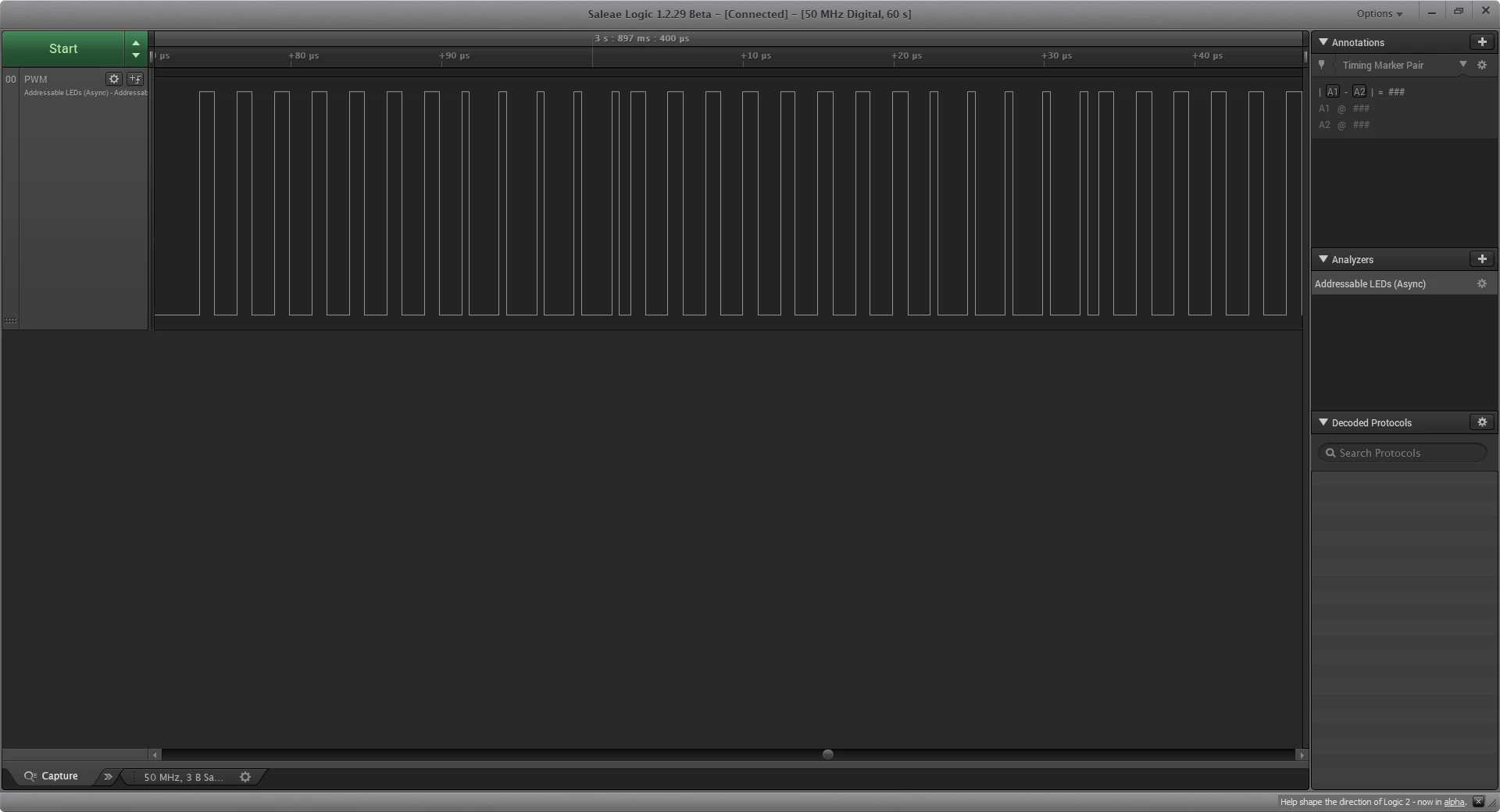
I got the PWM part down and the OPM done, the problem is that I want to send let say a duty cycle of 80% follow by a 32% duty Cycle. I got it working for sending one burst but noted in the datasheet the OPM disables the CEN, however I can never re-enable it?
Is that how OPM works? One time and thats it?
Essentially sending a duty cycle of 80% = 1 and sending a duty cycle of 32% = 0, so thats why I want to send it in pulses in PWM form.
EDIT: 1 Using the TIM15 configured in PWM mode with DMA. The DMA will transfer from a buffer into CCR1 to alter the PW on the fly.
Code:
Timer Setup with DMA
/*
 * Timer_Driver.c
 *
 * Created on: Jan. 8, 2021
 * Author: Christopher
 */


#include "Timer.h"

void init_Timer(uint16_t * RGB_Array) {

	RCC->APB2ENR |= RCC_APB2ENR_TIM15EN;

	GPIOA->MODER &= ~GPIO_MODER_MODE2;
	GPIOA->MODER |= GPIO_MODER_MODE2_ALT;

	GPIOA->OSPEEDR &= ~GPIO_OSPEEDR_OSPEED2;
	GPIOA->OSPEEDR |= GPIO_OSPEEDR_OSPEED2_VERY_HIGH;

	GPIOA->AFR[0] &= ~GPIO_AFRL_AFSEL2;
	GPIOA->AFR[0] |= GPIO_AFRL_AFSEL2_TIM15;

	TIM15->CCMR1 &= ~TIM_CCMR1_CC1S;
	TIM15->CCMR1 |= TIM_CCMR1_CC1S_OUTPUT_MODE;

	TIM15->CCMR1 &= ~TIM_CCMR1_OC1M;
	TIM15->CCMR1 |= TIM_CCMR1_OC1M_PWM1;

	TIM15->ARR = 0x12B;
	TIM15->PSC = 0x00;

	TIM15->AF1 &= ~TIM15_AF1_BKINE;
	TIM15->CCMR1 |= TIM_CCMR1_OC1PE;
	TIM15->CR1 |= TIM_CR1_ARPE;
	TIM15->CR1 |= TIM_CR1_URS;
	//TIM15->CR1 |= TIM_CR1_OPM;
	TIM15->DIER |= TIM_DIER_UDE;


	//TIM15->CCMR1 &= ~TIM_CCMR1_OC1PE;

	TIM15->BDTR |= TIM_BDTR_MOE;
	TIM15->CCER |= TIM_CCER_CC1E;
	//TIM15->CR1 |= TIM_CR1_CEN;

	RCC -> AHB1ENR |= RCC_AHB1ENR_DMA1EN;


	 DMAMUX1_Channel2 -> CCR |= DMAMUX_CxCR_DMAREQ_ID_TIM15_CH1;
	 DMA1_Stream2 -> CR &= ~DMA_SxCR_CT;
	 DMA1_Stream2 -> CR &= ~DMA_SxCR_PL;
	 DMA1_Stream2 -> CR &= ~DMA_SxCR_MSIZE;
	 DMA1_Stream2 -> CR &= ~DMA_SxCR_PSIZE;
	 DMA1_Stream2 -> CR &= ~DMA_SxCR_MINC;
	 DMA1_Stream2 -> CR &= ~DMA_SxCR_CIRC;
	 DMA1_Stream2 -> CR &= ~DMA_SxCR_DIR;
	 DMA1_Stream2 -> CR &= ~DMA_SxCR_PFCTRL;
	 DMA1_Stream2 -> CR &= ~DMA_SxCR_TCIE;
	 DMA1_Stream2 -> CR &= ~DMA_SxCR_HTIE;

	 DMA1_Stream2 -> CR |= DMA_SxCR_CT_MEM0;
	 DMA1_Stream2 -> CR |= DMA_SxCR_PL_Very_High;
	 DMA1_Stream2 -> CR |= DMA_SxCR_MSIZE_32BIT;
	 DMA1_Stream2 -> CR |= DMA_SxCR_PSIZE_32BIT;
	 DMA1_Stream2 -> CR |= DMA_SxCR_MINC;
	 DMA1_Stream2 -> CR |= DMA_SxCR_CIRC;
	 DMA1_Stream2 -> CR |= DMA_SxCR_DIR_M_TO_P;
	 DMA1_Stream2 -> CR |= DMA_SxCR_PFCTRL_DMAFLOW;
	 //DMA1_Stream2 -> CR |= DMA_SxCR_TCIE;

	 DMA1_Stream2 -> NDTR = 25;

	 DMA1_Stream2 -> PAR = (int) &TIM15->CCR1;
	 DMA1_Stream2 -> M0AR = (int) RGB_Array;

	 DMA1_Stream2 -> CR |= DMA_SxCR_EN;


}
Where the Action happens:
uint16_t RED [25] = {0x77, 0x77, 0x77, 0x77, 0x77, 0x77, 0x77 ,0x77,
					 0xEF, 0xEF, 0xEF, 0xEF, 0xEF, 0xEF, 0xEF, 0xEF,
					 0x77, 0x77, 0x77, 0x77, 0x77, 0x77, 0x77 ,0x77, 0x00};

uint16_t BLUE [25] = {0x77, 0x77, 0x77, 0x77, 0x77, 0x77, 0x77 ,0x77,
				 0x77, 0x77, 0x77, 0x77, 0x77, 0x77, 0x77 ,0x77,
					 0xEF, 0xEF, 0xEF, 0xEF, 0xEF, 0xEF, 0xEF, 0xEF, 0x00};

uint32_t GREEN [25] = {0xEF, 0xEF, 0xEF, 0xEF, 0xEF, 0xEF, 0xEF, 0xEF,
					 0x77, 0x77, 0x77, 0x77, 0x77, 0x77, 0x77 ,0x77,
					 0x77, 0x77, 0x77, 0x77, 0x77, 0x77, 0x77 ,0x77, 0x00};

void setLedLights(uint8_t color, uint16_t * RGB_Array) {

if (color == 1) {


	memcpy(RGB_Array, GREEN, sizeof(uint16_t) * 25);


} else if (color == 2) {

	memcpy(RGB_Array, RED, sizeof(uint16_t) * 25);


} else if (color == 3) {

	memcpy(RGB_Array, BLUE, sizeof(uint16_t) * 25);


}

TIM15->CR1 |= TIM_CR1_CEN;

}
Picture: