Stefan Stark
Associate II
October 18, 2023
Solved

Generate a specific PWM signal

  • October 18, 2023
  • 7 replies
  • 10157 views

Hi ST community,

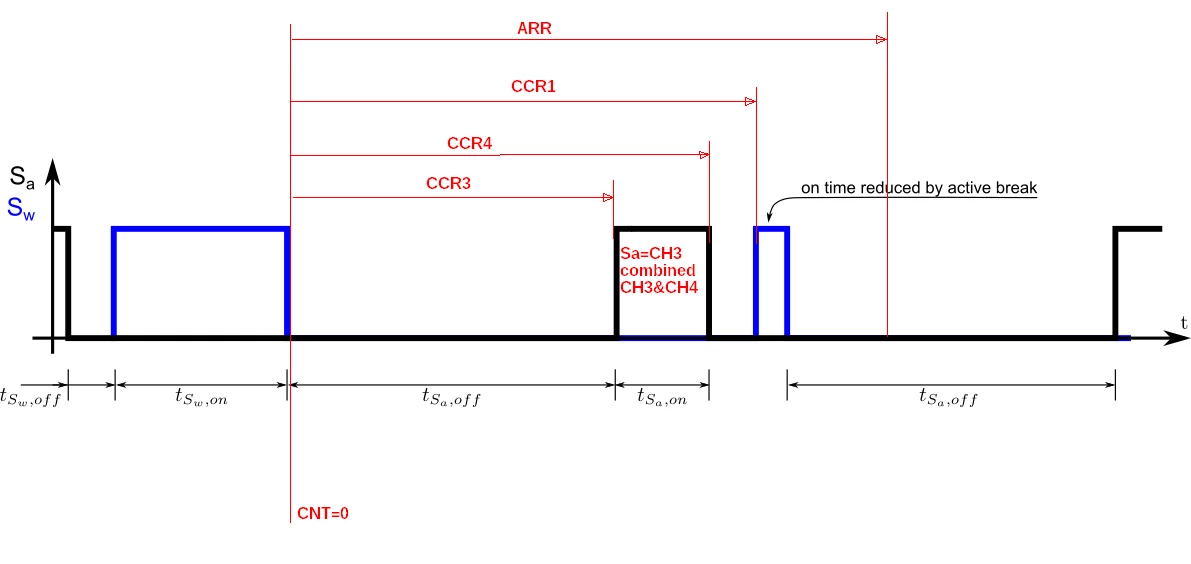
For a project I would like to generate two interdependent PWM signals (Sa and Sw in the attached figure) with the STM32G0. The constraints/tasks are as follows:

  • tSw,off = constant for ~100ns
  • tSw,on = in a time range from ~100ns to 20us and is limited cycle by cycle by an active break (peak control application).
  • tSa,off = set every 300us in a time range from ~100ns to 30us.
  • tSa,on = is set every 300us in a time range from ~100ns to 5us.

The times for tSa,off and tSa,on are thus adjusted every 300us. The time tSw,on is limited cycle by cycle by the active break.

Following limitations I had to mention:

  • I'm allowed to interrupt the software all 300us for a few us (so polling could be difficult).
  • Focus on the STM32G0 microcontroller series.
  • The on time tSw,on is limited cycle by cycle with an comparator.

I will not present my previous approaches now, in order not to influence your ideas.

I look forward to your feedback.
Br, Stefan

This topic has been closed for replies.
Best answer by waclawek.jan

waclawekjan_0-1698139753289.png


7 replies

TDK
October 18, 2023
  • Use a single timer with CH1 and CH3 in combined PWM mode 2.
  • Set CCR1/CCR2 appropriately to get the first (blue) pulse on CH1
  • Set CCR3/CCR4 appropriately to get the second (black) pulse on CH3
  • When changing values, wait until the timer just rolls over, so it's in the tsw_off stage, and change all CCRx at once, quickly, with interrupts disabled.
"If you feel a post has answered your question, please click ""Accept as Solution""."
Stefan Stark
Associate II
October 18, 2023

Thx for your input TDK.

Some thoughts/Questions:

  • How is it possible with this concept to limit the on time of the Sw (tSw,on) with a comparator signal (active break)?
  • How can I make sure / find the time when the timer just rolls over? An Interrupt may be too slow and not possible in the final application.

Br, Stefan

TDK
October 18, 2023

> How is it possible with this concept to limit the on time of the Sw (tSw,on) with a comparator signal (active break)?

So when a comparator goes high, you want the pulse to be low? Not sure, but there's likely a way. Definitely a solution in hardware with an AND gate.

> How can I make sure / find the time when the timer just rolls over? An Interrupt may be too slow and not possible in the final application.

Assuming CCR1 is the timer value of the start of the first blue pulse:

  • Disable interrupts
  • Wait for CNT >= CCR1
  • Wait for CNT < CCR1
  • Change ARR and CCRx values. Probably won't matter, but do them in order.
  • Enable interrupts.

100us is plenty of time to change a few registers.

"If you feel a post has answered your question, please click ""Accept as Solution""."
Stefan Stark
Associate II
October 18, 2023

Hi TDK, thx again for your input.

  1. Do you have a reference where such a solution in hardware with an AND is illustrated? Till now we use this break function to disable all outputs of a TIM...
  2. I fully understand the logic of your propose, is there a function (callback function) which pops up when CNT < CCR1? Or what is your idea to monitor this?

Thx & Br

Stefan

TDK
October 18, 2023

> I fully understand the logic of your propose, is there a function (callback function) which pops up when CNT < CCR1? Or what is your idea to monitor this?

Literally read the register and wait for the condition. The update event happens when CNT=0. You could also use that, but it is subject to more delay.

__disable_irq();
while (TIM1->CNT < TIM1->CCR1);
while (TIM1->CNT >= TIM1->CCR1);
TIM1->CCR1 = x;
TIM1->CCR2 = x;
TIM1->CCR3 = x;
TIM1->CCR4 = x;
TIM1->ARR = x;
__enable_irq();

Or follow the idea from @waclawek.jan to us DMA to do the same on the update event, which will be even faster. Better solution, harder to program, though.

"If you feel a post has answered your question, please click ""Accept as Solution""."
waclawek.jan
Super User
October 18, 2023

Timer period starts at beginning of Tsa,off. Tsa,on generated using Combined PWM mode as TDK said above. Tsw,on normally generated using the plain PWM2 mode on one channel, as timer period ends with end of Tsw,on.

Premature end of Tsw,on accomplished through feeding COMP output to TIx or ETR (see TIMx_TISEL or TIMx_AF1 registers), setting that signal as Slave-mode controller's input (TIMx_SMCR.TS) and setting Slave-mode controller to Reset in TIMx_SMCR.SMS.

Update all required TIMx_CCRx together with TIMx_ARR in Update interrupt (or learn how to use Update-triggered "burst" DMA through the TIMx_DMAR/DCR mechanism). Enabling ARR/CCRx preset (TIMx_CR1.ARPE & TIMx_CCMRx.OCxPE) helps.

JW

Stefan Stark
Associate II
October 18, 2023

Thx jan for your feedback. I have to think about that. We tried in a similar project the DMA-Burst mode function, do you have that in mind?

Br, Stefan

waclawek.jan
Super User
October 19, 2023

> DMA-Burst mode function

Yes, although I don't like the word "burst" as in DMA context that may mean several very different things. That's why I'm referring to the TIMx_DMAR/DCR register pair, that's unambiguous.

By using preloaded ARR and CCRx registers, the time window for update is one whole timer cycle, from Update to Update. Although, even with DMA, don't expect 5 registers (ARR..CCR3) to be updated within 400ns.

Tackle this one step at a time. For testing, you can modify the ARR/CCRx registers in Update interrupt, working with longer pulses/period; proceed to DMA later.

Final word, if you plan to use Cube/HAL for this, well, just don't.

JW

Stefan Stark
Associate II
October 23, 2023

I tried the "Combined PWM" (without "DMA burst") and found that the "Preload" functions (ARR preload and CCR preload) work (in contrast to the operation in "One Pulse Mode").

Next I will try to connect the COMP output to the ETR and thus end the phase Ts,w prematurely. However, I am concerned that the time tSa,off will be extended, which would not be acceptable for the final application.

waclawek.jan
Super User
October 23, 2023

> However, I am concerned that the time tSa,off will be extended

It won't if you do what I said above.

(Also I never said One Pulse Mode and I don't see how and why would that be applicable here.)

JW

Stefan Stark
Associate II
October 24, 2023

(Also I never said One Pulse Mode and I don't see how and why would that be applicable here.)


This is true, in the past we have often used the OPM to run similar projects (cycle by cycle peak controlled applications).


I tired to follow your instructions and implement this code after I started the combined PWM:

 TIM1->AF1  |= TIM1_AF1_ETRSEL_0;               // SET COMP1 output as ETR input source

  TIM1->SMCR |= 0x70;                                        // Set Bit 4,5 and 6 to ue ETR as trigger input

  TIM1->SMCR |= 0x4;                                         // Set slave mode selection (SMS) to Reset mode

In the attached screenshot you can see the first small signal measurements. In yellow (C1) the output of TIM1 channel 1, in blue (C3) the output of TIM1 channel 3 and in green the output of the COMP1. As you can see, the  comparator output limits the on time of TIM1 channel 1 (as expected) and it looks like that the CNT is also reset in this case (because of the missing TIM1 channel 3), which is also somehow expected, because in the RM0444 the SMS description mentions this for the Reset mode. But this is not an option for the final application. As shown in the picture of the first post, after a limited tSw,on the defined tSa,off should occur. Any hints to improve this?

Thx & Br

Stefan

waclawek.jan
Super User
October 24, 2023

Post content of TIM1 registers.

Which channel is which signal?

JW

waclawek.jan
waclawek.janBest answer
Super User
October 24, 2023

waclawekjan_0-1698139753289.png


Stefan Stark
Associate II
October 24, 2023

Based on your drawing, I tried to implement both signals within the combined PWM.
- Sw: TIM_CH1 = CCR1 & CCR2 (where CCR2 = ARR)
- Sa: TIM_CH2 = CCR3 & CCR4
The ETR configuration remains the same.

In the software I update the registers every 300us. As you can see in the figure below, the tSa,off (orange) graph changes as expected without unexpected jumps (NICE).

I also tried to simulate a break situation of the tSw,on. The comparator output limits the on-time of TIM_CH1 as expected without changing tSw,on or other timings.

CombinedPWM_COMP1_ResetMode_COMP1out.bmp.png

But if I understand you correctly, your idea was to run the Sa with the combined PWM function and the Sw with the PWM2 mode. I have tried this and it works as well. Why do you prefer this approach? Because with this approach one register less has to be written?

Thanks & Br

Stefan


waclawek.jan
Super User
October 25, 2023
But if I understand you correctly, your idea was to run the Sa with the combined PWM function and the Sw with the PWM2 mode. I have tried this and it works as well. Why do you prefer this approach? Because with this approach one register less has to be written?

Yes.

JW