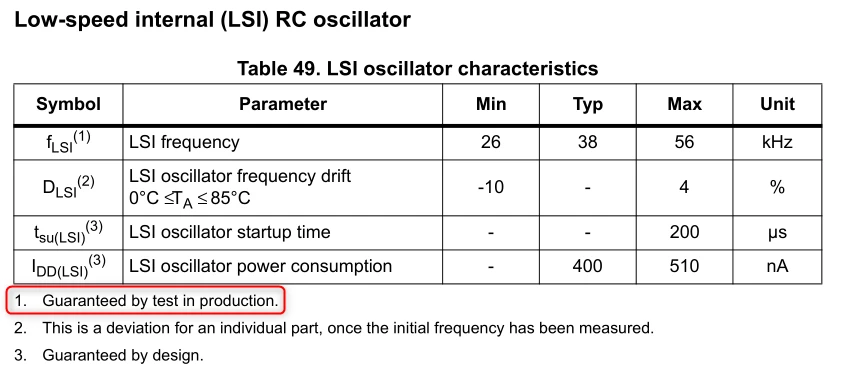
The Electrical Characteristics Min and Max values, according to the data-sheet, are tested at both 25C and the maximum operating temperature (which according to the data sheet ordering codes might be 85C, 105C or 125C). They actually test this, and anything that's outside this must have something wrong with it and is rejected.
That is a huge margin, and reflects the underlying physics of transistors in a CMOS process. Maybe, for example, some of the dopants diffused through the substrate further than usual due to the presence of a tiny trace impurity. And this chip from this batch will have this value. But the next chip, even from the same wafer, might have a different value because the gas flows inside the furnace meant it was exposed to less dopant gas or whatever.
But once that chip is made, it will always be a "slow", a "fast" or a "somewhere in between" LSI chip.
That margin is so wide that you can't do much useful timing with it - a human will notice if e.g. the LED flash rate on one product is twice that on another one. But what you can do is calibrate it against the factory-trimmed HSI16 (while the processor is running, and so burning significant power). And then turn off HSI16 to do your LED-flash timing just off LSI. In this case the drift will only be the -10% +4% range from something that might be +/- 1%, which should be acceptable for LED flashing.
So both numbers are useful - or at least could be depending on the application and how the code is written.
Hope this helps,
Danish