

Solved
Duplicate write to external SDRAM
Hello,
I am using STM32F469 with an external SDRAM (Alliance AS4C16M16MSA-6BIN) through FMC bus. Both STM32F469 and AS4C16M16MSA-6BIN run at 1.8V. The FMC bus is configured with 13 address pins and 16 data pins as follows:
 hsdram1.Instance = FMC_SDRAM_DEVICE;


 /* hsdram1.Init */


 hsdram1.Init.SDBank = FMC_SDRAM_BANK1;

 hsdram1.Init.ColumnBitsNumber = FMC_SDRAM_COLUMN_BITS_NUM_9;

 hsdram1.Init.RowBitsNumber = FMC_SDRAM_ROW_BITS_NUM_13;

 hsdram1.Init.MemoryDataWidth = FMC_SDRAM_MEM_BUS_WIDTH_16;

 hsdram1.Init.InternalBankNumber = FMC_SDRAM_INTERN_BANKS_NUM_4;

 hsdram1.Init.CASLatency = FMC_SDRAM_CAS_LATENCY_3;

 hsdram1.Init.WriteProtection = FMC_SDRAM_WRITE_PROTECTION_DISABLE;

 hsdram1.Init.SDClockPeriod = FMC_SDRAM_CLOCK_PERIOD_2;

 hsdram1.Init.ReadBurst = FMC_SDRAM_RBURST_DISABLE;

 hsdram1.Init.ReadPipeDelay = FMC_SDRAM_RPIPE_DELAY_1;


 /* Timing configuration for 75 MHz of SDRAM clock frequency () */


 SdramTiming.LoadToActiveDelay = 2;

 SdramTiming.ExitSelfRefreshDelay = 7;

 SdramTiming.SelfRefreshTime = 4;

 SdramTiming.RowCycleDelay = 7;

 SdramTiming.WriteRecoveryTime = 2;

 SdramTiming.RPDelay = 2;

 SdramTiming.RCDDelay = 2;
And SDRAM is configured as:
 __IO uint32_t tmpmrd = 0;


 /* Step 1: Configure a clock configuration enable command */

 Command.CommandMode = FMC_SDRAM_CMD_CLK_ENABLE;

 Command.CommandTarget = FMC_SDRAM_CMD_TARGET_BANK1;

 Command.AutoRefreshNumber = 1;

 Command.ModeRegisterDefinition = 0;


 /* Send the command */

 HAL_SDRAM_SendCommand(&hsdram1, &Command, SDRAM_TIMEOUT);


 /* Step 2: Insert 100 us minimum delay */

 /* Inserted delay is equal to 1 ms due to systick time base unit (ms) */

 HAL_Delay(1);


 /* Step 3: Configure a PALL (precharge all) command */

 Command.CommandMode = FMC_SDRAM_CMD_PALL;

 Command.CommandTarget = FMC_SDRAM_CMD_TARGET_BANK1;

 Command.AutoRefreshNumber = 1;

 Command.ModeRegisterDefinition = 0;


 /* Send the command */

 HAL_SDRAM_SendCommand(&hsdram1, &Command, SDRAM_TIMEOUT);


 /* Step 4: Configure an Auto Refresh command */

 Command.CommandMode = FMC_SDRAM_CMD_AUTOREFRESH_MODE;

 Command.CommandTarget = FMC_SDRAM_CMD_TARGET_BANK1;

 Command.AutoRefreshNumber = 4;

 Command.ModeRegisterDefinition = 0;


 /* Send the command */

 HAL_SDRAM_SendCommand(&hsdram1, &Command, SDRAM_TIMEOUT);


 /* Step 5: Program the external memory mode register */

 tmpmrd = (uint32_t)SDRAM_MODEREG_BURST_LENGTH_1 |\

 SDRAM_MODEREG_BURST_TYPE_SEQUENTIAL |\

 SDRAM_MODEREG_CAS_LATENCY_3 |\

 SDRAM_MODEREG_OPERATING_MODE_STANDARD |\

 SDRAM_MODEREG_WRITEBURST_MODE_SINGLE;


 Command.CommandMode = FMC_SDRAM_CMD_LOAD_MODE;

 Command.CommandTarget = FMC_SDRAM_CMD_TARGET_BANK1;

 Command.AutoRefreshNumber = 1;

 Command.ModeRegisterDefinition = tmpmrd;


 /* Send the command */

 HAL_SDRAM_SendCommand(&hsdram1, &Command, SDRAM_TIMEOUT);


 /* Step 6: Set the refresh rate counter */

 /* Set the device refresh rate */

 HAL_SDRAM_ProgramRefreshRate(&hsdram1, RefreshCount);
I am running a address bus test on the SDRAM.
datum *

BSP_SDRAM_MemTestAddressBus(volatile datum * baseAddress, uint32_t nBytes)

{

	uint32_t addressMask = (nBytes/sizeof(datum) - 1);

	uint32_t offset;

	uint32_t testoffset;


	datum pattern 		= (datum) 0xAAAAAAA;

	datum antipattern 	= (datum) 0x55555555;


	/*

	 * Write the default pattern at each of power-of-two offsets

	 * */

	for (offset = 1; (offset & addressMask) != 0; offset ++)

	{
		 *(__IO uint32_t*) (SDRAM_DEVICE_ADDR + 4*offset) = pattern;
	}


	/*

	 * Write the default pattern at each of power-of-two offsets

	 * */

	for (offset = 1; (offset & addressMask) != 0; offset <<= 1)

	{
		baseAddress[offset] = pattern;
	}


	/*

	 * Check for address bits stuck high.

	 * */

	testoffset = 2;

	baseAddress[testoffset] = antipattern;


	for (offset = 1; (offset & addressMask) != 0; offset <<= 1)

	{
		if (baseAddress[offset] != pattern)

		{
			return ((datum *) &baseAddress[offset]);
		}
	}

	baseAddress[testoffset] = pattern;

	/*

	 * Check for address bits stuck low or shorted.

	 * */

	for (testoffset = 1; (testoffset & addressMask) !=0; testoffset <<=1)

	{
		baseAddress[testoffset] = antipattern;

			if (baseAddress[0] != pattern)

			{
				return ((datum *) &baseAddress[testoffset]);
			}


		for (offset = 1; (offset & addressMask) != 0; offset <<=1)

		{
			if ((baseAddress[offset] != pattern) && (offset != testoffset))
			{
				return ((datum *) &baseAddress[testoffset]);
			}
		}

		baseAddress[testoffset] = pattern;
	}

	return (NULL);


}/* memTestAddressBus() */
The problem is, when one address is accessed, it always duplicates the operation to another address location. The memory reading is as follows:
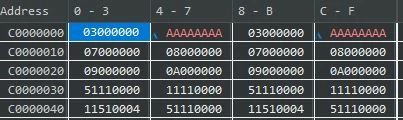
I simply wrote 0xAAAAAAA to the location 0xC00000004 and the data in 0xC0000000C updated at the same time.
Any suggestion on this issue? Thanks in advance.
