

Damien Ratazy
Associate III
August 12, 2018
Solved

Complementary outputs with dead-time?

  • August 12, 2018
  • 6 replies
  • 4915 views

Hello,

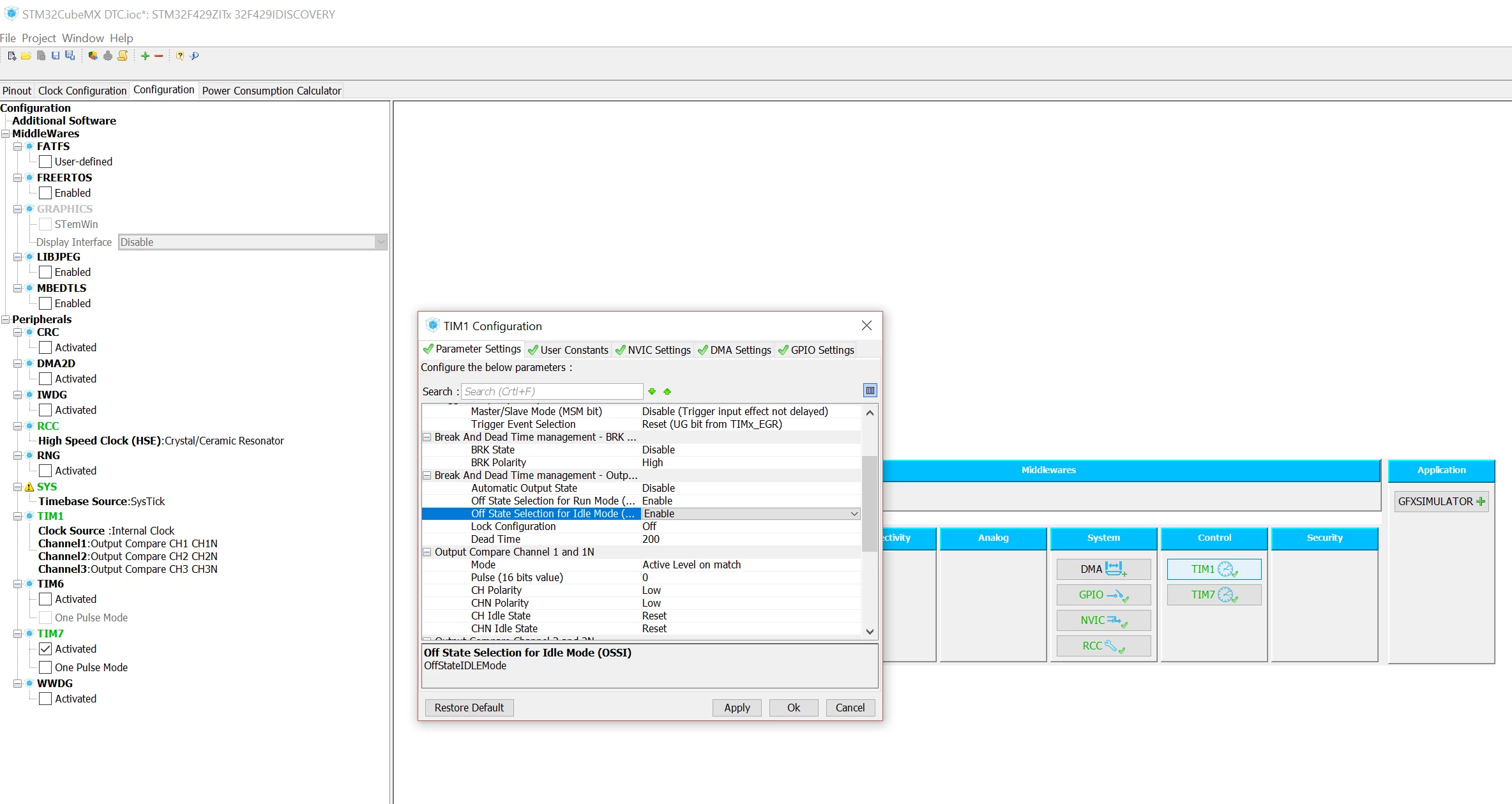
I'm trying to have complementary outputs with dead-time on CH1/CH2/CH3 and CH1/CH2/CH3N using TIM1 and Output Compare Mode on STM32F429.

So I configured STM32CubeMX like in the picture below :
0690X000006BskZQAS.png

And there is the portion of my code :

(for testing purposes, a button press changes the state of CH1/CH1N)

void TIM1_ItUpFcn()
{
		if (HAL_GPIO_ReadPin(GPIOA,GPIO_PIN_0)==1)
		{
			TIM1->CCER = 4;
		}
		else
			{
			TIM1->CCER = 5;
			}
}

That code changes CC1E/CC1NE bits.

As a result,on the scope, I do get my complementary outputs on CH1 and CH1N, they invert each other when I press the button, but with no deadtime! I don't understand why i don't have that deadtime, like explained below :
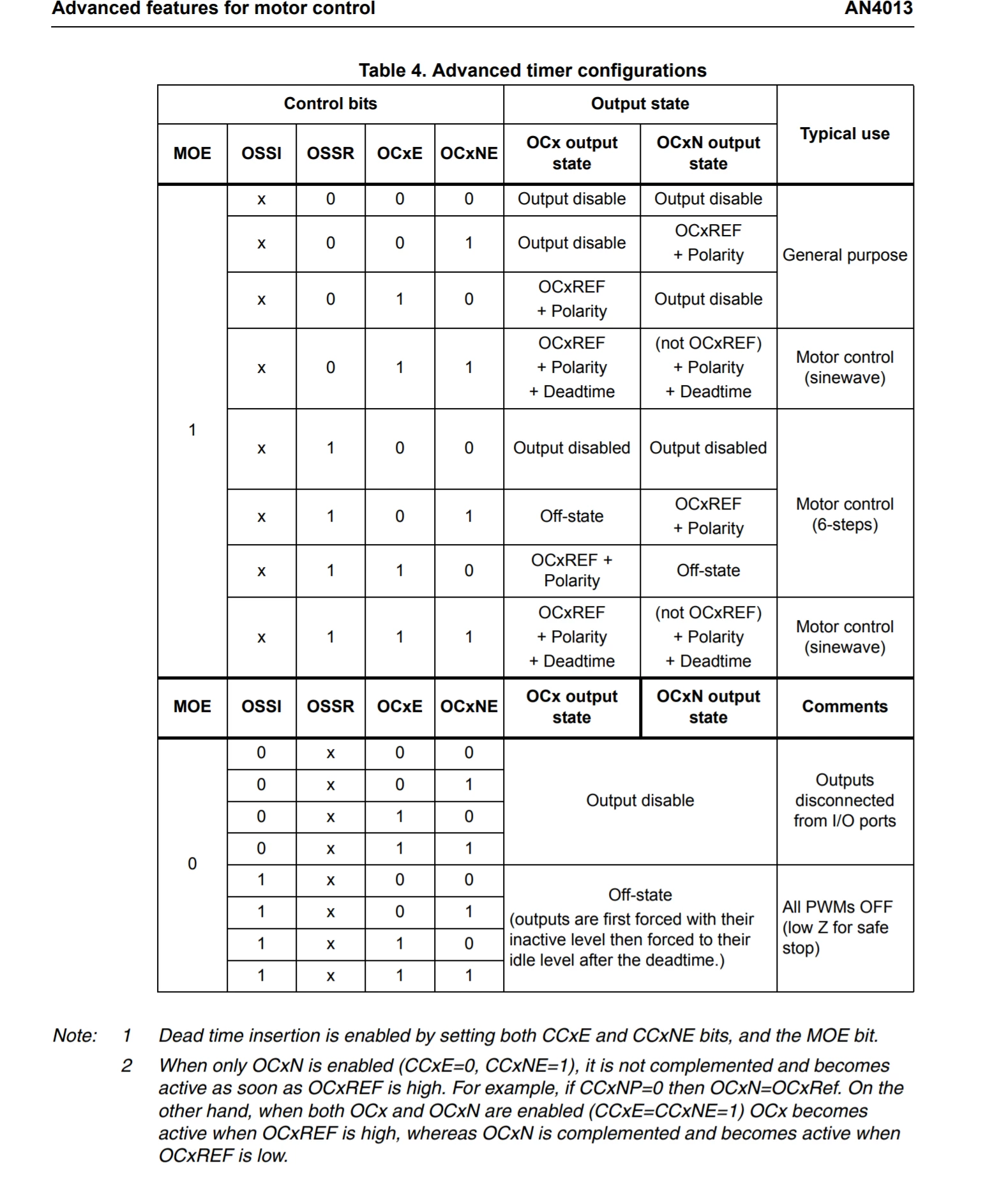

0690X000006BskUQAS.png

    This topic has been closed for replies.
    Best answer by waclawek.jan

    So you have both CH1 and CH1N enabled in CCER, and CH1 set to OC1M = 0b001 i.e. set to active when match.

    After enabling the timer, you should then see only one edge, first a falling one on CH1N, and then a rising one on CH1, delayed by 320 timer cycles.

    You maybe expect that there is dead time inserted when you manipulate the outputs through CCER - this is not the case; dead time is related to the OCxREF signal and that does not change when you change CCER; see the Complementary outputs and dead-time insertion chapter in RM.

    JW

    6 replies

    waclawek.jan
    Super User
    August 13, 2018

    Read out and check/post the content of all TIM registers (mainly BDTR)

    JW

    Damien Ratazy
    Associate III
    August 13, 2018

    Hello,

    In debug mode, BDTR=0x0000ACC8 (‭1010 1100 1100 1000‬)

    There is the TIM1+TIM7 init code :

    void DTC_initialize(void)
    {
     /* Registration code */
     
     /* initialize error status */
     rtmSetErrorStatus(DTC_M, (NULL));
     
     /* user code (Start function Body) */
     
     /*Store TIM7 data information and its handler */
     G_TIM_Data[G_NbTimConf] = &TIM7_DataLink;
     G_TIM_Handler[G_NbTimConf] = &htim7;
     G_NbTimConf++; /*Inc number of configured TIM */
     
     /*Store TIM information */
     TIM7_DataLink.TIM_Prescaler = 8999;
     TIM7_DataLink.TIM_APBClock = 90000000;
     TIM7_DataLink.TIM_ARR = 5000 - 1;
     TIM7_DataLink.TIM_Clock = 10000.0;
     TIM7_DataLink.TIM_Freq = 2.0;
     TIM7_DataLink.CH1_duty = 0.0;
     TIM7_DataLink.CH2_duty = 0.0;
     TIM7_DataLink.CH3_duty = 0.0;
     TIM7_DataLink.CH4_duty = 0.0;
     TIM7_DataLink.CH1_type = UNKNOWN;
     TIM7_DataLink.CH2_type = UNKNOWN;
     TIM7_DataLink.CH3_type = UNKNOWN;
     TIM7_DataLink.CH4_type = UNKNOWN;
     
     /* Interrupt vector initialization */
     TIM7_DataLink.ItUpFcn = NULL;
     TIM7_DataLink.ItTrgFcn = NULL;
     TIM7_DataLink.ItComFcn = NULL;
     TIM7_DataLink.ItBrkFcn = NULL;
     TIM7_DataLink.ItCcFcn = NULL;
     
     /* Auto-reload preload enable */
     SET_BIT((&htim7)->Instance->CR1, TIM_CR1_ARPE);
     
     /*Update register value with blocset value*/
     /*Prescaler*/
     __HAL_TIM_SET_PRESCALER(&htim7,TIM7_DataLink.TIM_Prescaler);
     
     /*Autoreload: ARR */
     __HAL_TIM_SetAutoreload(&htim7, 5000 - 1);
     
     /* Time Base start IT */
     HAL_TIM_Base_Start_IT(&htim7);
     
     /* Update interrupt function */
     TIM7_DataLink.ItUpFcn = TIM7_ItUpFcn;
     
     /* Start interrupt for Update event*/
     HAL_TIM_Base_Start_IT(&htim7);
     
     /*Store TIM1 data information and its handler */
     G_TIM_Data[G_NbTimConf] = &TIM1_DataLink;
     G_TIM_Handler[G_NbTimConf] = &htim1;
     G_NbTimConf++; /*Inc number of configured TIM */
     
     /*Store TIM information */
     TIM1_DataLink.TIM_Prescaler = 0;
     TIM1_DataLink.TIM_APBClock = 180000000;
     TIM1_DataLink.TIM_ARR = 3600 - 1;
     TIM1_DataLink.TIM_Clock = 1.8E+8;
     TIM1_DataLink.TIM_Freq = 50000.0;
     TIM1_DataLink.CH1_duty = 0.0;
     TIM1_DataLink.CH2_duty = 0.0;
     TIM1_DataLink.CH3_duty = 0.0;
     TIM1_DataLink.CH4_duty = 0.0;
     TIM1_DataLink.CH1_type = OUTPUT_COMP;
     TIM1_DataLink.CH2_type = OUTPUT_COMP;
     TIM1_DataLink.CH3_type = OUTPUT_COMP;
     TIM1_DataLink.CH4_type = UNKNOWN;
     
     /* Interrupt vector initialization */
     TIM1_DataLink.ItUpFcn = NULL;
     TIM1_DataLink.ItTrgFcn = NULL;
     TIM1_DataLink.ItComFcn = NULL;
     TIM1_DataLink.ItBrkFcn = NULL;
     TIM1_DataLink.ItCcFcn = NULL;
     
     /* Auto-reload preload enable */
     SET_BIT((&htim1)->Instance->CR1, TIM_CR1_ARPE);
     
     /*Update register value with blocset value*/
     /*Prescaler*/
     __HAL_TIM_SET_PRESCALER(&htim1,TIM1_DataLink.TIM_Prescaler);
     
     /*Autoreload: ARR */
     __HAL_TIM_SetAutoreload(&htim1, 3600 - 1);
     
     /*Set CH1 Pulse value*/
     __HAL_TIM_SetCompare(&htim1, TIM_CHANNEL_1, (uint32_t)((3600 - 1)/2));
     
     /*Set CH2 Pulse value*/
     __HAL_TIM_SetCompare(&htim1, TIM_CHANNEL_2, (uint32_t)((3600 - 1)/2));
     
     /*Set CH3 Pulse value*/
     __HAL_TIM_SetCompare(&htim1, TIM_CHANNEL_3, (uint32_t)((3600 - 1)/2));
     
     /* Wait for htim1 State READY */
     while ((&htim1)->State == HAL_TIM_STATE_BUSY) {
     }
     
     HAL_TIM_OC_Start(&htim1, TIM_CHANNEL_1);
     
     /* Enable the complementary OC output 1 */
     HAL_TIMEx_OCN_Start(&htim1, TIM_CHANNEL_1);
     
     /* Wait for htim1 State READY */
     while ((&htim1)->State == HAL_TIM_STATE_BUSY) {
     }
     
     HAL_TIM_OC_Start(&htim1, TIM_CHANNEL_2);
     
     /* Enable the complementary OC output 2 */
     HAL_TIMEx_OCN_Start(&htim1, TIM_CHANNEL_2);
     
     /* Wait for htim1 State READY */
     while ((&htim1)->State == HAL_TIM_STATE_BUSY) {
     }
     
     HAL_TIM_OC_Start(&htim1, TIM_CHANNEL_3);
     
     /* Enable the complementary OC output 3 */
     HAL_TIMEx_OCN_Start(&htim1, TIM_CHANNEL_3);
     
     /* Update interrupt function */
     TIM1_DataLink.ItUpFcn = TIM1_ItUpFcn;
     
     /* Start interrupt for Update event*/
     HAL_TIM_Base_Start_IT(&htim1);
     ;
     ;
     ;
     ;
    }

    waclawek.jan
    Super User
    August 13, 2018

    And the rest of the registers? I don't Cube.

    JW

    Damien Ratazy
    Associate III
    August 13, 2018

    Here you go

    waclawek.jan
    waclawek.janBest answer
    Super User
    August 13, 2018

    So you have both CH1 and CH1N enabled in CCER, and CH1 set to OC1M = 0b001 i.e. set to active when match.

    After enabling the timer, you should then see only one edge, first a falling one on CH1N, and then a rising one on CH1, delayed by 320 timer cycles.

    You maybe expect that there is dead time inserted when you manipulate the outputs through CCER - this is not the case; dead time is related to the OCxREF signal and that does not change when you change CCER; see the Complementary outputs and dead-time insertion chapter in RM.

    JW

    Damien Ratazy
    Associate III
    August 14, 2018

    Okay, so I finally found how to turn ON CH1/CH2/CH3 and CH1/CH2/CH3N with the appropriate deadtime, using CCMR1 and CCMR2 registers (by setting bits 4-6 for OC1M, bits 12-14 for OC2M on CCMR1, bits 4-6 for OC3M on CCMR2).