Associate
January 13, 2024
Solved

Avoid cross-effects between the LC sensors

Hi all,

I'm using application note AN4636 for LC sensor.

I tested with the example source code, and they work well for one sensor.

But when I use multiple sensors, I face an issue. If I use the same value for inductor and capacitor for each sensor, the oscillators between these sensors are affected, the amplitude decrease and the shape change.

I can avoid this issue by adjusting the value of inductors to create difference oscillator frequencies, but I think it is not good solution to ensure the stable and consistency of product.

Can anyone give me advice to solve this problem?

I appreciate this help.


Thanks!


This topic has been closed for replies.
AScha.3
AScha.3Best answer
Super User
January 14, 2024

Hi,

Its just an idea : try at first soldering a short on the not active LCs , to see/prove the effect on the active LC ;

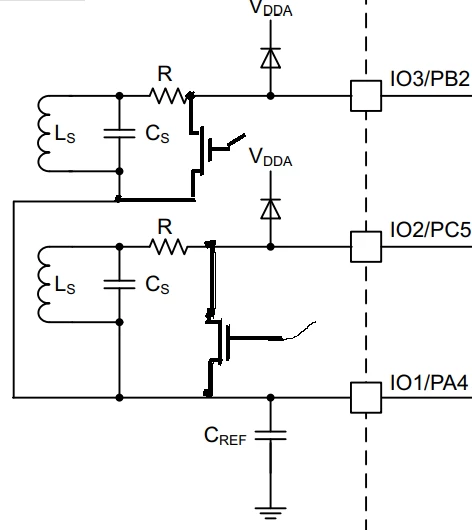
if good effect, can switch with mosfet as switch and drive each of the gates from a port pin , all hi , except the mosfet at active LC , only this one drive lo, to have this mosfet at off state:


AScha3_1-1705221562669.png

The mosfet needs to be "on" at VDD /2 , so (i looked at mouser) maybe RUC002N05HZGT116 would be a good choice.

But first do a test with manually shorted LCs, only the active not shorted, to proove , its a useful idea.

If you feel a post has answered your question, please click on " Best Answer ".

4 replies

phoungvdAuthor
Associate
January 13, 2024

This is the link of oscillator for two situations.

LC sensor - Google Drive

AScha.3
Super User
January 13, 2024

Hi,

>advice to solve this problem?

You cannot "solve" something, which is the consequence of physical laws.

Maybe you can avoid some effects ...or reduce unwanted effect, thats all.


So if you have this LC sensors and want reduce the coupling effects, you can :

- separate them or screen them against each other (maybe impossible, if you cannot change mechanical position)

- shift the resonances away from each other (simplest way: use different C 's )

- damping the coupling (short the unused LC , to avoid them to catch energy )

If you feel a post has answered your question, please click on " Best Answer ".
phoungvdAuthor
Associate
January 14, 2024

Hi AScha.3,

Thank you so much for your advice,

For "damping the coupling (short the unused LC , to avoid them to catch energy )", you can tell me more detail about the way use hardware or firmware to short the unused LC. I'm using the recommend schematic from ST (attached picture).

Thanks!

phoungvd_0-1705214976688.png


AScha.3
AScha.3Best answer
Super User
January 14, 2024

Hi,

Its just an idea : try at first soldering a short on the not active LCs , to see/prove the effect on the active LC ;

if good effect, can switch with mosfet as switch and drive each of the gates from a port pin , all hi , except the mosfet at active LC , only this one drive lo, to have this mosfet at off state:


AScha3_1-1705221562669.png

The mosfet needs to be "on" at VDD /2 , so (i looked at mouser) maybe RUC002N05HZGT116 would be a good choice.

But first do a test with manually shorted LCs, only the active not shorted, to proove , its a useful idea.

If you feel a post has answered your question, please click on " Best Answer ".