
ADC conversion triggered by timer output compare
I am trying to make the ADC channels sample the current through some motor channels synchronised to the center of the center aligned PWM waveform to avoid switching noise.
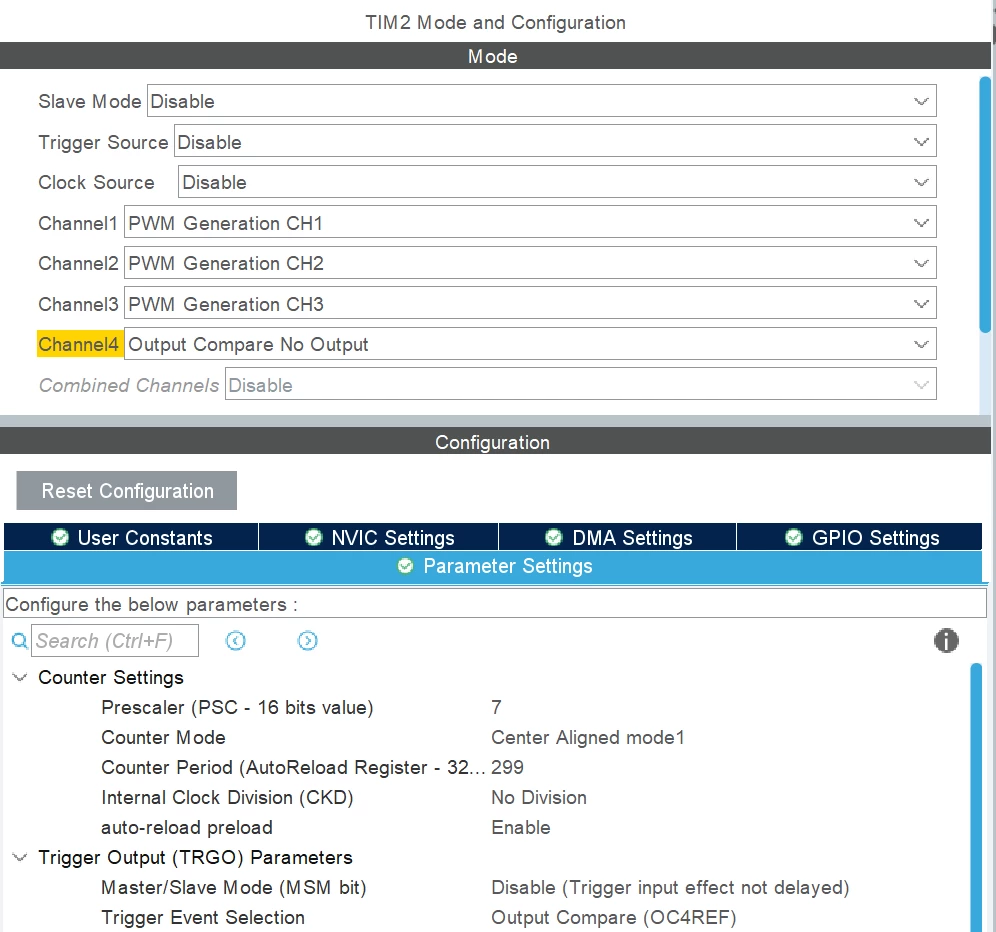
The microcontroller I am using is the STM32F411 series, and I am using the first 3 channels of Timer 2 for PWM. The 4th channel is set to "Output compare no output", and I also set the timer trigger output event selection to Output compare (OC4REF). I set the pulse of channel 4 to the TOP value of the timer so it triggers when the counter counts to the TOP (midpoint of PWM).

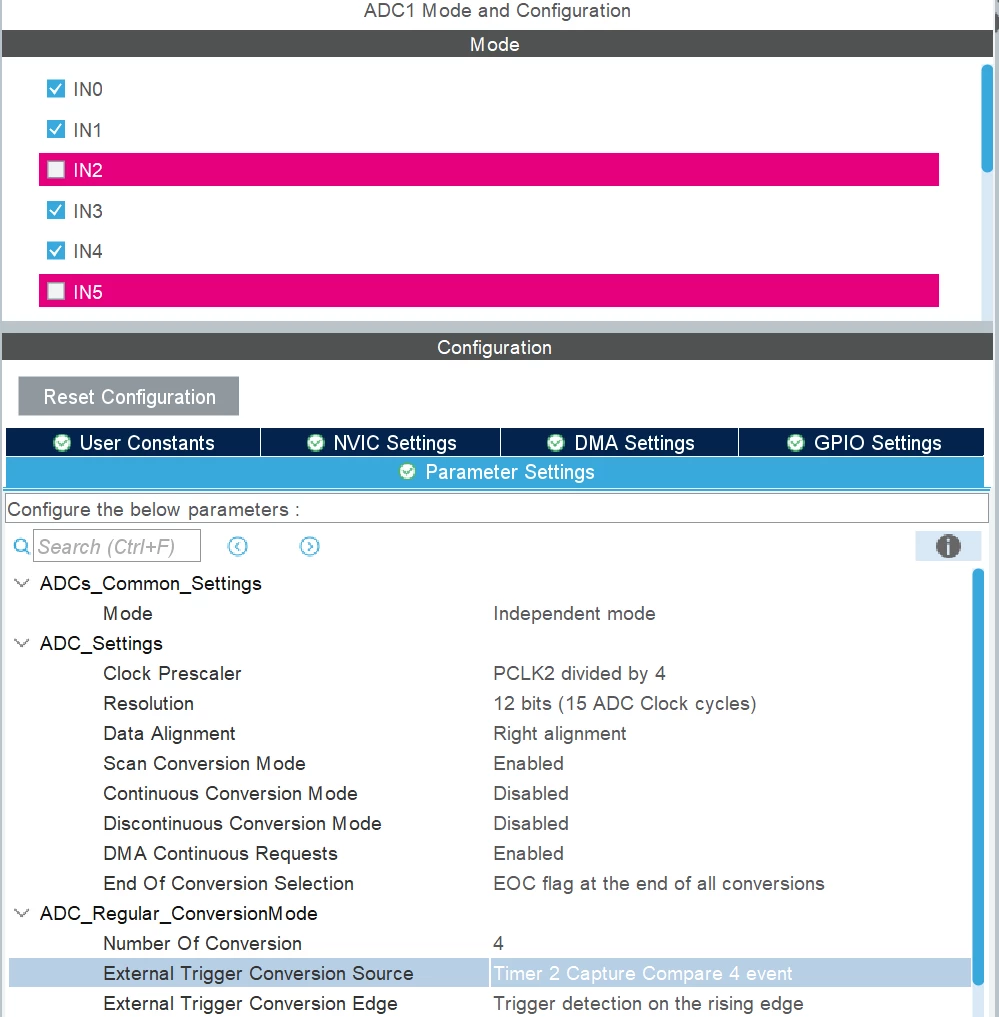
For the ADC, i am trying to sample 4 inputs (2 phases for 2 motors) and shift the data into a buffer using DMA. I enabled scan conversion mode as well as DMA continuous requests, and set the trigger source to Timer 2 capture compare 4 event, triggered on the rising edge. The ADC global interrupt is also enabled.
In code, I started timer 2 using:
HAL_TIM_Base_Start(&htim2);
HAL_TIM_OC_Start(&htim2, TIM_CHANNEL_4);
Then, I start the ADC using:
HAL_ADC_Start_DMA(&hadc1, ADC_buff, 4);In the ADC conversion complete callback function, I shift the buffer values into the motor struct for processing:
void HAL_ADC_ConvCpltCallback(ADC_HandleTypeDef *hadc)
{
 motor.phase_current[0] = ADC_buff[0];
 motor.phase_current[1] = ADC_buff[1];
}
However, the values in the buffer just remained at 0 without updating. I tried debugging it by adding a breakpoint at the HAL_ADC_ConvCpltCallback() function to see if it was doing anything, but the breakpoint was never triggered. I also tried to trigger the ADC manually using "regular conversion launched by software" instead of the timer, and the values updated fine. So I'm pretty sure the issue is with the triggering the ADC with Timer 2 compare match. I have already tried many different configurations of timer 2, but all of them did not work (conversion callback function was never called).
Any suggestions would be appreciated!