

Amel NASRI
ST Technical Moderator
December 31, 2018
Solved

2019 STM32 Wish List

  • December 31, 2018
  • 171 replies
  • 63888 views

Dear Community Members & STM32 fans,

Let’s end 2018 thanking you for your involvement in our Community and wishing you all the best for 2019!

0690X000006CwKbQAK.jpg

As already done in 2017 (https://community.st.com/s/feed/0D50X00009bLPmvSAG) and in 2018 (https://community.st.com/s/feed/0D50X00009bLSAKSA4), we open this space to hear from you.

This is an opportunity for us to evaluate what we deliver as offer and to know your expectations.

If we come back to the STM32 portfolio end of last year, it was like this:
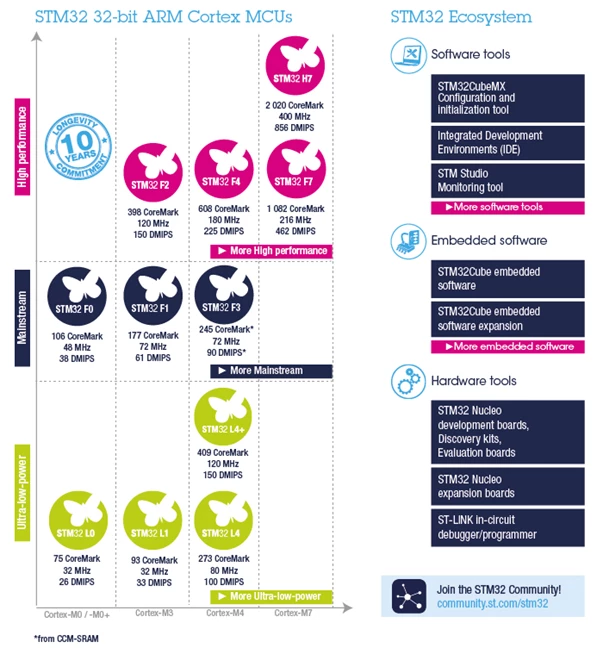
0690X000006CwKgQAK.png

Now the image is getting larger with new products as well as ecosystem components:
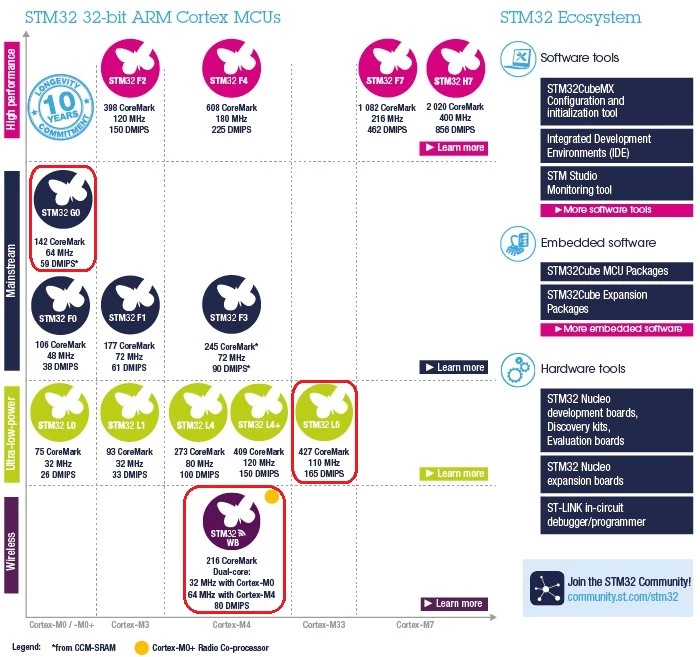
0690X000006CwKlQAK.jpg

Compared to the wishes you shared previous years, we weren’t able to answer all proposals for sure, but may be some of our solutions met what you looked for. Like for example: delivering .ioc file in the STM32Cube package which we started with STM32G0...

Either you are a follower of the STM32 history as well as the Community updates, or a new member in this space, would you mind share with us your feedback answering the following 3 questions:

  • What shouldn’t be done (don’t say migration to new Community platform or new CubeMX interface (because both of them will be improved)?
  • What you appreciate the most as STM32 related offer?
  • What do you expect/suggest related to the STM32 and its ecosystem?

All together, keep UP our STM32 Community!

    This topic has been closed for replies.
    Best answer by Amel NASRI

    Dear All,

    Instead of creating 2020 wishlist and in order to better handle your proposals, we suggest the "Ideas zone" that you can see from navigational bar.

    You find more details on how to use it in "Announcing Idea Zone!".

    Don't hesitate to submit your STM32 related ideas there and attach them to relevant categories!

    -Amel

    171 replies

    Uwe Bonnes
    Chief
    January 15, 2019

    Allow 1 bit SPI transfer, so that SPI can easily do JTAG and set TMS for the last SCLK.

    Asantos
    Associate III
    January 15, 2019

    STM32Cube_FW_XX projects examples made using STM32CubeMx.

    More Applications notes showing how to configure the peripherals at register level. Ex

    ...

     TIM2->CCMR1 = 0x31;  //ICF1 = 3 (FILTER N=8) CC1S = 01b Modo capture 1 (directed TI1-> IC1)

      TIM2->CCER = 0x0A;  //CC1NP =1, CC1P = 1 (both edges)

     TIM2->SMCR = 0x54;  //SMS = 4 (RESET), TS= 5 (trigger by TI1FP1)

    ...

    waclawek.jan
    Super User
    January 15, 2019

    I would shorten this to: More Applications notes and way more examples.

    https://community.st.com/s/feed/0D50X00009XkVvLSAV

    JW

    waclawek.jan
    Super User
    January 15, 2019
    waclawek.jan
    Super User
    January 15, 2019

    Bitfield values definitions in the CMSIS-mandated device headers.\

    https://community.st.com/s/feed/0D50X00009XkVsDSAV

    JW

    Dave Nadler
    Senior III
    January 15, 2019

    Absolutely! Its absurd to have to work out hex values to read and write.

    All your competitors provide such sensible definitions for all peripheral control fields.

    Given the well-known deficiencies in LL and HAL, many of us are forced to use the

    ugly shift macros, and waste time debugging without decoded bitfields...

    Another vote for better device headers!

    Best Regards, Dave

    thanks4opensource
    Associate III
    April 25, 2019

    waclawek.jan and Dave Nadler:

    These are old posts but I've just come online here and agree completely. You may want to check out my post in the "Share Your Activities" section. It's about my open-source project which I wrote partly to address these missing definitions in the CMSIS headers (also dissatisfaction with the design and inefficiencies of the LL and HAL libraries), but it does more than that. Maybe too much more "more" than what you're seeking, but that's for you to decide. If you're getting notifications of replies to your posts and look at my "Share" and/or the project it links to I'd be interested in your feedback and suggestions. Thanks!

    waclawek.jan
    Super User
    January 15, 2019

    More technical staff presence in the forum. I mean presence, not random occurence.

    It would be even better if the middle management would be present and willing to discuss; it would also give them invaluable first-hand experience with this ehm uhm...

    JW

    kurta999
    Senior
    February 3, 2019

    Yes yes.. At least like in Visaul GDB forum for example..

    StefanoP
    Visitor II
    January 16, 2019

    Internal HS USB Phy on STM32H7 MCUs, or in alternative better pin multiplexing options.

    RobG
    Associate III
    January 16, 2019

    I have been working with the STM family for about a year on project I inherited. It used the old standard peripheral libraries. I was looking forward with the new project to updating to the Cube libraries.

    I think you need to spend a little more time on them. I was trying to create a High Speed USB Human Interface Device with a STM32F407. Discovery board should be a great start right? Big let down!

    1) With IAR embedded Workbench 8.30.2 and Cube 1.21.0. I tried to compile the 408 Discovery demonstration to C++. I had to typecast 25 calls then it couldn't find some functions. I got my code based off of the demo working in C, but compiled to C++ and it hangs. So in short you need some C++ testing please.

    2) Although the discovery board won't support it directly. I think you need a USB High Speed example. I have searched posted here and 2 weeks later still looking for answers.

    From what I have used I like the Cube better than the SP libraries, but they are still lacking in my opinion.

    Thanks

    Mich1
    Associate III
    January 18, 2019

    STM32Cube indent using 2 spaces: a wish to change it to 4 spaces in option.

    possibility to specify additionnal directories for peripherals (not only src and inc)

    Edimahler
    Associate II
    April 1, 2020

    Same here. Desperately searching for this some years already. There was once a solution for CubeMX, but can't find the same one for CubeIDE: Using a Powershell command to replace all specific entries in all the templates of CubeMX...

    Some help would be highly appreciated!

    ManishNair
    Associate III
    January 18, 2019

    I am new to ST's micro controller and started with STM32H743/STM32H753.

    When compared to the developments using other companies products, i am feeling very hard to (start with STM32) find the exact solutions; (even though sufficient/plenty of resources provided by ST).

    What newbies requires, to start development around a Core, are code examples/methods/procedure , for that specific controller.... You provide Reference manuals, 'how to get..." documents, application notes, etc etc without the sample programs ( i can'd find any sample code in documents provided for H7x3, may be you included them for any other product or somewhere else). ((((Thanks to CliveTwo.Zero (Community Member) who patiently and immediately solves my problem in ST community...)))

    So my hope/suggestion in 2019, is to include some sample code any where else Referance / development / how to manuals (I Know the codes are in CubeH7 example folder for nucleo and eval, but can't find how to incorporate them in a code for custom Board).

    Second thing, support !... when compared with TI , the support from ST is very poor ! No response even after 24 hours. ( I stared using TM4C1294NCPDT (just after it was launched) with a max knowledge of using MCS51 8-bit controller in assembly language ) they guided me to explore/implement knook and corner of Cortex M3. There I got my problems solved within hours. The indexing of solutions /reference are organised well physiologically. )

    Also the multiplexing of pins in H7x3 can be improved functionally.

    Andrea Canepa
    Senior
    January 18, 2019

    I do motor control.

    My ideal MCU would have the peripherals of STM32F303 (many comparators, amplifiers, ADC, etc.) with the Cortex M7 CPU with a frequency of 200/300 MHz at least. There is the STM32H7 series but it has few analog comparators and amplifier, with many other unnecessary peripherals for motor control (HDMI, etc.).

    Many requests written by the other members are among those that I also consider necessary.

    I would also add:

    1. Increase connection flexibility on I/O pins: currently we can select for each pin a single signal that can be "source" or "destination", ie input or output from the pin, this creates limitations. The greater flexibility if the "GPIO alternate function" are used ONLY to select source signals when the pin works as an output, because it is impossible to have more than one source to send to the digital output. The input signals (ie destinations to the various peripherals) should ALWAYS remain active whatever the use of the pin (Input or Output), because this does not create conflicts. Subsequently, in the various peripherals where these signals arrive, it will be possible to select which input to use for a function. In this way I can send the signal present on an input pin to several peripherals at the same time (Timer, SPI, etc.), I could command an output with a PWM and simultaneously verify that it is working properly by means of a timer that picks up its status logical. All this is what some competitors do (for example the Infineon XMC series), as you can see the "alternate" are only signal sources to send to the output transistor, while the logic state of the pin is unique and goes to some peripherals, which can also be used simultaneously. Look at this: 0690X000006D9eMQAS.jpg
    2. The "Peripheral interconnect matrix" is too RIGID. The number of connections between the various devices must be increased. It is not permissible that between two timers there is only one connection (TRGO) that unites them. Suppose I have to combine two timers to count over 16 bits and I must also share the start commands and direction (in addition to the counting clock obviously), how can I do?
    3. We need a block that can connect the peripheral to each other to link the various signals from peripheral. Now I am forced to use external pins and combine them with copper tracks to send signals that can not be sent internally because the connections are missing. For curiosity, take a look at the XBAR peripheral found in the NXP KV5 series MCUs.

    Other suggestions have already been written and I do not want to repeat.

    Andrea