


Low Level SPI transaction on STM32F439z
I've been messing with the LL drivers for SPI and have run into some confusion.
I have HCLK set to 100 Mhz and PCLK1 set to 25 Mhz.
I set up the bus using the code generated from STM32cubeMX:
static void MX_SPI1_Init(void)
{

 /* USER CODE BEGIN SPI1_Init 0 */

 /* USER CODE END SPI1_Init 0 */

 LL_SPI_InitTypeDef SPI_InitStruct = {0};

 LL_GPIO_InitTypeDef GPIO_InitStruct = {0};

 /* Peripheral clock enable */
 LL_APB2_GRP1_EnableClock(LL_APB2_GRP1_PERIPH_SPI1);

 LL_AHB1_GRP1_EnableClock(LL_AHB1_GRP1_PERIPH_GPIOA);
 /**SPI1 GPIO Configuration
 PA5 ------> SPI1_SCK
 PA6 ------> SPI1_MISO
 */
 GPIO_InitStruct.Pin = LL_GPIO_PIN_5|LL_GPIO_PIN_6;
 GPIO_InitStruct.Mode = LL_GPIO_MODE_ALTERNATE;
 GPIO_InitStruct.Speed = LL_GPIO_SPEED_FREQ_VERY_HIGH;
 GPIO_InitStruct.OutputType = LL_GPIO_OUTPUT_PUSHPULL;
 GPIO_InitStruct.Pull = LL_GPIO_PULL_NO;
 GPIO_InitStruct.Alternate = LL_GPIO_AF_5;
 LL_GPIO_Init(GPIOA, &GPIO_InitStruct);

 /* USER CODE BEGIN SPI1_Init 1 */

 /* USER CODE END SPI1_Init 1 */
 /* SPI1 parameter configuration*/
 SPI_InitStruct.TransferDirection = LL_SPI_FULL_DUPLEX;
 SPI_InitStruct.Mode = LL_SPI_MODE_MASTER;
 SPI_InitStruct.DataWidth = LL_SPI_DATAWIDTH_16BIT;
 SPI_InitStruct.ClockPolarity = LL_SPI_POLARITY_LOW;
 SPI_InitStruct.ClockPhase = LL_SPI_PHASE_2EDGE;
 SPI_InitStruct.NSS = LL_SPI_NSS_SOFT;
 SPI_InitStruct.BaudRate = LL_SPI_BAUDRATEPRESCALER_DIV2;
 SPI_InitStruct.BitOrder = LL_SPI_MSB_FIRST;
 SPI_InitStruct.CRCCalculation = LL_SPI_CRCCALCULATION_DISABLE;
 SPI_InitStruct.CRCPoly = 10;
 LL_SPI_Init(SPI1, &SPI_InitStruct);
 LL_SPI_SetStandard(SPI1, LL_SPI_PROTOCOL_MOTOROLA);
 /* USER CODE BEGIN SPI1_Init 2 */

 /* USER CODE END SPI1_Init 2 */

}
I then enable the bus in main
LL_SPI_Enable(SPI1);I then run a tight loop
 while (1)
 {
 /* USER CODE END WHILE */

	HAL_GPIO_WritePin(SPI1_CS_GPIO_Port, SPI1_CS_Pin, GPIO_PIN_RESET);
	SPI1_Receive();
	HAL_GPIO_WritePin(SPI1_CS_GPIO_Port, SPI1_CS_Pin, GPIO_PIN_SET);
 /* USER CODE END WHILE */
}
Which finally calls my spi function
static inline void SPI1_Receive(void){
	while(!LL_SPI_IsActiveFlag_TXE(SPI1));
	LL_SPI_TransmitData16(SPI1,0xA0A0);
	while(!LL_SPI_IsActiveFlag_RXNE(SPI1));
	LL_SPI_ReceiveData16(SPI1);
}
Note that I have removed all data handling to rule out any issues there.
I based this code on figure 253 of RM0090.
I end up with a 2.5 us delay after 3 transmissions. Don't worry about the signal level of the clock looking weird, I'm using a probe with a long grounding lead that's coupling to a lot of noise.
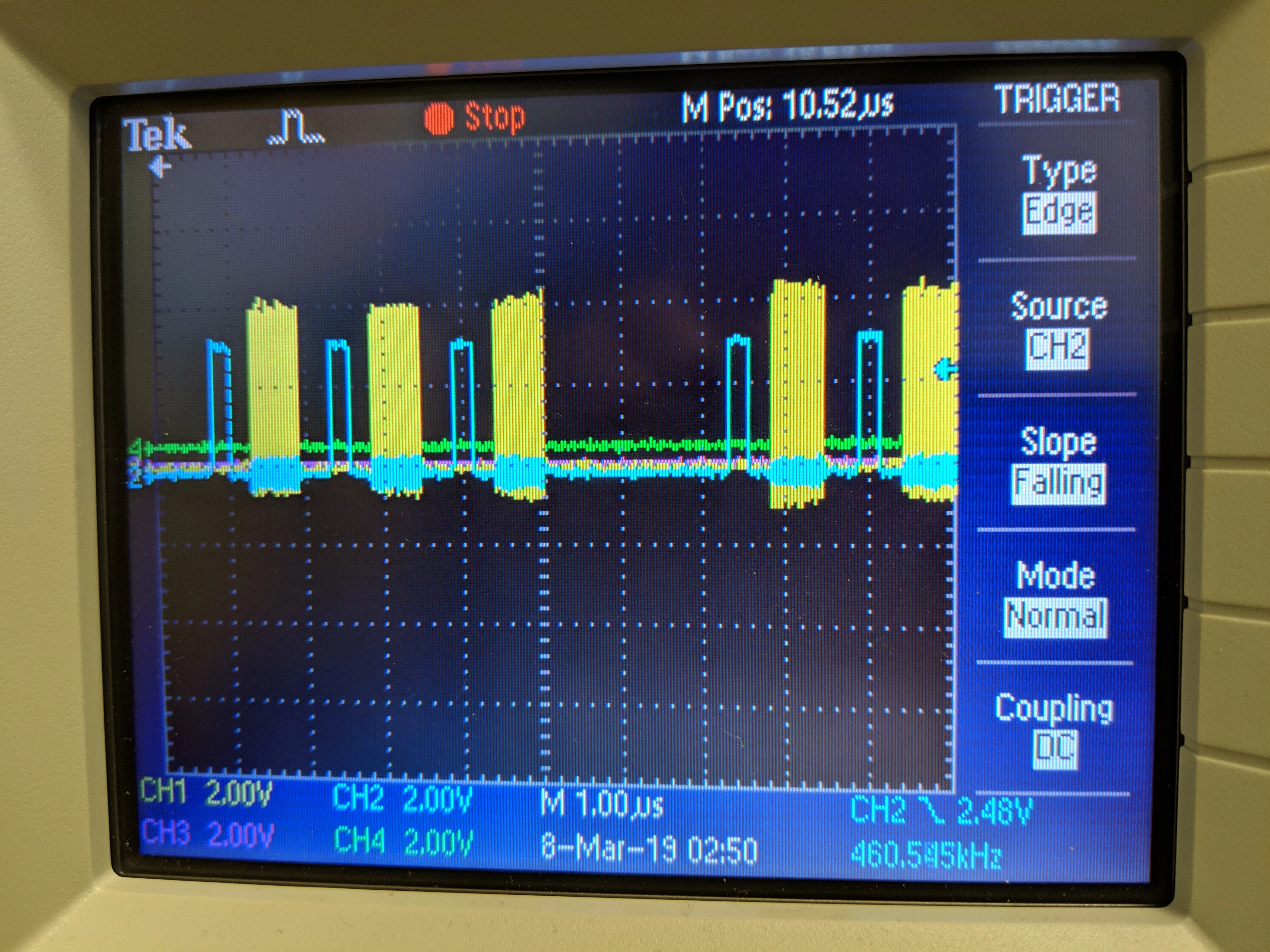
I ran into this problem originally when I tried hiding the latency of two consecutive transactions by sending two transmissions and then gathering the data afterward.
static void SPI1_Receive_2_pipelined(void){
	while(!LL_SPI_IsActiveFlag_TXE(SPI1));
	LL_SPI_TransmitData16(SPI1,0xA0A0);
	while(!LL_SPI_IsActiveFlag_TXE(SPI1));
	LL_SPI_TransmitData16(SPI1,0xA0A0);
	while(!LL_SPI_IsActiveFlag_RXNE(SPI1));
	LL_SPI_ReceiveData16(SPI1);
	while(!LL_SPI_IsActiveFlag_RXNE(SPI1));
	LL_SPI_ReceiveData16(SPI1);
}
This results in a delay between the two data transmissions being long after every other transmission after the first 4. This significantly reduces the timing slack to pick up the first data word before it gets overwritten. In addition it modulates the sampling rate of the SPI peripheral, which I wanted to be a deterministic and stable as possible.
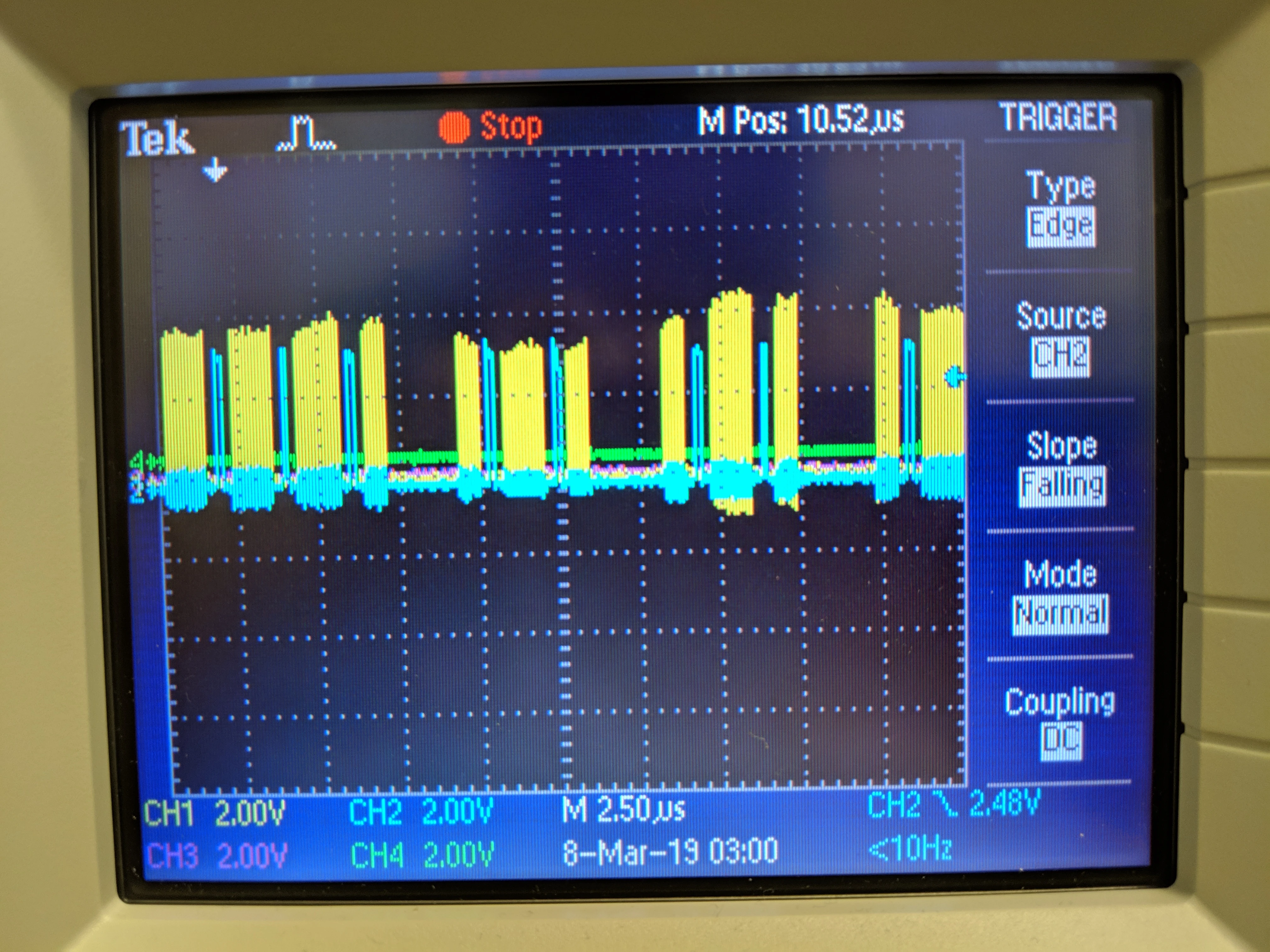
Eventually the systick handler fires during this slack time and I miss the first word of data, deadlocking on the second while loop.
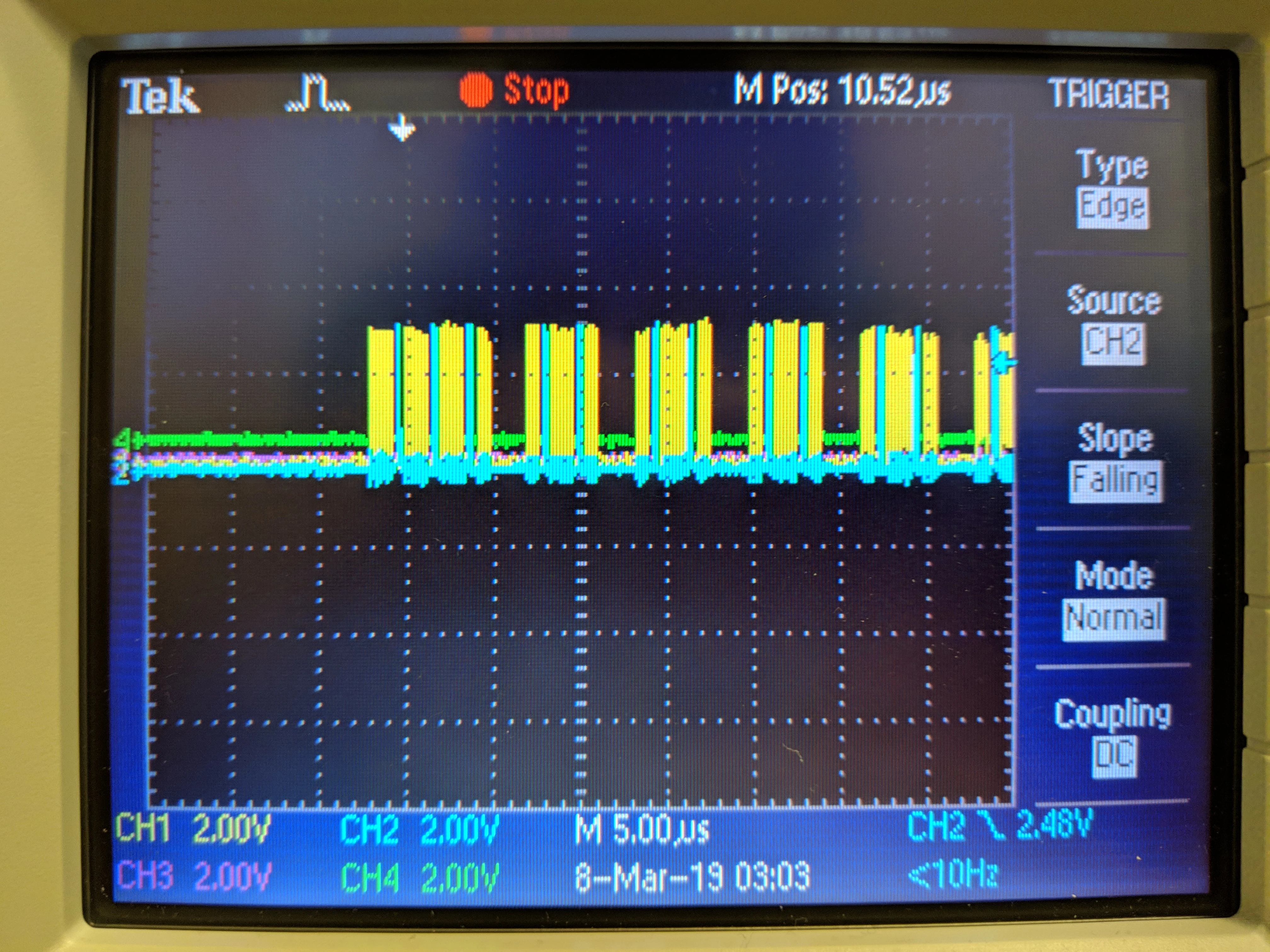
What is causing this delay? I went with a pure blocking implementation since it was simple to debug, and I need to toggle cs to reset the state machine of the SPI slave. Would a DMA based implementation prevent this? I am unfamiliar with this DMA engine, and wanted to check I'm not missing a simple solution before diving into that.