
Associate
October 8, 2026
Solved

How do I switch SDMMC2 from 3.3V to 1.8V signaling on STM32N6570-DK ?

  • October 8, 2026
  • 7 replies
  • 20 views

Hi,

I'm working with an STM32N6570-DK and need the microSD slot (CN13, SDMMC2) to run at 1.8V signaling instead of the 3.3V default. The device I'm connecting only supports 1.8V, and the target speed is modest, around 25 MHz.

What's the correct procedure to make this switch on this board?

So far I've driven SD_SEL (PO5) high to flip U32, but CN13 pin 3 still measures 3.3V. AN5967 (Getting started with hardware development for STM32N6) section 12.4 points to PWR_SVMCR2.VDDIO5VRSEL together with OTP124 bit 13 (HSLV_VDDIO5), which currently reads 0 on my board.
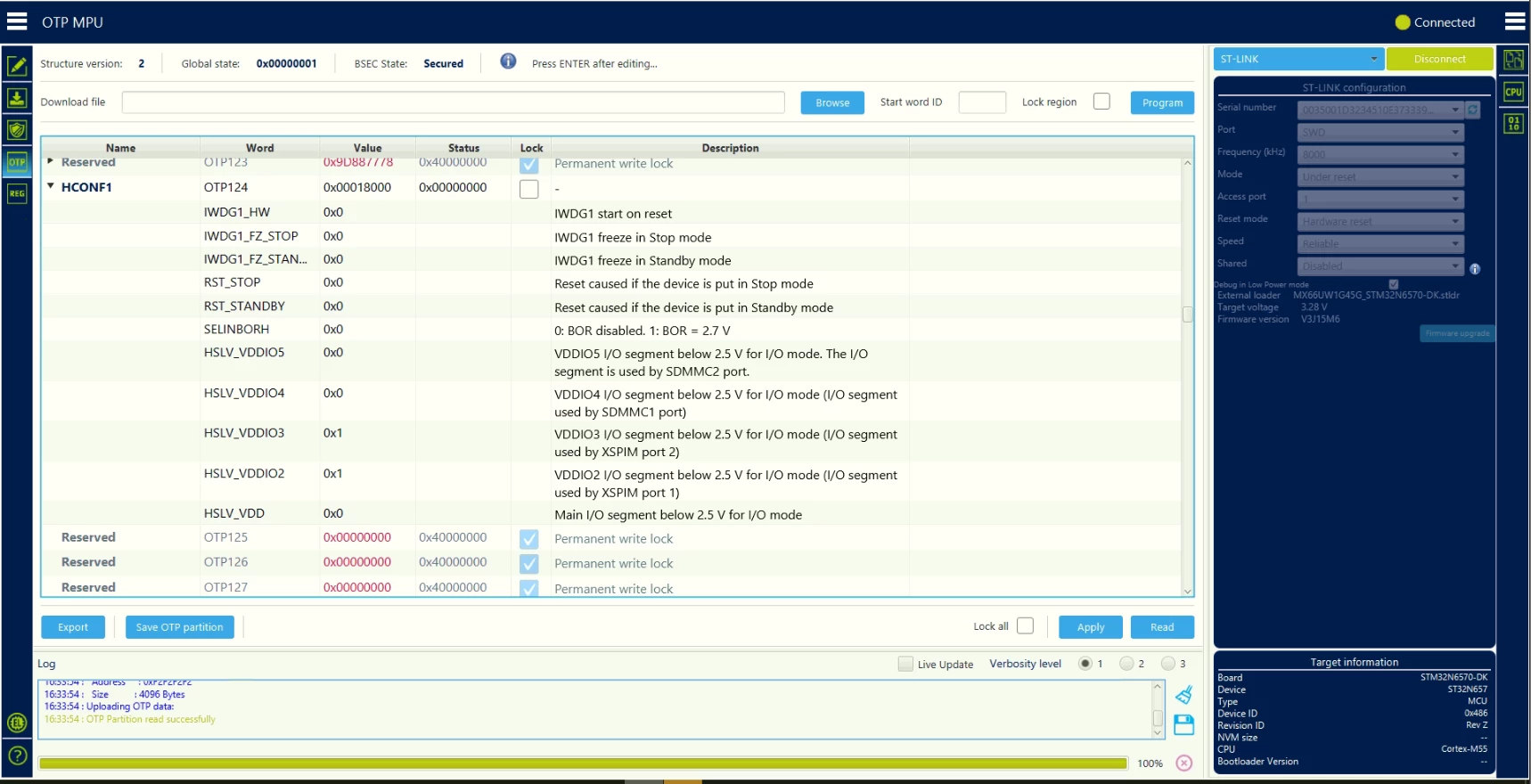
Two things I'm unsure about:

  1. Is burning HSLV_VDDIO5 actually required for 1.8V operation, or only to reach the datasheet frequencies? 

  2. Does burning it permanently prevent the slot from working with ordinary 3.3V SD cards?

     

Best answer by jiangfan
  • STM32N6570-DK VDD_SD (CN13 pin 4) is either 3.3V or 0V (RESET or PWR_SD_EN is LOW), VDDIO_SD (one side of R73~R77) is either 3.3V or 1.8V.

So, driven SD_SEL (PO5) high, VDDIO_SD (one side of R73~R77) will be 1.8V.

7 replies

jiangfan
jiangfanBest answer
ST Employee
October 9, 2026
  • STM32N6570-DK VDD_SD (CN13 pin 4) is either 3.3V or 0V (RESET or PWR_SD_EN is LOW), VDDIO_SD (one side of R73~R77) is either 3.3V or 1.8V.

So, driven SD_SEL (PO5) high, VDDIO_SD (one side of R73~R77) will be 1.8V.

GeminiAuthor
Associate
October 9, 2026

Thanks, that explains it. I was measuring CN13 pin 3 (CMD), which the MCU drives, so it wasn't telling me anything about VDDIO_SD.

While I'm at it ... Does VDDIO_SD also supply the MCU's VDDIO5 pins, or just the pull-ups? And once VDDIO_SD is at 1.8V, do I still need to set PWR_SVMCR2.VDDIO5VRSEL? The HAL header warns that HSLV must be set first and that writing VRSEL while the rail is still at 3.3V damages the device, so I'd rather get the sequence right before trying anything.

jiangfan
ST Employee
October 9, 2026

VDDIO_SD also supply the STM32N6's VDDIO5 (VDDIO5_1, VDDIO5_2) on STM32N6570-DK

jiangfan
ST Employee
October 9, 2026

driven SD_SEL (PO5) high, VDDIO_SD (one side of R73~R77) will be 1.8V, → CN13 pin 4 will be 1.8V;

while CN13 pin 3 is SD_CMD - it mainly depends on STM32N6 PC3 and micro SD card, or VDDIO_SD (1.8V now) if STM32N6 PC3 and micro SD card are floating

jiangfan
ST Employee
October 9, 2026

HSLV stands for High Speed Low Voltage. Its main purpose, in my understanding, is to let the GPIO to work at expected High Speed when the GPIO is powered at Low Voltage.

  1. Is burning HSLV_VDDIO5 actually required for 1.8V operation, or only to reach the datasheet frequencies? 

answer: burning HSLV_VDDIO5 not mandatory for 1.8V operation, but mainly to reach the datasheet frequencies.  target speed around 25 MHz, I suppose no need to set HSLV_VDDIO5

  1. Does burning it permanently prevent the slot from working with ordinary 3.3V SD cards

answer (not 100% sure): burning HSLV_VDDIO5 to 1, does not permanently prevent the slot from working with ordinary 3.3V SD cards, as you said, another dependent point is PWR_SVMCR2.VDDIO5VRSEL

GeminiAuthor
Associate
October 9, 2026

That clears it up, appreciate the help